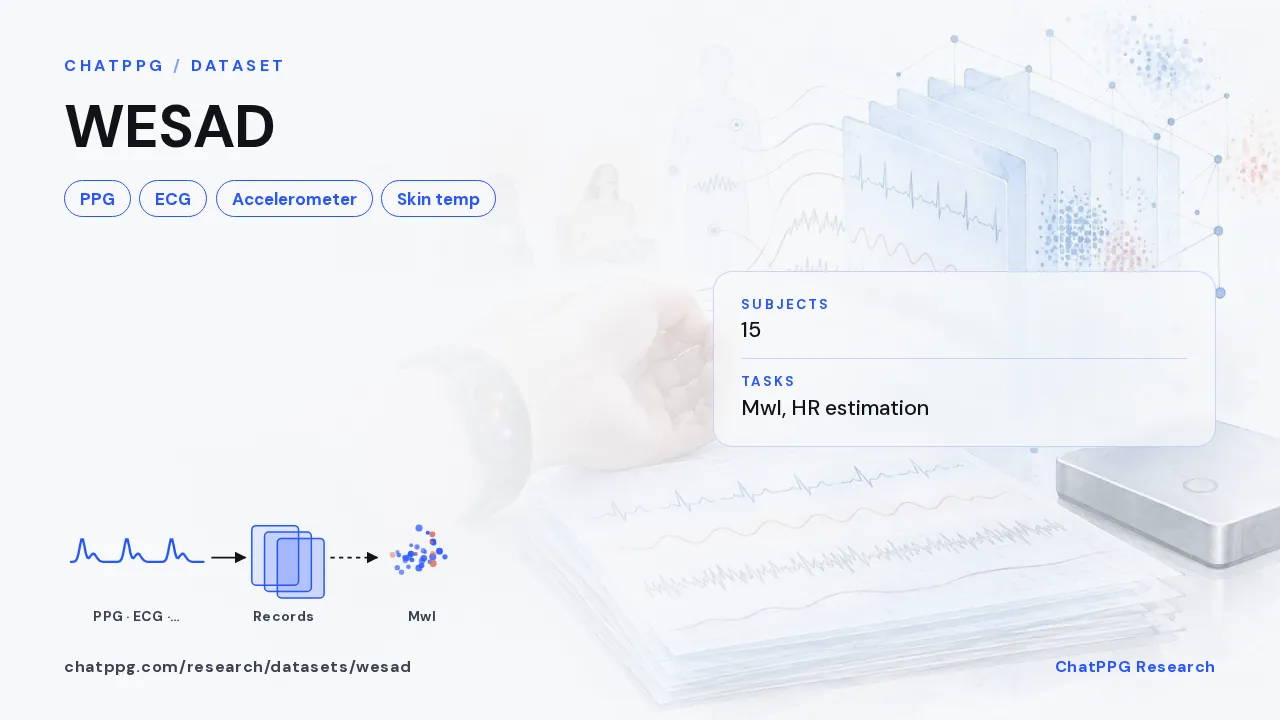
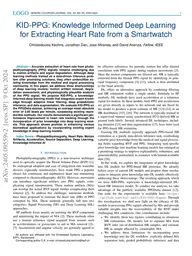
WESAD (Wearable Stress and Affect Detection) is a public multimodal dataset for detecting stress and emotional states from wearable sensors. It was introduced by Philip Schmidt, Attila Reiss, Robert Duerichen, Claus Marberger and Kristof Van Laerhoven in "Introducing WESAD, a Multimodal Dataset for Wearable Stress and Affect Detection" at ICMI 2018 in Boulder, USA.
The authors created it because the affective computing community lacked a standard wearable stress dataset that offered high-quality multimodal data and more than one affective state. WESAD records 15 subjects during a lab study with three states: neutral (baseline), stress and amusement. Self-reports from several established questionnaires are included alongside the sensor data.
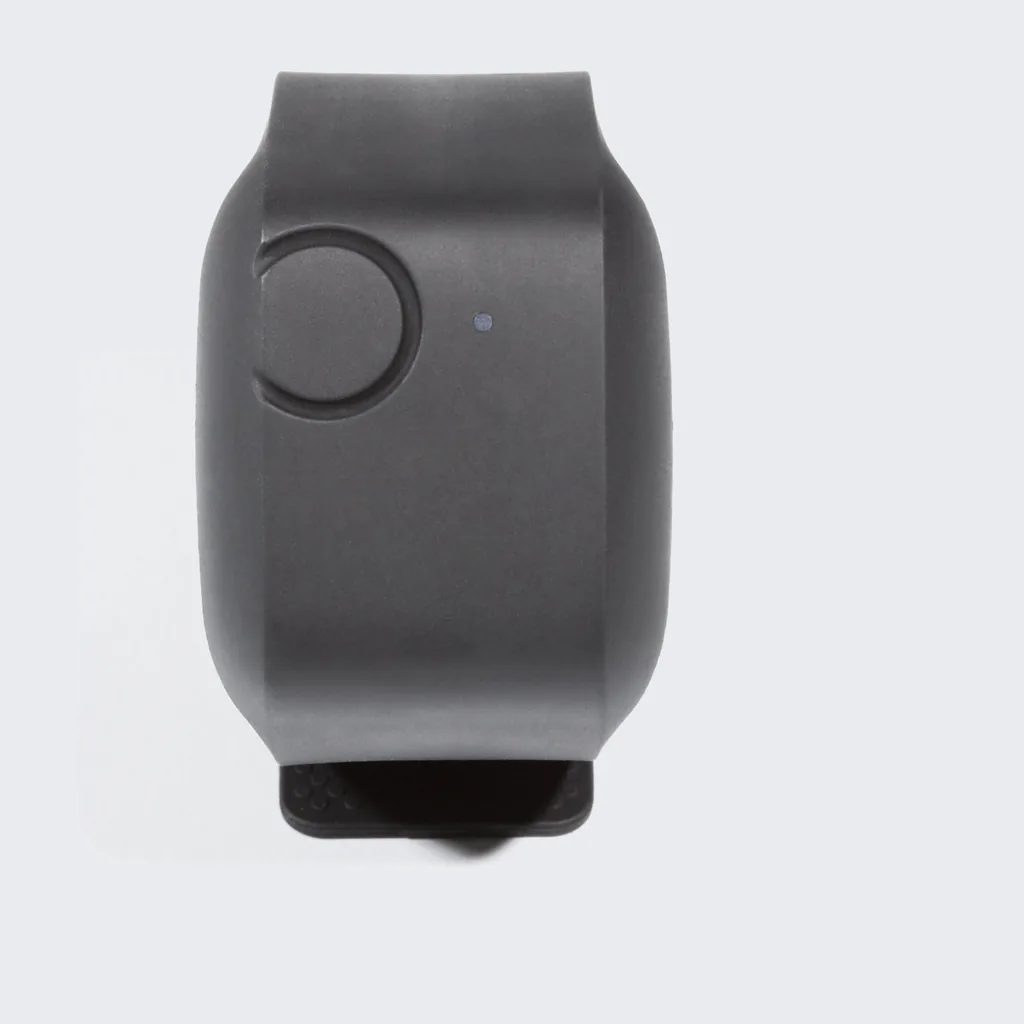
Two devices recorded at once. The chest-worn RespiBAN captured ECG, electrodermal activity, electromyogram, respiration, body temperature and three-axis acceleration, all at 700 Hz. The wrist-worn Empatica E4 captured blood volume pulse (PPG) at 64 Hz, electrodermal activity at 4 Hz, body temperature at 4 Hz and three-axis acceleration at 32 Hz. That pairing of a clinical-grade chest ECG with consumer wrist PPG is why WESAD shows up so often in PPG research, both for stress detection and as a heart rate estimation benchmark.
The original paper includes a benchmark built with well-known features and standard machine learning methods. It reached accuracies of up to 80% on the three-class problem (baseline vs stress vs amusement) and up to 93% on the binary stress vs non-stress problem. It also compares the chest and wrist locations and the individual sensor modalities. Later work from the same group used WESAD as a second test set for deep heart rate estimation, alongside PPG-DaLiA.
The data is a 2.5 GB zipped download from the University of Siegen page, which also links an interactive in-browser viewer. The UCI Machine Learning Repository lists WESAD with DOI 10.24432/C57K5T but defers licensing to the original site, where the terms allow scientific, non-commercial use with credit to the owners.
Benchmark
up to 80% (3-class) and 93% (binary) accuracy
Size
2.5 GB zipped
Paper
Introducing WESAD (Schmidt, Reiss, Duerichen, Marberger, Van Laerhoven), ICMI 2018, doi 10.1145/3242969.3242985
States
neutral (baseline), stress, amusement, plus questionnaire self-reports
Wrist (Empatica E4)
BVP/PPG 64 Hz, accelerometer 32 Hz, EDA and temperature 4 Hz
Chest (RespiBAN)
ECG, EDA, EMG, respiration, temperature, accelerometer at 700 Hz
WESAD (Wearable Stress and Affect Detection) is a multimodal lab dataset of 15 subjects recorded with a wrist-worn Empatica E4 and a chest-worn RespiBAN during three affective states: neutral baseline, stress and amusement, plus self-report questionnaires (Schmidt et al., ICMI 2018). The authors report up to 80% accuracy for three classes and up to 93% for stress versus non-stress.
Full photo credits and licences are on each device page. An icon means we have no openly licensed or manufacturer-cleared photo of that exact device yet.
A public multimodal dataset for wearable stress and affect detection: 15 subjects in a lab study with wrist (Empatica E4) and chest (RespiBAN) sensors across baseline, stress and amusement conditions.
What signals are in WESAD?
Blood volume pulse, ECG, EDA, EMG, respiration, body temperature and three-axis acceleration. Chest signals are 700 Hz; wrist BVP is 64 Hz, ACC 32 Hz, EDA and temperature 4 Hz.
What accuracy is reported on WESAD?
Up to 80% for baseline vs stress vs amusement and up to 93% for stress vs non-stress in the original paper; newer results are on this page's leaderboard.
Can I use WESAD commercially?
No. The terms allow scientific, non-commercial use with credit to the owners.
How big is WESAD?
About 2.5 GB zipped.
What is WESAD?
WESAD is a multimodal wearable dataset of 15 subjects in a lab study covering neutral, stress and amusement states, with wrist PPG from an Empatica E4 and chest ECG from a RespiBAN.
How do I download WESAD?
Download the 2.5 GB zip from https://ubi29.informatik.uni-siegen.de/usi/data_wesad.html. Use is limited to scientific, non-commercial purposes with credit.
WESAD vs PPG-DaLiA?
Both use the same two devices and 15 subjects. WESAD is a lab study of affective states with questionnaires; PPG-DaLiA records daily life activities for heart rate estimation under motion.
What are WESAD benchmark results?
The original paper reached up to 80% accuracy for three-class (baseline, stress, amusement) and up to 93% for binary stress detection with standard machine learning.
Cite this dataset
This citation is the paper recorded with this dataset. Check it against the publisher before submitting.
Schmidt, P., Reiss, A., Duerichen, R., Marberger, C., & Van Laerhoven, K. (2018). Introducing WESAD, a Multimodal Dataset for Wearable Stress and Affect Detection. Proceedings of the 20th ACM International Conference on Multimodal Interaction, 400–408. https://doi.org/10.1145/3242969.3242985
Schmidt, Philip, Attila Reiss, Robert Duerichen, Claus Marberger, and Kristof Van Laerhoven. 2018. "Introducing WESAD, a Multimodal Dataset for Wearable Stress and Affect Detection." Proceedings of the 20th ACM International Conference on Multimodal Interaction, 400–408. https://doi.org/10.1145/3242969.3242985.
Schmidt, P., Reiss, A., Duerichen, R., Marberger, C. and Van Laerhoven, K. (2018) 'Introducing WESAD, a Multimodal Dataset for Wearable Stress and Affect Detection', Proceedings of the 20th ACM International Conference on Multimodal Interaction, pp. 400–408. doi: 10.1145/3242969.3242985.
Schmidt, Philip, et al. "Introducing WESAD, a Multimodal Dataset for Wearable Stress and Affect Detection." Proceedings of the 20th ACM International Conference on Multimodal Interaction, 2018, pp. 400–408. https://doi.org/10.1145/3242969.3242985.
P. Schmidt, A. Reiss, R. Duerichen, C. Marberger, and K. Van Laerhoven, "Introducing WESAD, a Multimodal Dataset for Wearable Stress and Affect Detection," Proceedings of the 20th ACM International Conference on Multimodal Interaction, pp. 400–408, 2018, doi: 10.1145/3242969.3242985.
@inproceedings{schmidt2018introducing,
  title         = {{Introducing WESAD, a Multimodal Dataset for Wearable Stress and Affect Detection}},
  author        = {Schmidt, Philip and Reiss, Attila and Duerichen, Robert and Marberger, Claus and Van Laerhoven, Kristof},
  year          = {2018},
  booktitle     = {Proceedings of the 20th ACM International Conference on Multimodal Interaction},
  pages         = {400--408},
  publisher     = {ACM},
  doi           = {10.1145/3242969.3242985}
}
Cite the ChatPPG record
Cite the dated snapshot 2026-10 for a fixed, reproducible version. Please also cite the original publications listed above.
APA
ChatPPG. (2026). WESAD: dataset record (Version 2026-10) [Data set]. ChatPPG Research Hub. https://chatppg.com/research/datasets/wesad
BibTeX
@misc{chatppg_dataset_wesad,
  author       = {{ChatPPG}},
  title        = {{WESAD: dataset record}},
  year         = {2026},
  month        = nov,
  version      = {2026-10},
  howpublished = {\url{https://chatppg.com/research/datasets/wesad}},
  note         = {ChatPPG Research Hub, Snapshot 2026-10, https://chatppg.com/research/snapshots/2026-10}
}
CITATION.cff
cff-version: 1.2.0
message: "If you use this resource, please cite it as below."
type: dataset
title: "WESAD: dataset record"
authors:
  - name: "ChatPPG"
url: "https://chatppg.com/research/datasets/wesad"
repository-artifact: "https://chatppg.com/research/snapshots/2026-10"
version: "2026-10"
date-released: "2026-11-26"
History
Record updated
Newsletter
Get new PPG datasets, papers and models
Get alerts when new models are benchmarked on WESAD, plus the weekly digest.
New datasets, papers and models
Practical guides from the hub
Unsubscribe anytime
The waveform is an illustration of a PPG pulse, not a recording.