Activity counts measure attention, not model quality. Missing counts are unknown. Publication status follows the linked source; a listed venue alone does not confirm peer review.
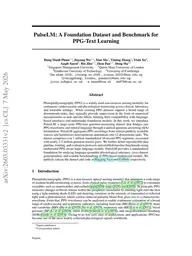
PulseLM is a large PPG-text question-answering dataset and benchmark for training language models that read PPG. It is described in "PulseLM: A Foundation Dataset and Benchmark for PPG-Text Learning" by Hung Manh Pham, Jinyang Wu, Xiao Ma, Yiming Zhang, Yixin Xu, Aaqib Saeed, Bin Zhu, Zhou Pan and Dong Ma (arXiv 2603.03331, 2026).
Most PPG datasets supervise models with numbers or task-specific labels. That works for classic models but fits poorly with language interfaces and multimodal foundation models. PulseLM bridges raw PPG waveforms and natural language by turning everything into a single question-answering format.
The dataset aggregates PPG recordings from sixteen publicly available sources and harmonizes their different annotations into 12 downstream tasks. The repository lists tasks such as heart rate, HRV measures (SDNN, RMSSD and pNN50), respiratory rate, sleep apnea, SpO2, signal quality and stress. In total there are over 1 million standardized 10-second PPG segments with nearly 2.5 million question-answer pairs.
The authors also define a reproducible data pipeline along with training and evaluation protocols, and they report baseline benchmarks using multimodal PPG-aware large language models, with results on the test set only. That makes PulseLM useful both as training data and as a common yardstick for comparing PPG language models across datasets.
The dataset is on Hugging Face (Manhph2211/PulseLM) as parquet files, and it is one of the most downloaded PPG resources in this hub. The code is on GitHub (manhph2211/PulseLM), where the license is CC BY 4.0. Because PulseLM is built from other public datasets, the terms of each original source still apply to the underlying recordings.
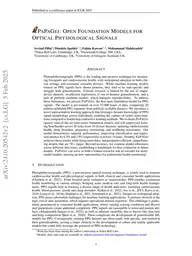
The hub lists PulseLM with models because it is mainly a benchmark for PPG language models. If you are building a model that answers questions about a pulse waveform, this is the most direct starting point, and it pairs well with PPG encoders such as PaPaGei or Pulse-PPG as the signal side of the model.
Signals
PPG, Text
Sources
sixteen public PPG datasets
Tasks
12 downstream tasks in a question-answering format
Year
2026
Paper
PulseLM: A Foundation Dataset and Benchmark for PPG-Text Learning (Pham et al.), arXiv 2603.03331, 2026
Size
over 1 million 10-second PPG segments, nearly 2.5 million QA pairs
Dataset
Hugging Face Manhph2211/PulseLM; code github.com/manhph2211/PulseLM (CC BY 4.0)
Results as reported by the authors; not independently reproduced. A SOTA star marks the best value among results reported under the same evaluation protocol; ties go to the earlier publication.
Embed this badge (1 badge for READMEs and project pages)
Photoplethysmography (PPG) is a widely used non-invasive sensing modality for continuous cardiovascular and physiological monitoring across clinical, laboratory, and wearable settings. While existing PPG datasets support a broad range of downstream tasks, they typically provide supervision in the form of numerical measurements or task-specific labels, limiting their compatibility with language-based interfaces and multimodal foundation models. In this work, we introduce PulseLM, a large-scale PPG-text question-answering dataset that bridges raw PPG waveforms and natural language through a unified question-answering (QA) formulation. PulseLM aggregates PPG recordings from sixteen publicly available sources and harmonizes heterogeneous annotations into 12 downstream tasks. The dataset comprises over 1 million standardized 10-second PPG segments, associated with nearly 2.5 million question-answer pairs. We further define reproducible data pipeline, training, and evaluation protocols and establish baseline benchmarks using multimodal PPG-aware large language models. PulseLM provides a standardized foundation for studying language-grounded physiological inference, cross-dataset generalization, and scalable benchmarking of PPG-based multimodal models. We publicly release the dataset and code at https://huggingface.co/datasets/Manhph2211/PulseLM and https://github.com/manhph2211/PULSE-LM, respectively.
Verbatim fromarXiv· arXiv metadata (abstracts are released under CC0)
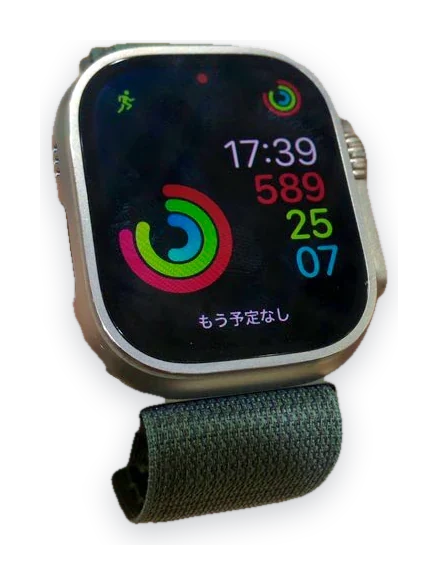
Full photo credits and licences are on each device page. An icon means we have no openly licensed or manufacturer-cleared photo of that exact device yet.
PulseLM is a PPG-text question-answering dataset and benchmark with over 1 million 10-second PPG segments and nearly 2.5 million QA pairs drawn from sixteen public sources.
How do I download PulseLM?
The dataset is at https://huggingface.co/datasets/Manhph2211/PulseLM and the code at https://github.com/manhph2211/PulseLM.
PulseLM vs PaPaGei?
PaPaGei is a PPG encoder that outputs embeddings. PulseLM is a dataset and benchmark for PPG-aware language models that answer questions about waveforms.
What are PulseLM's benchmark results?
The paper sets baseline results on 12 tasks using multimodal PPG-aware large language models, reported on the test set only.
Cite this model
Cite the publication recorded for this model. Check it against the publisher before submitting.
Pham, H. M., Wu, J., Ma, X., Zhang, Y., Xu, Y., Saeed, A., Zhu, B., Pan, Z., & Ma, D. (2026). PulseLM: A Foundation Dataset and Benchmark for PPG-Text Learning. arXiv preprint. https://doi.org/10.48550/ARXIV.2603.03331
Pham, Hung Manh, Jinyang Wu, Xiao Ma, Yiming Zhang, Yixin Xu, Aaqib Saeed, Bin Zhu, Zhou Pan, and Dong Ma. 2026. "PulseLM: A Foundation Dataset and Benchmark for PPG-Text Learning." arXiv preprint. https://doi.org/10.48550/ARXIV.2603.03331.
Pham, H. M., Wu, J., Ma, X., Zhang, Y., Xu, Y., Saeed, A., Zhu, B., Pan, Z. and Ma, D. (2026) 'PulseLM: A Foundation Dataset and Benchmark for PPG-Text Learning', arXiv preprint. doi: 10.48550/ARXIV.2603.03331.
Pham, Hung Manh, et al. "PulseLM: A Foundation Dataset and Benchmark for PPG-Text Learning." arXiv preprint, 2026. https://doi.org/10.48550/ARXIV.2603.03331.
H. M. Pham et al., "PulseLM: A Foundation Dataset and Benchmark for PPG-Text Learning," arXiv preprint, 2026, doi: 10.48550/ARXIV.2603.03331.
@misc{pham2026pulselm,
  title         = {{PulseLM: A Foundation Dataset and Benchmark for PPG-Text Learning}},
  author        = {Pham, Hung Manh and Wu, Jinyang and Ma, Xiao and Zhang, Yiming and Xu, Yixin and Saeed, Aaqib and Zhu, Bin and Pan, Zhou and Ma, Dong},
  year          = {2026},
  howpublished  = {arXiv preprint},
  publisher     = {arXiv},
  doi           = {10.48550/ARXIV.2603.03331},
  eprint        = {2603.03331},
  archivePrefix = {arXiv}
}
History
Added to the ChatPPG research hub
Newsletter
Get new PPG datasets, papers and models
Get alerts when PulseLM is benchmarked on new datasets, plus the weekly digest.
New datasets, papers and models
Practical guides from the hub
Unsubscribe anytime
The waveform is an illustration of a PPG pulse, not a recording.