Activity counts measure attention, not model quality. Missing counts are unknown. Publication status follows the linked source; a listed venue alone does not confirm peer review.
SLIP is an open-source framework for language-aligned sensor representations that work across different sensor setups. It reuses a pretrained decoder-only language model through cross-attention and uses a flexible patch embedder, so it handles new sensor configurations, sampling rates and lengths without retraining. Across 11 datasets it reached 77.14% average linear-probe accuracy, 3.56 points above SensorLM.
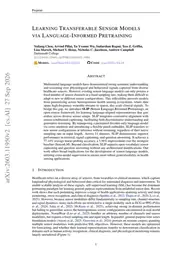
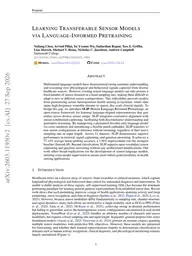
Multimodal language models have demonstrated strong semantic understanding and reasoning over physiological and behavioral signals captured from diverse healthcare sensors. However, existing sensor-language models can only process a fixed number of sensor channels at a fixed sampling rate, making them difficult to adapt to new or different sensor configurations. This inflexibility prevents models from generalizing across heterogeneous health sensing ecosystems, where data spans high-frequency wearable streams to sparse, day-scale clinical signals. To bridge this gap, we introduce SLIP (Sensor Language-Informed Pretraining), an open-source framework for learning language-aligned representations that generalize across diverse sensor setups. SLIP integrates contrastive alignment with sensor-conditioned captioning, facilitating both discriminative understanding and generative reasoning. By repurposing a pretrained decoder-only language model via cross-attention and introducing a flexible patch embedder, SLIP transfers to new sensor configurations at inference without retraining, regardless of their native sampling rate or input length. Across 11 datasets, SLIP demonstrates superior performance in retrieval, signal captioning, and question answering. It achieves a 77.14% average linear-probing accuracy, a 3.56% improvement over the strongest baseline (SensorLM). Beyond classification, SLIP supports open-vocabulary sensor captioning and question answering without any architectural modifications. Our work offers broad implications for the development of sensor-language models, utilizing cross-modal supervision to ensure more robust generalizability in health sensing applications.
Verbatim fromarXiv· arXiv metadata (abstracts are released under CC0)
Key results
3.56
accuracy
Across 11 datasets it reached 77.14% average linear-probe accuracy, 3.56 points above SensorLM.
How it works
Datasets linked in the hub; pretraining vs evaluation roles follow the paper.
Pretraining data
~600K sensor–caption pairs, ~1 B time points
Architecture
FlexMLP patch embedder + sensor encoder, cross-attention into Gemma-3-270M
Inputs
PPG, ECG, IMU, EEG, Text, time-series
Approach
sensor language · foundation model · contrastive · captioning · QA · Gemma 3 270M
Full photo credits and licences are on each device page. An icon means we have no openly licensed or manufacturer-cleared photo of that exact device yet.
Cite the publication recorded for this model. Check it against the publisher before submitting.
Chen, Y., Pillai, A., Wu, Y. Y., Regmi, S., Griffin, T. Z., Marsch, L., Heinz, M. V., Jacobson, N. C., & Campbell, A. (2026). SLIP: Learning Transferable Sensor Models via Language-Informed Pretraining. arXiv preprint. https://arxiv.org/abs/2603.11950
Chen, Yuliang, Arvind Pillai, Yu Yvonne Wu, Sudarshan Regmi, Tess Z. Griffin, Lisa Marsch, Michael V. Heinz, Nicholas C. Jacobson, and Andrew Campbell. 2026. "SLIP: Learning Transferable Sensor Models via Language-Informed Pretraining." arXiv preprint. https://arxiv.org/abs/2603.11950.
Chen, Y., Pillai, A., Wu, Y. Y., Regmi, S., Griffin, T. Z., Marsch, L., Heinz, M. V., Jacobson, N. C. and Campbell, A. (2026) 'SLIP: Learning Transferable Sensor Models via Language-Informed Pretraining', arXiv preprint. Available at: https://arxiv.org/abs/2603.11950
Chen, Yuliang, et al. "SLIP: Learning Transferable Sensor Models via Language-Informed Pretraining." arXiv preprint, 2026. https://arxiv.org/abs/2603.11950.
Y. Chen et al., "SLIP: Learning Transferable Sensor Models via Language-Informed Pretraining," arXiv preprint, 2026, [Online]. Available: https://arxiv.org/abs/2603.11950.
@misc{chen2026slip,
  title         = {{SLIP: Learning Transferable Sensor Models via Language-Informed Pretraining}},
  author        = {Chen, Yuliang and Pillai, Arvind and Wu, Yu Yvonne and Regmi, Sudarshan and Griffin, Tess Z. and Marsch, Lisa and Heinz, Michael V. and Jacobson, Nicholas C. and Campbell, Andrew},
  year          = {2026},
  howpublished  = {arXiv preprint},
  eprint        = {2603.11950},
  archivePrefix = {arXiv}
}
History
Record updated
Added to the ChatPPG research hub
Newsletter
Get new PPG datasets, papers and models
Get alerts when SLIP (Sensor Language-Informed Pretraining; any-channel sensor-language FM) is benchmarked on new datasets, plus the weekly digest.
New datasets, papers and models
Practical guides from the hub
Unsubscribe anytime
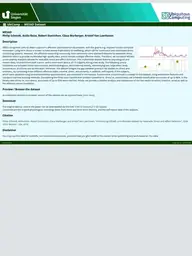
The waveform is an illustration of a PPG pulse, not a recording.