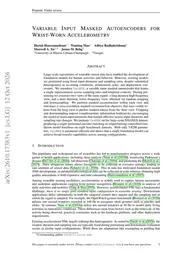
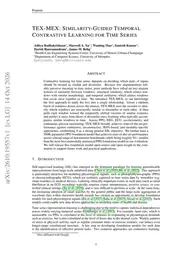
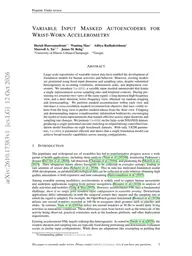
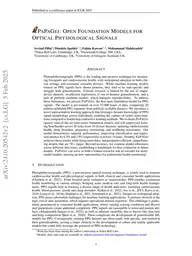
Activity counts measure attention, not model quality. Missing counts are unknown. Publication status follows the linked source; a listed venue alone does not confirm peer review.
Pulse-PPG is an open-source PPG foundation model trained only on raw photoplethysmography collected in daily life, introduced by Mithun Saha, Maxwell A. Xu and colleagues (Wanting Mao, Sameer Neupane, James M. Rehg and Santosh Kumar) and published in the Proceedings of the ACM on Interactive, Mobile, Wearable and Ubiquitous Technologies (IMWUT) in 2025.
Most earlier PPG foundation models were either open but trained on clinical recordings, or trained on wearable data and kept closed. Pulse-PPG sits between those two groups. Its pre-training data comes from the Mobile Open Observation of Daily Stressors (MOODS) study, a 100-day field study with 120 participants who wore a smartwatch every day. The authors describe the corpus as about 200 million seconds of raw PPG, split into 4-minute segments at 50 Hz, and they resample evaluation data to the same 50 Hz rate.
The model has 28.5 million parameters. The authors compare it with PaPaGei, the strongest open PPG foundation model at the time, and with much larger general-purpose time-series models: Chronos with 200 million parameters and MOMENT with 385 million parameters. Downstream tasks range from blood pressure prediction on clinical PPG to stress detection on mobile field data.
The headline result is that a model trained on uncurated field data generalized better across clinical and mobile health tasks, in both lab and field settings, than a comparable model trained on clinical data. Pre-training on field data also beat pre-training on clinical data in many tasks. The authors read this as evidence that real-world variability teaches the model finer-grained representations.
The weights are on Zenodo (DOI 10.5281/zenodo.17270930, MIT license), and the GitHub repository maxxu05/pulseppg (MIT) includes a download script, preprocessing for the public evaluation datasets and the training code. Its training objective reuses the RelCon loss from the same group's motion foundation model for wrist accelerometry, applied with a motif-based distance between PPG segments.
Signals
PPG
Segments
4-minute PPG segments at 50 Hz
Model size
28.5 million parameters
Weights
Zenodo DOI 10.5281/zenodo.17270930 (MIT)
Code
github.com/maxxu05/pulseppg (MIT)
Paper
Pulse-PPG: An Open-Source Field-Trained PPG Foundation Model for Wearable Applications Across Lab and Field Settings (Saha, Xu et al.), Proc. ACM IMWUT 9(3), 2025
Pre-training data
raw smartwatch PPG from a 100-day field study (MOODS) with 120 participants, about 200 million seconds of PPG
Baselines
PaPaGei, Chronos (200 million parameters), MOMENT (385 million parameters)
instantaneous HR · linear probe on frozen embeddings
Best comparison: MOMENT 7.508
Results as reported by the authors; not independently reproduced. A SOTA star marks the best value among results reported under the same evaluation protocol; ties go to the earlier publication.
Embed this badge (3 badges for READMEs and project pages)
Markdown
[](https://chatppg.com/research/models/pulse-ppg#key-results)
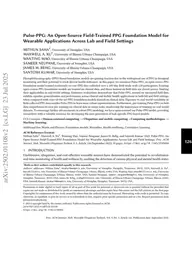
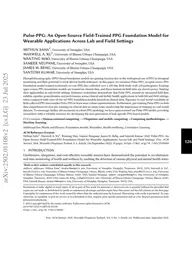
Photoplethysmography (PPG)-based foundation models are gaining traction due to the widespread use of PPG in biosignal monitoring and their potential to generalize across diverse health applications. In this paper, we introduce Pulse-PPG, the first open-source PPG foundation model trained exclusively on raw PPG data collected over a 100-day field study with 120 participants. Existing PPG foundation models are either open-source but trained on clinical data or closed-source, limiting their applicability in real-world settings. We evaluate Pulse-PPG across multiple datasets and downstream tasks, comparing its performance against a state-of-the-art foundation model trained on clinical data. Our results demonstrate that Pulse-PPG, trained on uncurated field data, exhibits superior generalization across clinical and mobile health applications in both lab and field settings. This suggests that exposure to real-world variability enables the model to learn fine-grained representations, making it more adaptable across tasks. Furthermore, pre-training on field data surprisingly outperforms its pre-training on clinical data in many tasks, reinforcing the importance of training on real-world, diverse datasets. To encourage further advancements in robust foundation models leveraging field data, we plan to release Pulse-PPG, providing researchers with a powerful resource for developing more generalizable PPG-based models.
Verbatim fromarXiv· arXiv metadata (abstracts are released under CC0)
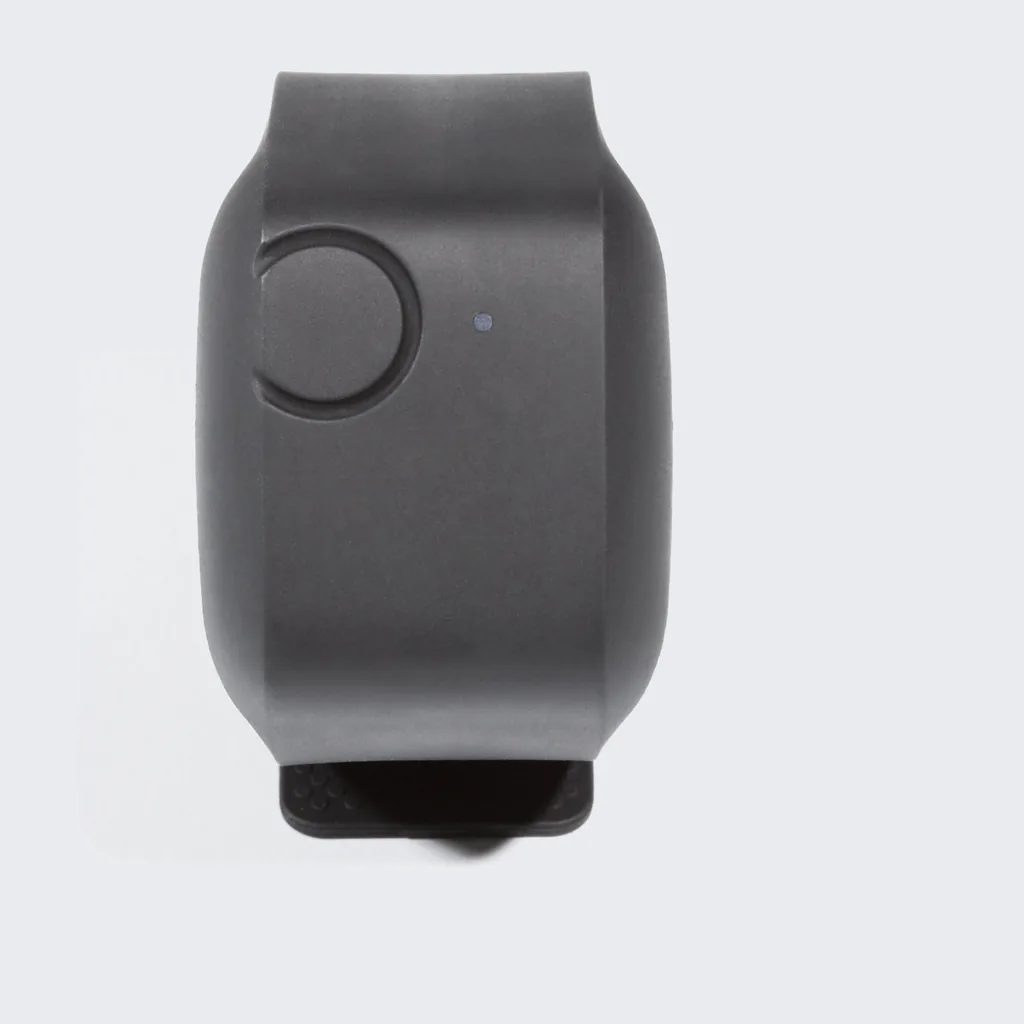
Full photo credits and licences are on each device page. An icon means we have no openly licensed or manufacturer-cleared photo of that exact device yet.
Pulse-PPG is an open-source PPG foundation model trained only on raw smartwatch PPG from a 100-day field study with 120 participants. It was published in Proc. ACM IMWUT in 2025 and has 28.5 million parameters.
How do I download Pulse-PPG?
The weights are on Zenodo at https://doi.org/10.5281/zenodo.17270930 under the MIT license. The GitHub repository https://github.com/maxxu05/pulseppg has a download script and evaluation code.
Pulse-PPG vs PaPaGei: which should I use?
Pulse-PPG was trained on wearable field data at 50 Hz, while PaPaGei was trained on clinical and sleep-study PPG at 125 Hz. The Pulse-PPG authors report better generalization across clinical and mobile health tasks than PaPaGei, so it is the closer fit for smartwatch data.
What are Pulse-PPG's benchmark results?
In the paper, the field-trained model generalized better across clinical and mobile health tasks in lab and field settings than a model trained on clinical data, and field pre-training beat clinical pre-training in many tasks. The 28.5 million parameter model also outperformed Chronos (200 million parameters) and MOMENT (385 million parameters).
Cite this model
Cite the publication recorded for this model. Check it against the publisher before submitting.
Saha, M., Xu, M. A., Mao, W., Neupane, S., Rehg, J. M., & Kumar, S. (2025). Pulse-PPG: An Open-Source Field-Trained PPG Foundation Model for Wearable Applications across Lab and Field Settings. Proceedings of the ACM on Interactive, Mobile, Wearable and Ubiquitous Technologies, 9(3), 1–35. https://doi.org/10.1145/3749494
Saha, Mithun, Maxwell A. Xu, Wanting Mao, Sameer Neupane, James M. Rehg, and Santosh Kumar. 2025. "Pulse-PPG: An Open-Source Field-Trained PPG Foundation Model for Wearable Applications across Lab and Field Settings." Proceedings of the ACM on Interactive, Mobile, Wearable and Ubiquitous Technologies 9 (3): 1–35. https://doi.org/10.1145/3749494.
Saha, M., Xu, M. A., Mao, W., Neupane, S., Rehg, J. M. and Kumar, S. (2025) 'Pulse-PPG: An Open-Source Field-Trained PPG Foundation Model for Wearable Applications across Lab and Field Settings', Proceedings of the ACM on Interactive, Mobile, Wearable and Ubiquitous Technologies, 9(3), pp. 1–35. doi: 10.1145/3749494.
Saha, Mithun, et al. "Pulse-PPG: An Open-Source Field-Trained PPG Foundation Model for Wearable Applications across Lab and Field Settings." Proceedings of the ACM on Interactive, Mobile, Wearable and Ubiquitous Technologies, vol. 9, no. 3, 2025, pp. 1–35. https://doi.org/10.1145/3749494.
M. Saha, M. A. Xu, W. Mao, S. Neupane, J. M. Rehg, and S. Kumar, "Pulse-PPG: An Open-Source Field-Trained PPG Foundation Model for Wearable Applications across Lab and Field Settings," Proceedings of the ACM on Interactive, Mobile, Wearable and Ubiquitous Technologies, vol. 9, no. 3, pp. 1–35, 2025, doi: 10.1145/3749494.
@article{saha2025pulseppg,
  title         = {{Pulse-PPG: An Open-Source Field-Trained PPG Foundation Model for Wearable Applications across Lab and Field Settings}},
  author        = {Saha, Mithun and Xu, Maxwell A. and Mao, Wanting and Neupane, Sameer and Rehg, James M. and Kumar, Santosh},
  year          = {2025},
  journal       = {Proceedings of the ACM on Interactive, Mobile, Wearable and Ubiquitous Technologies},
  volume        = {9},
  number        = {3},
  pages         = {1--35},
  publisher     = {Association for Computing Machinery (ACM)},
  doi           = {10.1145/3749494},
  eprint        = {2502.01108},
  archivePrefix = {arXiv}
}
History
Record updated
Added to the ChatPPG research hub
Newsletter
Get new PPG datasets, papers and models
Get alerts when Pulse-PPG is benchmarked on new datasets, plus the weekly digest.
New datasets, papers and models
Practical guides from the hub
Unsubscribe anytime
The waveform is an illustration of a PPG pulse, not a recording.