PaperarXiv:2606.15284
CAP: Towards PPG Universal Representation Learning with Patient-level Supervision
KDD 2026
 (opens in a new tab)
He, Chenyang et al., "CAP: Towards PPG Universal Representation Learning with Patient-level Supervision", arXiv:2606.15284, CC BY 4.0
TL;DR
CAP tables compare mainly to SiamQuality and GPT-PPG (plus PaPaGei-P on HR row without LOSO MAE). CAP wins on reported AF/HR/RR/BP numbers but is clinical-EHR-anchored closed-weight; Pulse-PPG/PaPaGei remain open wrist baselines.
- Result: CAP achieves a particularly large gain on respiratory rate prediction (up to +87.6% relative improvement over the state-of-the-art baseline) and delivers an average relative +26.7% across all tasks.
Abstract
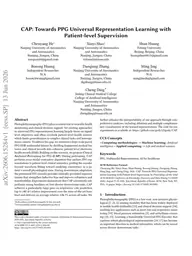
Photoplethysmography (PPG) plays a central role in wearable health monitoring and clinical decision support. Yet existing approaches to universal PPG representation learning largely focus on signal-level objectives and often overlook patient-level health context, which limits generalization to complex clinical tasks and heterogeneous cohorts. To address this gap, we construct a large-scale paired PPG-EHR multimodal dataset by distilling fragmented medical histories and clinical records into cohesive, patient-level electronic health records (EHR). Building on this resource, we propose Clinical Anchored Pretraining for PPG (CAP). During pretraining, CAP performs cross-modal contrastive alignment that anchors PPG representations to patient-level clinical semantics, guiding the encoder beyond waveform fitting toward modeling consistency in a patient's overall physiological state. During downstream adaptation, the pretrained PPG encoder provides clinically grounded representations that strengthen inductive bias and improve robustness and transferability. Experiments demonstrate that CAP consistently outperforms strong baselines on four diverse downstream tasks. CAP achieves a particularly large gain on respiratory rate prediction (up to +87.6% relative improvement over the state-of-the-art baseline) and delivers an average relative +26.7% across all tasks. We further enhance the interpretability of our approach through comprehensive analyses, including ablations and multiple complementary visualizations of the learned representations. The code for our experiments is available at: https://github.com/gody123gody/CAP .
Verbatim from arXiv (opens in a new tab) · arXiv metadata (abstracts are released under CC0)
Results on ChatPPG leaderboards
All leaderboardsNo results from this paper on ChatPPG leaderboards yet. Browse the leaderboards.
Tasks & signals
Signals
Devices
Keywords
Datasets used
 BIDMC PPG and Respiration (Pimentel 2016 / PhysioNet)Evaluation53 subjects · PPG · ECG · SpO₂
 PulseDB v2.0cleaned MIMIC-III + VitalDB cuffless-BP benchmark (MIMIC part ODbL; VitalDB part CC BY-NC-SA)Evaluation5,361 subjects · PPG · ECG · BP
 Stanford wrist PPG AF (DeepBeat)Torres-Soto & Ashley 2020, Synapse syn21985690PPG
 VitalDBintraoperative multi-parameter vitals (PhysioNet mirror)6,388 subjects · PPG · ECG · BP
 WESADWearable Stress and Affect DetectionEvaluation15 subjects · PPG · ECG · IMU
Models
How it works
Cite this paper
He, C., Shao, X., Huang, S., Huang, B., Zhang, D., Jing, M., & Ding, C. (2026). CAP: Towards PPG Universal Representation Learning with Patient-level Supervision. KDD 2026. https://doi.org/10.1145/3770855.3818881
He, Chenyang, Xinyi Shao, Shun Huang, Bosong Huang, Daoqiang Zhang, Ming Jing, and Cheng Ding. 2026. "CAP: Towards PPG Universal Representation Learning with Patient-level Supervision." KDD 2026. https://doi.org/10.1145/3770855.3818881.
He, C., Shao, X., Huang, S., Huang, B., Zhang, D., Jing, M. and Ding, C. (2026) 'CAP: Towards PPG Universal Representation Learning with Patient-level Supervision', KDD 2026. doi: 10.1145/3770855.3818881.
He, Chenyang, et al. "CAP: Towards PPG Universal Representation Learning with Patient-level Supervision." KDD 2026, 2026. https://doi.org/10.1145/3770855.3818881.
C. He et al., "CAP: Towards PPG Universal Representation Learning with Patient-level Supervision," KDD 2026, 2026, doi: 10.1145/3770855.3818881.
@inproceedings{he2026cap,
  title         = {{CAP: Towards PPG Universal Representation Learning with Patient-level Supervision}},
  author        = {He, Chenyang and Shao, Xinyi and Huang, Shun and Huang, Bosong and Zhang, Daoqiang and Jing, Ming and Ding, Cheng},
  year          = {2026},
  booktitle     = {KDD 2026},
  doi           = {10.1145/3770855.3818881},
  eprint        = {2606.15284},
  archivePrefix = {arXiv}
}Record updated
Added to the ChatPPG research hub