Smartwatch AF detection vs Holter: what a 150-person wrist-worn study found
A 150-person npj Digital Medicine study compared wrist PPG + single-lead ECG to 24-h Holter for AF detection and burden, then tracked 28 days of wear.
Reviewed by Sameer Sontakey, Co-founder and Chief AI & Algorithms Officer at Sensor Bio. ChatPPG is independent and device-neutral; it is not a Sensor Bio product.
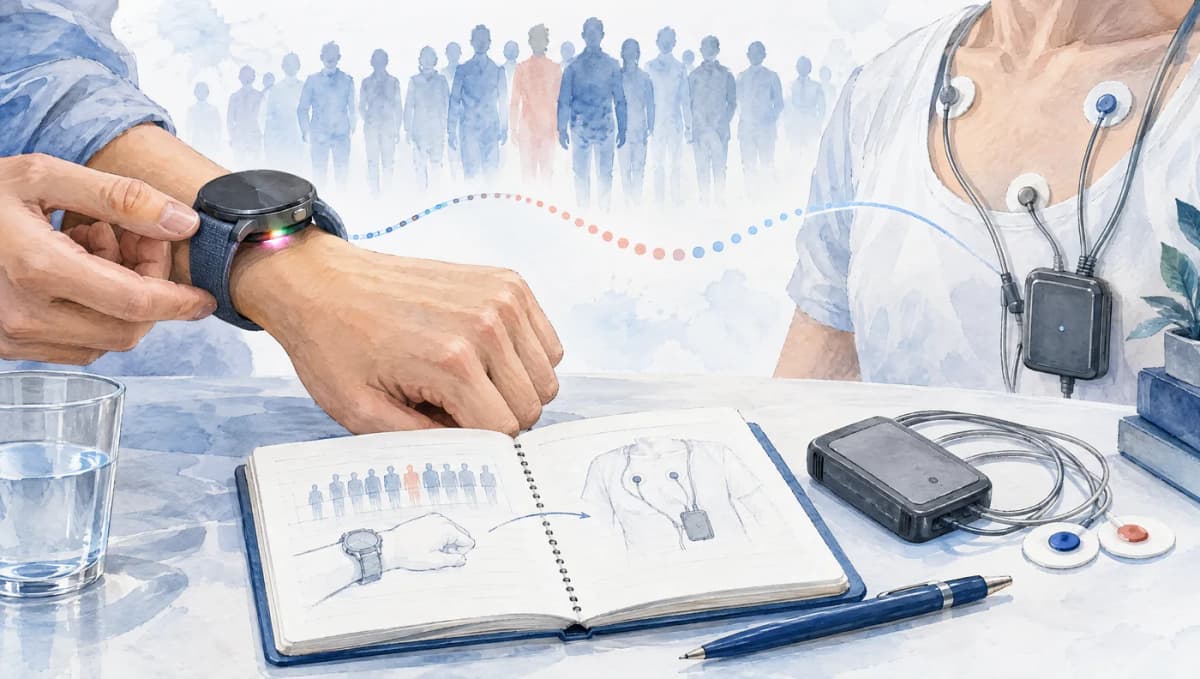
Twenty-four-hour Holter monitoring is still the everyday clinical reference for ambulatory atrial fibrillation (AF) workups. Paroxysmal AF can sit outside that window. A 2025 open-access study in npj Digital Medicine put a wrist-worn PPG plus single-lead ECG device, the Corsano CardioWatch 287-2 (CW2), head-to-head with standard Holter for 24 hours, then kept the wristband on for 27 more days (van Vliet et al., 2025, DOI 10.1038/s41746-025-01555-9).
For readers comparing smartwatch AF detection vs Holter, the question is concrete: on overlapping time, how close are the wrist algorithms to Holter for AF detection and AF burden, and does a month of wear find AF that 24 hours missed?
This post walks through the numbers as reported. It is educational, not medical advice. A wearable AF flag is not a diagnosis.
Study design: 150 Holter patients, then 28 days of wrist wear
The trial was prospective and single-centre at Reinier de Graaf Gasthuis in Delft, the Netherlands (June-December 2023), registered as ClinicalTrials.gov NCT05899959. Consecutive patients already scheduled for standard-of-care 24-h Holter were invited. After withdrawals and replacements for insufficient PPG quality, the analysed cohort was 150 adults (mean age 64 ± 12 years; 41% female).
Each participant wore the CW2 on the non-dominant wrist while Holter ran, then continued CW2 for a total of 28 days. The bracelet uses multi-wavelength PPG (paired green, red, and infrared) sampled at 32 Hz or 128 Hz, plus an accelerometer, and can prompt a 30-second single-lead ECG when PPG suggests AF. PPG rhythm classification used the Happitech algorithm; single-lead ECG classification used Cardiolyse. Holter reference used custo flash 500/510/510 V recorders with automated analysis plus human overreading.
For the Holter day, PPG and Holter were time-aligned and split into 90-second windows. Holter windows counted as AF when more than half the window contained AF. PPG windows labeled AF or sinus rhythm were scored against that reference; windows labeled undetermined, too much movement, or poor quality were excluded from the detection metrics.
For background on how optical AF screening works in general, see can wearables detect AFib and PPG atrial fibrillation screening.
PPG vs Holter: sensitivity, specificity, and predictive values
Across the 24-h Holter period the CW2 collected 103,368 ninety-second PPG windows; 56,781 (54.9%) met quality criteria for analysis. On those analysable windows, the PPG algorithm reached:
- Sensitivity 98.8%
- Specificity 98.2%
- Positive predictive value (PPV) 80.7%
- Negative predictive value (NPV) 99.9%
Those figures match the abstract’s summary that PPG and single-lead ECG algorithms achieved specificity ≥98% and sensitivity ≥95% versus Holter. They apply to quality-filtered windows in ambulatory conditions, not to every second of every day. Motion and poor contact still discard a large share of raw PPG time.
Single-lead ECG vs Holter on the same day
Patients also recorded successful 30-second CW2 ECGs during the Holter period (162 successful recordings in the reported comparison). Against Holter in the matching windows, the ECG algorithm reached:
- Sensitivity 95.8%
- Specificity 98.6%
- PPV 92.0%
- NPV 99.3%
So the on-demand ECG strip was slightly less sensitive than continuous PPG window scoring in this dataset, with higher PPV. That fits a workflow where PPG watches for irregular pulse and ECG supplies a strip clinicians recognize.
AF burden: nearly one-to-one with Holter over 24 hours
Detection answers “was AF present in this window?” Burden answers “what fraction of time was AF?” During the overlapping Holter day, Holter AF burden among patients with AF ranged from 0.42% to 100%, with the shortest AF period lasting 6 minutes.
Comparing PPG-based burden (AF windows ÷ analysable windows; no AF counted as 0%) with Holter burden:
- Pearson R² = 0.99 (reported as 0.9937 in Figure 2)
- RMSE 2.2%
- Bland-Altman mean difference 0.17%, with 95% limits of agreement about -4.2% to 4.5%
For why burden matters clinically beyond a yes/no AF label, see AFib burden monitoring with smartwatches.
Twenty-eight days of wear: more AF found than on 24-h Holter
Patient adherence to the CW2 was 90.9%, about 22 hours of wear per day, without a drop across the study. Over the full 28 days, analysable PPG time averaged 17.4 of 24 hours (72.5%) per day, higher than the 54.9% analysable fraction on the Holter day.
AF alerts were throttled: PPG needed AF in at least three detections within 10 minutes, and ECG prompts came at most every 4 hours and not between 23:00 and 07:00. Across participants the device sent 721 ECG alerts; patients who got alerts received a median of 4 (range 1-32). Patients responded to 69.8% of alerts on average, needing 1.7 ± 3.8 ECG attempts before a successful strip. When an ECG was taken within one hour of an alert, the ECG algorithm confirmed AF in 66.8% of those cases. Some mismatch is expected if a short paroxysm ends before the strip is recorded.
Prevalence rose with monitoring length:
| Definition | Patients with AF | Prevalence |
|---|---|---|
| 24-h Holter | 22 / 150 | 14.7% |
| 28-day CW2, single-lead ECG-confirmed only | 29 / 150 | 19.3% |
| 28-day CW2, PPG detections | 40 / 150 | 26.7% |
That rise is why people ask about smartwatch AF detection vs Holter for paroxysmal AF: a quiet day on Holter does not prove a quiet month. Related reading: paroxysmal atrial fibrillation monitoring with wearables and wearable AF detection after catheter ablation.
The paper is clear about constraints:
- Quality gating: Only high-quality PPG windows enter the sensitivity/specificity tables. That reduces false positives but means large stretches of daily life are not scored.
- Single centre, Holter-referred cohort: Results describe patients already getting Holter care in one Dutch hospital, not a general consumer population.
- Skin tone gap: No Fitzpatrick V or VI participants were included; the authors call for broader demographic studies.
- Short simultaneous gold-standard window: Direct Holter comparison lasted 24 hours; the 28-day prevalence gain has no continuous Holter twin for the full month.
- Competing interests: Corresponding author E. Ronner reports consulting fees/support from Corsano; N. Peters from Happitech; S. Steinhubl discloses other digital-health roles. Those ties belong in any careful read of the paper.
Catalogued summaries of this and related AF wearable papers also sit on the ChatPPG research hub.
What this study does and does not settle
Supported by these data: In ambulatory Holter patients, CW2 PPG and single-lead ECG algorithms showed high sensitivity and specificity versus Holter on analysable windows; PPG AF burden tracked Holter burden closely over the shared day; and extending monitoring to 28 days increased detected AF prevalence relative to 24-h Holter alone.
Not settled here: Whether any specific consumer smartwatch brand matches these figures; whether anticoagulation or other treatment decisions should change based on wearable alerts alone; how algorithms perform across all skin tones; or how a wristband compares with implantable loop recorders or multi-week patch monitors in a randomized outcomes trial.
Clinically, the usual path remains: irregular-rhythm or AF alerts prompt confirmatory ECG and clinician judgment. Wearables widen the observation window; they do not replace that step.
Practical takeaways
- For detection accuracy vs Holter (same day): This study’s PPG and ECG algorithms cleared the ≥95% sensitivity / ≥98% specificity bar the authors highlight, with PPG PPV about 81% and ECG PPV about 92% on the reported windows.
- For AF burden: Expect close agreement with Holter when PPG quality is good enough to analyse (R² ≈ 0.99 here).
- For paroxysmal AF yield: Longer continuous wear can raise detected prevalence substantially versus a single Holter day (14.7% → 19.3% ECG-confirmed → 26.7% PPG in this cohort).
- For daily life: Plan for incomplete PPG coverage and multi-attempt ECGs; usable monitoring still averaged many hours per day with ~91% adherence.
- For decisions about care: Treat alerts as signals to evaluate, not as a finished diagnosis.
If you are mapping the wider evidence base for optical AF tools, start with the guides linked above and the papers listed on /research.
References
- van Vliet, M., Aalberts, J. J. J., Hamelinck, C., Hauer, A. D., Hoftijzer, D., Monnink, S. H. J., Schipper, J. C., Constandse, J. C., Peters, N. S., Lip, G. Y. H., Steinhubl, S. R., & Ronner, E. (2025). Ambulatory atrial fibrillation detection and quantification by wristworn AI device compared to standard holter monitoring. npj Digital Medicine, 8, 177. https://doi.org/10.1038/s41746-025-01555-9
Frequently Asked Questions
- Can a smartwatch match a 24-hour Holter for AF detection?
- In van Vliet et al. (npj Digital Medicine, 2025), the Corsano CardioWatch 287-2's PPG algorithm reached 98.8% sensitivity and 98.2% specificity versus simultaneous 24-h Holter on analysable 90-second windows, and its single-lead ECG algorithm reached 95.8% sensitivity and 98.6% specificity. That is head-to-head performance on quality-filtered windows in one ambulatory study, not a claim that consumer smartwatches replace Holter diagnosis.
- Does longer wearable wear find more atrial fibrillation than a 24-hour Holter?
- In the same study of 150 patients, AF prevalence was 14.7% on 24-h Holter (22 of 150). Over 28 days of CardioWatch wear, prevalence rose to 19.3% when counting single-lead ECG-confirmed AF and to 26.7% when counting PPG detections. Longer monitoring helps catch paroxysmal AF that may miss a short Holter window.
- How well did wrist PPG estimate AF burden compared with Holter?
- Across the overlapping 24-h period, PPG-based AF burden correlated with Holter AF burden at R² = 0.99 (Pearson), with RMSE 2.2% and Bland-Altman mean difference 0.17% (limits of agreement about -4.2% to 4.5%). Cases with no AF were counted as 0% burden.
- Is a wearable AF alert a diagnosis?
- No. Wearable PPG or single-lead ECG alerts are screening or monitoring signals. Clinical atrial fibrillation diagnosis still requires clinician review of ECG (or equivalent) and care decisions. This article is educational and is not medical advice.
- What device and trial was this?
- The investigational device was the Corsano CardioWatch 287-2 (CW2), a wrist-worn multi-wavelength PPG device with on-demand single-lead ECG. The prospective single-centre study enrolled patients receiving standard-of-care 24-h Holter at Reinier de Graaf Gasthuis (Delft, Netherlands) and is registered as ClinicalTrials.gov NCT05899959.
Related articles
AFib Burden Monitoring on a Smartwatch: What Can Be Estimated and When ECG Still Matters
AF burden is a clinical concept, but smartwatch burden estimates are only approximations. This guide explains what wearables can estimate, what makes burden hard to calculate, and when ECG remains necessary.
AFib Detection After Catheter Ablation With a Wearable: Where Smartwatches Help Between Formal Rhythm Checks
After AF ablation, wearables can help surface recurrence between scheduled rhythm checks, but they do not replace ECG-based follow-up. This guide explains how smartwatches fit after ablation and when clinicians still need formal monitoring.
Can Wearables Detect AFib? Clinical Evidence & FDA-Cleared Devices
A comprehensive review of wearable atrial fibrillation detection covering PPG-based irregular rhythm detection, ECG-enabled smartwatches, the Apple Heart Study, Fitbit Heart Study, FDA clearances, sensitivity and specificity data, and clinical guidelines for screening versus diagnosis.
Paroxysmal Atrial Fibrillation Monitoring With Wearables: Why Intermittent AF Is Hard to Catch
Paroxysmal atrial fibrillation often escapes short rhythm studies because episodes are intermittent and sometimes silent. This guide explains where wearables help, where Holter and patch ECG still lead, and why ECG confirmation remains essential.
PPG Sensors in Wearable Technology: From Wrist Bands to Smart Rings and Earbuds
How PPG sensors work across wearable form factors. Compare wrist bands, smart rings, earbuds, and patches for heart rate accuracy and motion artifacts.