Wearable guides
Sensor Bio V2: B2B Raw PPG Platform
Sensor Bio V2 (model S2001) is a screenless B2B platform: configurable PPG sampling, raw waveform export for enterprise partners, and an SDK on Sensor Bio’s cloud. Sensor Bio describes that export as AI-ready data. It is a general wellness device, not FDA cleared, and not a consumer score app.
Public V2 facts
Manufacturer pages
- Sensor Bio
- Sensor Bio V2 product page
- V2 vs Polar 360 comparison
- Biostrap is now Sensor Bio
- Sensor Bio science
Specification rows are from the Sensor Bio V2 product page. Manufacturer specification, not an independent test.
- Screenless band
- Model S2001. Sealed one-size wrist band. No display.
- Wavelengths
- Green ~530 nm, red ~655 nm, infrared ~940 nm.
- Raw export
- PPG, IBI, and accelerometer up to 100 Hz, on enterprise-tier partner accounts.
- Classification
- General wellness. Not FDA cleared or approved. Not for diagnostic use.
Separate from this specification, Sensor Bio’s Why Sensor Bio deck says 350 raw optical readings per second, against about one every two seconds on a typical wearable, and lists V2 as available now with Clarity coming next. Those are company claims. The sampling rates above are the published V2 sheet. Sensor Bio
Kairos papers are separate from the V2 specification. Device records live in the research hub.
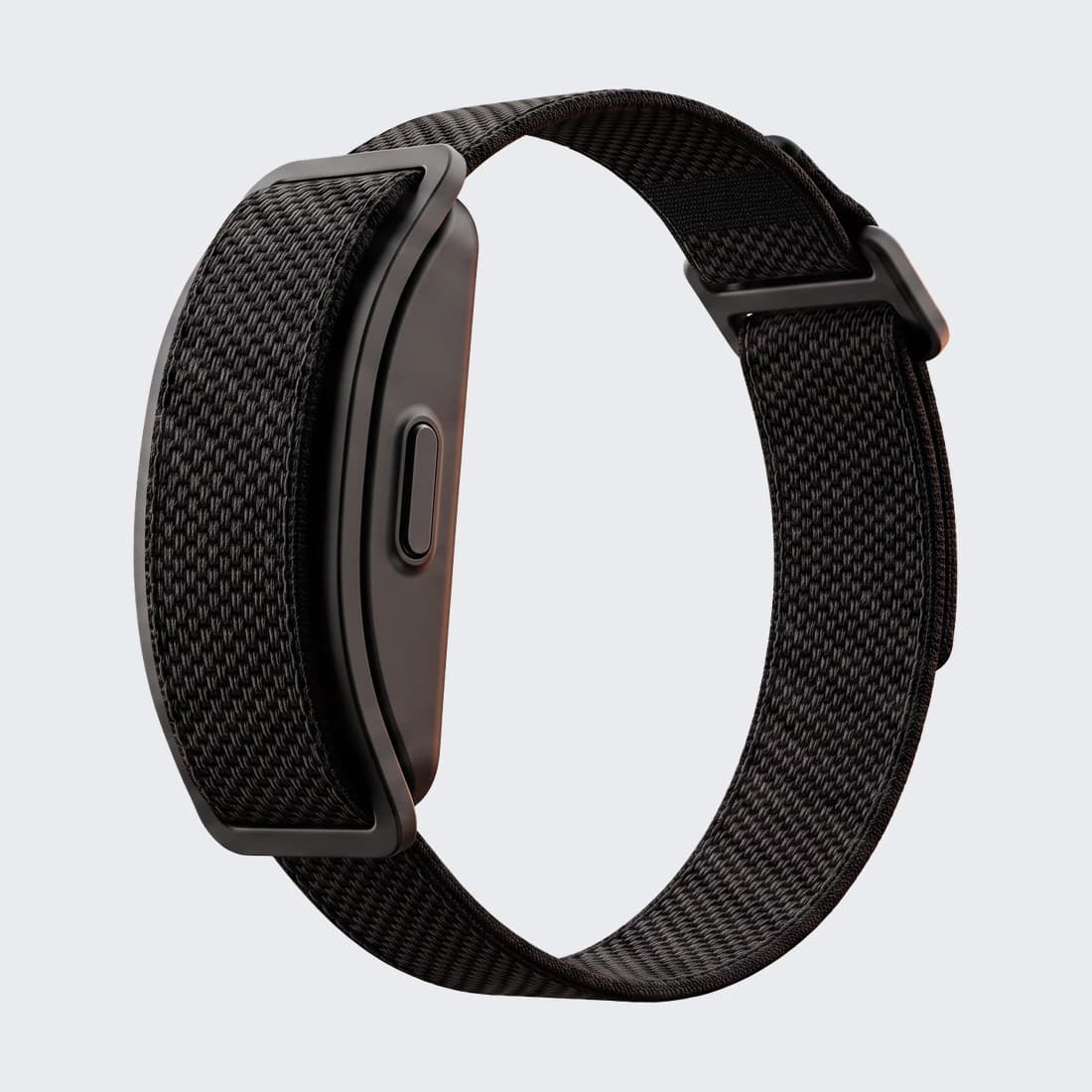
AI-ready B2B platform
Sensor Bio describes V2 as infrastructure partners build on, not as a wrist score for one wearer. The company site says its APIs support research pipelines, clinical systems, and AI development, and calls the data a layer for AI and analytics. The Why Sensor Bio deck uses the phrase “AI ready” for that same idea. The concrete layer under the pitch is the S2001 band, the cloud, and the SDK: configurable capture, raw series for enterprise partners, and scores computed on the same export. ChatPPG is describing that public specification and the company’s own overview. This is not a claim that V2 is a cleared diagnostic device or a hosted model.
The V2 product page lists four deployment properties: raw data, one platform (band, cloud, and SDK), white-label branding, and configuration per environment. V2 is sold through partnership, not a consumer checkout. No prescription is required. Sensor Bio names enterprise, defense, and research as the settings partners configure.
Why Sensor Bio, in the company’s words
This section repeats Sensor Bio’s Why Sensor Bio deck. The deck sends readers to Sensor Bio. These lines are company claims. They are not measurements from the V2 product page, and ChatPPG has not independently audited them.
The deck says raw optical readings at 350 per second, and that a typical wearable takes one about every two seconds. The V2 product page specifies sampling at 25, 50, or 100 Hz, with raw export up to 100 Hz. This guide keeps that published S2001 rate. It does not treat 350 per second as the product-page specification.
Under “trusted at scale,” the deck names the American Heart Association, Children’s Hospital Los Angeles, the Gatorade Sports Science Institute, LSU, NIH, Orlando Health, Stanford, and UCLA. That is Sensor Bio’s list. This guide has not checked each relationship. Sensor Bio’s February 2026 announcement separately names Stanford, NASA, and Gatorade as examples of research and enterprise deployments.
The deck says full raw data access through open SDKs and APIs, into a workflow, a dashboard, or an EMR. The science page describes SDK and API access, including EMR and EHR systems. The V2 page documents eight SDK surfaces, interface v0.17.0. Raw waveform export on that page is for enterprise-tier partner accounts. The deck also says administrators can generate API and SDK keys from the console, and it shows an algorithm library spanning cardio, sleep, recovery, stress, and respiratory measures. Those panels are illustrations in the deck.
The deck describes four layers. Capture is research-grade sensing, raw by default, from a screenless wearable: raw PPG, inter-beat intervals, heart rate and HRV, motion and skin temperature, and high-frequency raw export. Connect is the partner’s app, dashboard, or EMR, with an iOS and Android SDK, a cloud API and CSV or JSON, live biometric streaming, and white-label. Build is the partner’s brand and a configurable data model for research and enterprise, which the deck counts as more than 100 configurations. Act is rules and thresholds, alerts, and personalized recommendations.
White-label is also on the V2 product page: the partner’s brand on the hardware, the app, and the reporting. The deck’s configuration panel says sample rate, data cadence, and which sensors are active are set once per organization, and its example is 100 Hz with PPG, motion, and skin temperature. The published sheet is the 25, 50, or 100 Hz choice plus a configurable duty cycle. “100+ configurations” is the company’s count. The product page does not enumerate 100 settings.
Signal Studio on the V2 page notifies by push, email, SMS, or phone, under organization rules. The deck says a trigger can be delivered by push, text, email, or an AI call. Its example is a resting heart rate above 90 bpm held for two nights, notifying a coach. That threshold is the deck’s illustration, not a threshold published on the product page.
The deck lists V2 as available now and Clarity as coming next. It does not give Clarity a sampling rate, a datasheet, or a regulatory status. The current public hardware sheet is the V2 product page.
Highly configurable capture
Sampling defaults to 50 Hz and can be set to 25 or 100 Hz per organization. Duty cycle is configured alongside the sampling rate. Sensor Bio also says capture cadence, the data model, retention, alerting, and reporting are shaped to the deployment. The product page gives a hospital, a base, and a research protocol as examples.
Those settings change what the band can report. Heart rate variability and respiratory rate require PPG sampling of at least 50 Hz. At the 25 Hz setting, only heart rate is available. Continuous high-frequency recording also shortens the on-device buffer, which the product page places at about 14 days under the default duty cycle and from roughly 30 minutes to two weeks depending on settings.
Raw data by default
Raw PPG, inter-beat intervals, and accelerometer data export at up to 100 Hz. Activity, sleep, and recovery scores are computed in the cloud on that series, so a partner can reconstruct a number from the export. Raw waveform export is available to partners on enterprise-tier accounts.
During an active recording, the live stream includes heart rate, HRV, respiratory rate, beat-to-beat intervals, raw PPG, signal-to-noise ratio, and motion. After sync, raw sensor metrics export across a 1 to 7 day window and computed metrics across a 1 to 30 day window, as CSV or JSON, up to 2 GB per file. History retention is configured per deployment. The cloud platform is hosted on AWS.
SDK, APIs, and white-label
The V2 product page describes eight SDK surfaces, compiled from interface v0.17.0. Categories one through seven are fetched from the cloud after sync. The eighth is the live stream during an active recording.
Vitals cover heart rate and HRV, respiratory rate, and the skin-temperature series. Activity covers steps, calories, the activity score, and movement duration. Recovery is the daily readiness score. Sleep includes the score, stages, overnight vitals, and timing. Spot check returns heart rate, HRV as rMSSD and SDNN, mean RR, stress index, respiratory rate, LF, HF, and the LF/HF ratio, Poincaré SD1, SD2, and SD1/SD2, ANS balance, and signal-to-noise ratio in dB. Workouts return average, minimum, and maximum heart rate and time in zone. Profile includes VO2 max, max heart rate, height, weight, stride, and bulk pulls of biometrics, sleep, and steps.
White-label is native: the partner’s brand can carry the hardware, the app, and the reporting. A customizable remote-patient-monitoring dashboard exports raw and derived data. Organization administrators set alert rules in Signal Studio, for example when heart rate crosses a threshold, and can notify by push, email, SMS, or phone. Sensor Bio says consumer-facing high and low heart-rate notifications are not offered.
Signals, scores, and limits
Three sensors are listed: multi-wavelength PPG (green ~530 nm, red ~655 nm, infrared ~940 nm), a three-axis accelerometer (±8 G default, ±16 G maximum, no GPS), and skin temperature from a metal contact plate, stated at ±0.1 °C. Skin temperature is a surface trend, with minimum, maximum, average, uncertainty, and baseline deviation. It is not core temperature.
Heart rate is continuous raw PPG. Sensor Bio states a validated range of 30 to 220 bpm, 1-second samples during active captures, and 1-minute averages otherwise. The export includes raw PPG, IBI, heart rate, and HRV, with filters for motion, a loose band, and tattoos. Heart rate is IBI-based and has no FDA clearance on this page.
HRV is reported when enough IBIs are valid: good signal quality and no motion. It is sampled every 2 minutes through the night, during the day when available, and on spot check. Reported fields include rMSSD, HRV-CV, and a sympathetic-shifted LF/HF ratio. Respiratory rate is derived from the IBI series through respiratory sinus arrhythmia, day or night, under the same valid-IBI rule, and only at 50 Hz or above.
SpO2 is listed as coming soon. A wellness-level range of 85 to 100 percent is planned and is not live. Activity from the accelerometer covers steps, cadence, movement intensity, sleep movement, sleep and activity classification, an activity score, calories, and movement minutes. Cadence and gait are available from the raw accelerometer. Post-exercise heart rate recovery is available from the raw data. Spot checks can report a stress index and autonomic balance: a parasympathetic score from HF and SD1, and a sympathetic score from LF and the LF/HF ratio.
Sleep is auto-detected, without manual logging, from heart rate, HRV, respiratory rate, and movement. Stages are REM, deep, light, and awake. Full REM staging needs sufficient PPG sampling; otherwise the system falls back to light, deep, and wake. Sensor Bio says a partner-defined classification is validated against polysomnography. That is the manufacturer’s statement. This guide does not have an independent epoch-agreement figure for V2.
Cloud scores are 0 to 100. The activity score combines heart rate reserve and movement. The sleep score combines overnight quality and duration. Recovery needs a 5-night baseline and does not currently count naps. Resting heart rate is the lowest sustained heart rate during sleep. Resting HRV is nocturnal rMSSD from the lowest-activity part of sleep.
Sensor Bio V2 vs Polar 360
Sensor Bio publishes a specification comparison with the Polar 360. The Sensor Bio column below follows the V2 product specification (model S2001). The Polar column follows only what that comparison page states about Polar 360. This is not an independent head-to-head trial, and it does not add accuracy metrics.
Scroll sideways to compare both devices.
| Specification | Sensor Bio V2 | Polar 360 |
|---|---|---|
| Role | B2B platform. Screenless band. Scores sit on the exported signal. | Screenless activity band that feeds the Polar Flow app. |
| Optical PPG | Green ~530 nm, red ~655 nm, infrared ~940 nm. | Precision Prime optical heart rate. Wavelengths are not stated. |
| Motion | Three-axis accelerometer, ±8 G default, ±16 G max. No GPS. | Accelerometer. |
| Raw export | PPG, IBI, and accelerometer up to 100 Hz. Enterprise-tier partner accounts. | Raw PPG and accelerometer only through a separate B2B SDK license. |
| Sampling | 50 Hz default; 25 or 100 Hz. Duty cycle configurable. HRV and respiratory rate need at least 50 Hz. | Not stated. |
| Battery | 5–7 days at the default duty-cycled 24/7 wear. | Up to 5 days per charge. |
| Water and weight | IP68, 1.5 m for 30 minutes. About 1 oz, one size. | 30 m (WR30), swimming and bathing. About 17 g (0.6 oz). |
| Platform | White-label. Sensor Bio cloud on AWS. Signal Studio organization rules. | Polar Flow. Configured per consumer account. OEM licensing on select hardware. |
| History | Raw metrics over 1–7 days; computed metrics over 1–30 days; CSV or JSON, up to 2 GB. | API limited to the most recent 90 days, with no older backfill. |
| Regulatory | General wellness. Not FDA cleared or approved. Not for diagnosis. | Not stated on Sensor Bio’s comparison page. |
Sensor Bio cells follow the V2 product specification. Polar cells follow Sensor Bio’s public comparison page. Polar sampling rate and LED wavelengths are not stated on that page. ChatPPG’s Polar guide and Polar vs Garmin page cover other Polar products. They are not a trial of V2 against the Polar 360.
V2 specification
The rows below are the public V2 specification: the product page and Sensor Bio’s specification matrix for model S2001. Manufacturer statements are labeled as such. They are not independent validation.
Model S2001, from Sensor Bio’s V2 product page. Manufacturer statements, not an independent test.
| Model | Sensor Bio V2, model S2001. Screenless sealed one-size plastic wrist band. Sensor and strap ship as one unit. |
|---|---|
| PPG | Green ~530 nm, red ~655 nm, infrared ~940 nm. |
| Accelerometer | Three-axis, ±8 G default, ±16 G maximum. No GPS. |
| Skin temperature | Metal contact plate, stated accuracy ±0.1 °C, continuous. Skin trend, not core temperature. |
| Sampling | 50 Hz default; 25 or 100 Hz per organization. Duty cycle configurable with sampling rate. |
| Raw export | PPG, IBI, and accelerometer up to 100 Hz. Enterprise-tier partner accounts. Raw window 1–7 days; computed metrics 1–30 days; CSV or JSON, up to 2 GB per file. |
| Heart rate | Continuous raw PPG. Stated validated range 30–220 bpm. 1-second samples during active captures; 1-minute averages otherwise. IBI-based. No FDA clearance. Filters for motion, loose band, and tattoos. |
| HRV | Needs valid IBIs and at least 50 Hz (not available at 25 Hz). Every 2 minutes at night, daytime when available, and spot check. rMSSD, HRV-CV, and LF/HF. |
| Respiratory rate | From IBI via respiratory sinus arrhythmia. At least 50 Hz and valid IBIs. |
| SpO2 | Coming soon. Wellness range 85–100% is planned and is not live. |
| Activity and gait | Accelerometer only. Steps, cadence, intensity, sleep movement, classification, activity score, calories, and movement minutes. Gait from raw accelerometer data. |
| Sleep | Auto-detected REM, deep, light, and awake. Falls back to light, deep, and wake when PPG sampling is insufficient for REM. Sleep score, duration, recommendations, and circadian score. |
| Cloud scores | Activity, sleep, and recovery on a 0–100 scale. Resting heart rate is the lowest sustained rate during sleep. Resting HRV is nocturnal rMSSD. Recovery needs a 5-night baseline; naps do not currently count. |
| Spot check | HR, rMSSD, SDNN, mean RR, stress index, respiratory rate, LF, HF, LF/HF, SD1, SD2, SD1/SD2, ANS balance, and SNR in dB. |
| Alerts | Signal Studio organization rules (push, email, SMS, or phone). No consumer high/low heart-rate notification. |
| On-device buffer | About 14 days at the default duty cycle. |
| Cloud | Sensor Bio cloud on AWS. Remote-patient-monitoring dashboard with raw and derived export. |
| SDK | Eight surfaces, interface v0.17.0: vitals, activity, recovery, sleep, spot check, workouts, profile, and live stream. |
| Battery | 5–7 days at the default duty-cycled 24/7 wear. Emergency charge about 15 minutes from 0% to 20%. Full charge about 120–240 minutes. |
| Ingress | IP68. 1.5 m for 30 minutes. |
| Connectivity | Bluetooth Low Energy 5.0. Phone minimum Bluetooth 4.0. Double-click to connect. No PIN pairing. |
| Operating temperature | −40 °C to +85 °C. |
| On-wrist and clock | Sensing stops about 0.5 seconds after removal. Real-time clock; the app writes UTC time. |
| Charging and weight | Proprietary USB-C cable. No wall adapter. About 1 oz for sensor and strap together. |
| Regulatory | General wellness. Not FDA cleared or approved. Not for diagnostic use. No prescription. FCC ID 2BTF2-S2001. IC 34896-S2001. CE and UKCA. RoHS and WEEE. Designed in the USA, made in China. |
Biostrap lineage and independent studies
Sensor Bio’s February 19, 2026 announcement says the company was founded in 2016 as Biostrap and was formerly known as Biostrap. The same note says the company was seeing demand for V2 and V3 devices. It does not publish a V3 hardware sheet. The continuity page directs former Biostrap users to Sensor Bio for support.
Sensor Bio’s science page describes PPG as the source of heart rate, heart rate variability, and respiratory rate, and says researchers can access raw and processed PPG and accelerometer data through the remote-monitoring dashboard. The same page also names a gyroscope in the platform description. The V2 hardware specification lists PPG, a three-axis accelerometer, and skin temperature.
Independent Kairos results are not V2 trials. Flatt et al. 2025 compared the Biostrap Kairos wristband with ECG at rest in young adults, supine (n = 32) and seated (n = 30). Resting heart rate showed excellent agreement. HF, LF, and SD2 showed poor agreement. SDNN had the strongest HRV agreement, then SD1 and RMSSD. Errors grew at higher HRV values. The authors limited recommended HRV use to SDNN for global variability and SD1 or RMSSD for parasympathetic activity.
Shah et al. 2026 had 12 people with sickle cell disease and 6 healthy controls wear a Biostrap wristband nightly, producing 131 recordings. Three of the six controls also wore a fingertip PPG sensor (9 nights). Overnight PPGampCV from the wristband correlated with the fingertip sensor on all 9 nights (r 0.24 to 0.7).
Sensor Bio’s own pages
The specification, the Polar 360 comparison, the science notes, and the Biostrap continuity page are published by Sensor Bio. This guide is a reading of those pages and of the company’s Why Sensor Bio deck. It is not a product offer.
Sourced figures
Every number in this guide comes from the source linked beside it. Each study result applies to that study's devices, participants and protocol only.
Biostrap Kairos vs ECG at rest (supine n = 32, seated n = 30): suitable for resting heart rate; HRV best limited to SDNN and SD1/RMSSD; HF, LF and SD2 showed poor agreement.
Biostrap wristband, nightly wear (12 people with sickle cell disease, 6 controls; 131 overnight recordings): wristband PPGampCV correlated with a fingertip PPG sensor on all 9 dual-device nights (overnight r 0.24 to 0.7).
Shah et al. (2026), JMIR Human Factors · Biostrap research record
Sensor Bio V2 specification: green (~530 nm), red (~655 nm), and infrared (~940 nm) PPG; 50 Hz default, configurable to 25 or 100 Hz with duty cycle; raw PPG, IBI, and accelerometer export up to 100 Hz on enterprise-tier accounts. General wellness device; not FDA cleared or approved.
Research records
- Sensor Bio V2 device record
- Biostrap device record
- Flatt et al. 2025
- Shah et al. 2026
- HRV wearable guide
- Autonomic testing note
Device records collect datasets, papers, and the sourced figures on this page.
Also named in this guide: Biostrap
Frequently Asked Questions
Is Sensor Bio V2 a consumer score app?
No. Sensor Bio sells V2 through partnership, not consumer checkout. It is a screenless band (model S2001) whose cloud scores sit on top of the exported signal. The V2 product page calls it a B2B platform product and a general wellness device. The company site describes the export as a data layer for AI development.
What can partners configure?
On the V2 product page, sampling defaults to 50 Hz and can be set to 25 or 100 Hz per organization. Duty cycle is configured with the sampling rate. Sensor Bio also says capture cadence, the data model, retention, alerting, and reporting are set for the deployment, including enterprise, defense, and research settings. At 25 Hz, only heart rate is available. The Why Sensor Bio deck separately counts more than 100 configurations. That count is the company’s claim. The product page does not list 100 settings.
Can partners export raw PPG?
The V2 product page says enterprise-tier accounts can export raw PPG, inter-beat intervals, and accelerometer data at up to 100 Hz. It lists a 1 to 7 day window for raw sensor metrics and a 1 to 30 day window for computed metrics, as CSV or JSON, up to 2 GB per file. Scores are computed from that same series. The Why Sensor Bio deck says full raw access through open SDKs and APIs. The science page describes SDK and API access.
What does the Sensor Bio SDK include?
The V2 product page describes eight SDK surfaces, compiled from interface v0.17.0: vitals, activity, recovery, sleep, spot check, workouts, profile, and a live stream during an active recording. Categories one through seven are fetched from the Sensor Bio cloud, hosted on AWS, after sync. The live stream includes heart rate, HRV, respiratory rate, beat-to-beat intervals, raw PPG, signal-to-noise ratio, and motion. The deck calls these open SDKs and APIs. The science page is where Sensor Bio describes the API.
Is Sensor Bio V2 FDA cleared?
Sensor Bio classifies V2 as a general wellness device. It is not FDA cleared or approved and is not intended for diagnostic use. Heart rate is described as IBI-based with no FDA clearance. The page lists CE and UKCA certification, FCC ID 2BTF2-S2001, and IC 34896-S2001 as manufacturer statements. No prescription is required.
Is Sensor Bio the same company as Biostrap?
Sensor Bio’s February 19, 2026 announcement says the company was founded in 2016 as Biostrap and was formerly known as Biostrap. The Biostrap continuity page directs former Biostrap users to Sensor Bio. Published Kairos studies describe that earlier wristband. They are not a V2 validation sheet.
What wavelengths and sampling rates does V2 use?
Green about 530 nm, red about 655 nm, and infrared about 940 nm, plus a three-axis accelerometer (±8 G default, ±16 G maximum, no GPS) and a skin-temperature metal plate stated at ±0.1 °C. Sampling is 25, 50, or 100 Hz. The default is 50 Hz. Duty cycle is configurable.
Who is Sensor Bio V2 for?
Sensor Bio describes V2 as a B2B platform for enterprise, research, and defense deployments, with white-label branding. Partners configure the data model, retention, alerting, and reporting. It is not a prescription device.
Does Sensor Bio V2 measure blood oxygen?
Not yet. The product page lists SpO2 as coming soon. A wellness-level range of 85 to 100 percent is planned and is not live.
How do heart-rate alerts work?
On the V2 product page, organization administrators set rules in Signal Studio, including a heart-rate threshold, and can notify by push, email, SMS, or phone. Sensor Bio says consumer-facing high and low heart-rate notifications are not offered. The Why Sensor Bio deck says delivery can be push, text, email, or an AI call. The AI call is that deck’s claim. The product-page channels are push, email, SMS, or phone.
When are HRV and respiratory rate available?
Both require PPG sampling of at least 50 Hz and enough valid inter-beat intervals, with good signal quality and low motion. At 25 Hz, only heart rate is available. HRV is sampled every 2 minutes through the night, during the day when available, and on spot check. Reported HRV fields include rMSSD, HRV-CV, and LF/HF. Respiratory rate is derived from the IBI series through respiratory sinus arrhythmia.
How did the Biostrap Kairos compare with ECG?
Flatt et al. (2025) compared the Kairos wristband with ECG at rest in young adults (supine n = 32, seated n = 30). Resting heart rate agreed well. The authors recommended limiting HRV to SDNN for global variability and SD1 or RMSSD for parasympathetic activity, because HF, LF, and SD2 agreed poorly and errors grew at higher HRV values. That study is about Kairos, not a published V2 trial.
What did Shah et al. 2026 test on a Biostrap wristband?
Twelve people with sickle cell disease and six healthy controls wore a Biostrap wristband nightly (131 recordings). On all nine nights recorded with both the wristband and a fingertip PPG sensor, overnight PPGampCV correlations ranged from 0.24 to 0.7. That is a feasibility and cross-validation result for that protocol.
How does V2 compare with the Polar 360?
Sensor Bio’s V2 vs Polar 360 comparison describes the Polar 360 as a screenless consumer activity band that syncs to Polar Flow, with raw PPG and accelerometer access only through a separate B2B SDK license and an API limited to the most recent 90 days. V2’s product specification describes three-wavelength PPG, enterprise-tier raw export up to 100 Hz, and white-label deployment. ChatPPG does not have an independent head-to-head trial of these two bands.
What does the Why Sensor Bio deck add?
Sensor Bio’s deck says 350 raw optical readings per second versus about one every two seconds on a typical wearable. It names the American Heart Association, Children’s Hospital Los Angeles, the Gatorade Sports Science Institute, LSU, NIH, Orlando Health, Stanford, and UCLA as a trust list. It describes open SDKs and APIs, four layers (Capture, Connect, Build, Act), white-label hardware and app, more than 100 configurations, and Signal Studio delivery by push, text, email, or an AI call. It lists V2 as available now and Clarity as coming next, without a Clarity datasheet. It calls the data AI-ready. Read the company site and the V2 product page beside that deck. The product page remains the S2001 specification, including 25, 50, or 100 Hz.
Where are Sensor Bio’s own pages?
Sensor Bio publishes the overview at Sensor Bio, the V2 specification on the Sensor Bio V2 product page, the Polar comparison on the V2 vs Polar 360 comparison, the name change on Biostrap is now Sensor Bio, and the sensing notes on Sensor Bio science.
Sources
- Sensor Bio. Sensor Bio
- Sensor Bio. Sensor Bio V2
- Sensor Bio. Sensor Bio V2 vs Polar 360
- Sensor Bio. Explore the Science Behind Sensor Bio
- Sensor Bio. Biostrap is now Sensor Bio
- Sensor Bio. Hydrow Founder Bruce Smith Named CEO of Sensor Bio to Scale Global Preventive Health Infrastructure
- Flatt et al. (2025). Biostrap Kairos Wristband Versus Electrocardiography for Resting Heart Rate Variability Assessment. Sensors. doi:10.3390/s25103165
- Shah et al. (2026). Wearable Device Photoplethysmography As a Viable Tool to Longitudinally Monitor Vasoconstriction Biomarkers for Predicting Vaso-Occlusive Crisis in Sickle Cell Disease: Feasibility and Validation Study. JMIR Human Factors. doi:10.2196/75465