Apple Watch vs Chest Strap: Heart Rate Accuracy Comparison
A comprehensive accuracy comparison between the Apple Watch (optical PPG) and chest strap heart rate monitors (electrical ECG-based) covering resting, steady-state exercise, HIIT, cycling, swimming, and clinical scenarios, with data from Gillinov et al. (2017), Horton et al. (2017), and practical guidance on when to use each type.
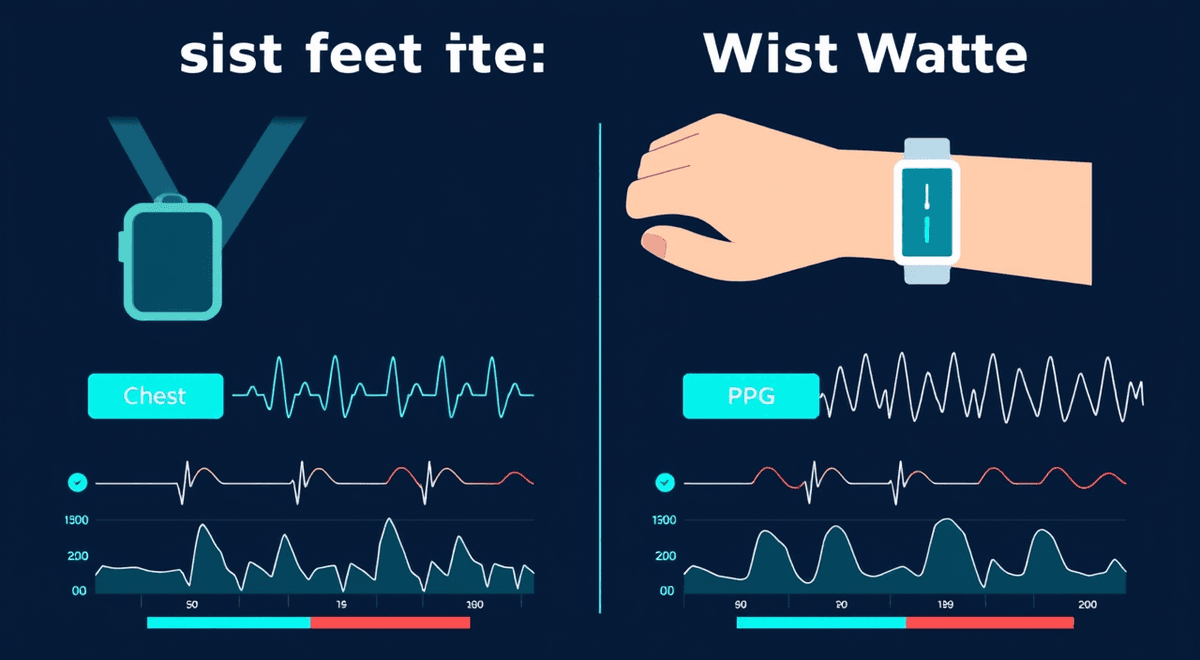
At rest, the Apple Watch and a chest strap like the Polar H10 are both accurate within plus or minus 1-2 BPM. During steady-state exercise, the gap widens to plus or minus 3-5 BPM for the Apple Watch versus plus or minus 1 BPM for the chest strap. During high-intensity interval training, the Apple Watch can deviate by 10-15 BPM while the chest strap remains within 1-2 BPM. The accuracy difference between these two fundamentally different sensor technologies is context-dependent, and understanding when and why they diverge is essential for choosing the right tool.
This is not a question of whether the Apple Watch is a bad heart rate monitor. It is, in fact, one of the best optical wrist-based monitors available. The question is whether optical PPG technology at the wrist can match electrical sensing at the chest, and the answer is nuanced. For many users and many activities, the Apple Watch is more than accurate enough. For specific use cases, particularly high-intensity training and cycling, a chest strap provides meaningfully better data.
This article reviews the peer-reviewed evidence, explains the technology differences, and provides practical guidance for different activities and training goals. For background on how the optical sensor in the Apple Watch works, see our guide to PPG technology.
How the Two Technologies Work
Understanding why accuracy differs requires understanding the fundamental technology difference between optical PPG and electrical heart rate sensing.
Apple Watch: Optical Photoplethysmography (PPG)
The Apple Watch uses green, red, and infrared LEDs on its back crystal to illuminate the skin of the wrist. Photodiodes detect changes in light absorption caused by pulsatile blood flow in the underlying arteries and arterioles. Each heartbeat sends a pulse of blood through the vasculature, causing a brief increase in blood volume that absorbs more light (particularly green light, which is strongly absorbed by hemoglobin). The Apple Watch's algorithm analyzes these pulsatile light changes to determine heart rate.
The key challenges for wrist PPG are:
- Motion artifact: Arm movement during exercise causes the sensor and skin to shift relative to each other, creating noise that can overwhelm the pulse signal
- Low perfusion: The dorsal wrist has relatively low arterial blood flow compared to the fingertip or earlobe, resulting in a weaker base signal
- Vasoconstriction: During intense exercise, blood is redirected to working muscles, further reducing peripheral perfusion at the wrist
- Skin and tissue variability: Darker skin, tattoos, dense hair, and subcutaneous fat can attenuate the optical signal
For technical details on how different PPG wavelengths handle these challenges, see our wavelength comparison guide. For information on how motion artifact removal algorithms address the motion challenge, see our signal processing article.
Chest Strap: Electrical Heart Rate Sensing
Chest straps like the Polar H10 use two electrode pads embedded in the strap fabric to detect the electrical potential generated by the heart's depolarization cycle. This is the same fundamental principle as a clinical ECG. The R-wave of each heartbeat produces a voltage spike detectable through the chest wall, and the strap's electronics measure the time between successive R-waves to calculate heart rate.
The advantages of electrical sensing are substantial:
- Direct measurement: Electrical signals originate from the heart itself, not from a downstream proxy (blood flow at the wrist)
- Minimal motion artifact: The chest does not move independently from the heart the way the wrist moves independently from the chest, and electrical signals are not affected by the mechanical motion artifacts that plague optical sensors
- Consistent contact: The elastic strap maintains consistent electrode contact against the chest wall during exercise
- No perfusion dependence: Electrical signals are not affected by vasoconstriction, skin color, or peripheral blood flow
The primary limitations of chest straps are comfort (some users find them restrictive or irritating), the need to wet the electrodes for initial contact, and occasional static or interference in very dry conditions. For a broader comparison of sensing technologies in wearable devices, see our device guide.
Resting Heart Rate: Both Are Excellent
At rest, the accuracy gap between the Apple Watch and a chest strap is minimal and clinically insignificant for most purposes.
Multiple validation studies confirm that the Apple Watch measures resting heart rate within plus or minus 1-2 BPM of clinical ECG. The Polar H10 achieves plus or minus 1 BPM accuracy at rest. For practical purposes, both are reliable for resting heart rate measurement.
This is because the conditions at rest favor PPG accuracy: minimal motion artifact, adequate peripheral perfusion, no vasoconstriction, and stable heart rate allowing the algorithm to average over multiple beats. The Apple Watch's multi-wavelength sensor and sophisticated algorithm handle resting conditions with ease.
For sleep and overnight resting heart rate, the Apple Watch performs well but is slightly less accurate than the Oura Ring, which benefits from the finger's superior PPG signal characteristics. Both the Apple Watch and Oura Ring outperform chest straps for sleep monitoring simply because almost no one sleeps comfortably wearing a chest strap.
Steady-State Exercise: The Apple Watch Performs Well
During steady-state exercise, defined as sustained activity at a relatively constant intensity, the Apple Watch delivers good accuracy that is sufficient for most training purposes.
Running at Constant Pace
Gillinov et al. (2017) evaluated wrist-based optical heart rate monitors during various exercise modalities and found that during treadmill running at constant pace, the Apple Watch achieved a concordance correlation coefficient (CCC) of approximately 0.91 with ECG reference. Mean absolute error was approximately 3-5 BPM during sustained running.
The Apple Watch benefits from the rhythmic, predictable arm swing pattern during running, which allows the motion compensation algorithm to effectively separate pulse signal from motion noise. The algorithm learns the cadence pattern and filters it from the PPG signal, leaving a cleaner pulse waveform for heart rate extraction.
At easy to moderate paces (zones 1-3 for most athletes), the Apple Watch is reliable enough for zone-based training. A displayed heart rate of 145 BPM likely corresponds to an actual heart rate of 140-150 BPM, which is adequate for maintaining general training zones.
Steady Cycling
Cycling at constant effort presents more challenges than running for wrist PPG but is still manageable during steady-state efforts. During sustained cycling at moderate intensity on smooth roads, the Apple Watch achieves accuracy within plus or minus 5-8 BPM. The error is larger than running because of handlebar vibration and grip effects, but during sustained effort without rapid intensity changes, the algorithm can maintain reasonable tracking.
High-Intensity Interval Training: The Gap Widens
HIIT is where the Apple Watch's limitations become most apparent and where a chest strap provides the greatest advantage.
Why HIIT Is Difficult for Wrist PPG
High-intensity interval training involves rapid transitions between maximum effort and recovery. These transitions challenge wrist PPG in multiple ways simultaneously:
-
Rapid heart rate changes: Heart rate may increase from 120 to 185 BPM within 30 seconds during a sprint interval, then drop back during recovery. The Apple Watch's algorithm applies temporal smoothing that introduces 5-15 seconds of lag, meaning the displayed heart rate is behind actual heart rate during both the ramp-up and recovery phases.
-
Increased motion artifact: HIIT often involves explosive movements (burpees, box jumps, sprints, rowing) that generate larger and more erratic motion artifacts than steady-state running.
-
Vasoconstriction during peak effort: At near-maximal effort, peripheral vasoconstriction reduces wrist blood flow, weakening the PPG signal precisely when accurate reading is most important.
-
Algorithm confusion during transitions: The motion compensation algorithm is calibrated for steady-state patterns. During HIIT transitions, the motion pattern changes abruptly, and the algorithm may briefly lose lock on the true heart rate.
What the Studies Show
Gillinov et al. (2017) found that during interval exercise protocols, wrist-based optical monitors including the Apple Watch showed significantly larger errors compared to steady-state conditions. Mean absolute errors during HIIT ranged from 8-15 BPM for wrist optical devices versus 1-2 BPM for chest straps.
Horton et al. (2017) specifically evaluated consumer wearable accuracy during varied exercise intensities and found that wrist-based devices consistently underperformed during high-intensity segments. The Apple Watch was among the better-performing wrist devices but still showed marked accuracy degradation during HIIT compared to rest and steady-state exercise.
The practical consequence is that during interval training, the Apple Watch may show you in zone 3 when you are actually in zone 5, or may show a peak heart rate of 170 BPM when your actual peak was 185 BPM. For athletes who make real-time training decisions based on heart rate (adjusting interval effort to hit specific heart rate targets, for example), this level of error is problematic.
A chest strap like the Polar H10 paired with the Apple Watch solves this problem entirely, providing real-time accurate heart rate data displayed on the watch face and recorded in the workout. For more on how peak detection algorithms handle these rapid transitions, see our technical guide.
Cycling: Chest Strap Strongly Recommended
Cycling deserves special attention because it represents arguably the worst-case scenario for wrist-based PPG accuracy and one of the most common activities where accurate heart rate data matters for training.
Why Cycling Is Problematic for the Apple Watch
Several cycling-specific factors compound to degrade wrist PPG accuracy:
Handlebar vibration. Road vibration transmitted through the handlebars to the wrist creates continuous high-frequency motion artifact that is difficult for the algorithm to filter because it does not have the predictable periodicity of running arm swing.
Grip pressure. Gripping the handlebars compresses the blood vessels and tissues on the wrist directly under the sensor. This mechanical compression alters blood flow patterns in ways that corrupt the PPG signal. Tighter grips (sprinting, climbing) produce worse effects.
Static arm position. Unlike running, cycling involves relatively static arms. The Apple Watch's motion compensation algorithm partially relies on accelerometer data to identify and remove arm-swing frequency components from the PPG signal. With static arms, this motion reference is less informative.
Aerodynamic positions. Riding in the drops, on aero bars, or in a tucked position changes the wrist angle and contact pressure with the sensor, potentially introducing positional artifacts.
Studies report Apple Watch errors of plus or minus 7-12 BPM during cycling, with occasional episodes of significantly larger error (20-30 BPM) when the algorithm briefly locks onto a harmonic of the cadence frequency instead of the actual pulse rate. Chest straps, unaffected by any of these factors, maintain plus or minus 1-2 BPM accuracy throughout all cycling conditions.
For serious cyclists who use heart rate for pacing, threshold identification, or combined power-and-HR training analysis, a chest strap is essential equipment. The Polar H10 can connect simultaneously to a Garmin cycling computer and an Apple Watch via its dual Bluetooth/ANT+ capability.
Swimming: A Mixed Picture
Swimming presents unique challenges and opportunities for heart rate monitoring that differ from land-based activities.
Apple Watch in Water
The Apple Watch is water-resistant and supports swim workout tracking, but heart rate accuracy during swimming is generally the worst of any major activity category. Water between the sensor and skin can refract and scatter the LED light, degrading signal quality. Arm movements during swimming strokes create large motion artifacts. Push-offs from the wall and flip turns introduce sudden motion spikes.
During swimming, the Apple Watch often reports heart rate intermittently rather than continuously, with gaps during active swimming and more reliable readings during rest intervals at the wall. Accuracy during active swimming is often plus or minus 10-20 BPM or worse, with some strokes (butterfly, backstroke) being more challenging than others.
Chest Strap in Water
Chest straps have traditionally struggled in water because water can conduct electrical signals between the electrodes, creating short circuits that produce erroneous readings. The Polar H10 has improved water resistance and includes a swim mode, but accuracy can still be affected during pool swimming. Open water swimming with a well-fitted strap tends to perform better than pool swimming with frequent wall push-offs.
Some swimmers find that a chest strap provides usable data during swimming while the Apple Watch does not, but neither technology delivers the reliability achieved during land-based activities. For swimming-specific heart rate data, post-workout averages from either device type tend to be more reliable than real-time readings during active swimming. Our wearable device guides cover swim-specific recommendations in more detail.
Clinical and Health Monitoring: Apple Watch Advantages
While the chest strap wins on exercise accuracy, the Apple Watch has significant advantages for health and clinical monitoring applications that a chest strap simply cannot provide.
Features Only the Apple Watch Offers
The Apple Watch includes FDA-cleared health features that have no chest strap equivalent:
- ECG recording: The Apple Watch's electrical heart sensor (different from the PPG optical sensor) can record a single-lead ECG tracing useful for AFib detection and sharing with physicians
- Irregular rhythm notification: Passive PPG-based screening for atrial fibrillation
- Blood oxygen measurement: SpO2 monitoring using red and infrared PPG wavelengths
- High and low heart rate alerts: Customizable notifications when resting heart rate exceeds or falls below set thresholds
- Cardio fitness estimation: VO2 max approximation from walking and running data
A chest strap provides none of these features. It measures heart rate and R-R intervals during exercise and that is all. For users interested in cardiac health screening, passive monitoring, or sharing health data with physicians, the Apple Watch provides irreplaceable value.
24/7 Monitoring Feasibility
The Apple Watch can be worn throughout the day and night (with charging breaks), providing continuous passive heart rate monitoring, sleep tracking, and health screening. A chest strap is impractical for extended wear because of comfort limitations and the need for electrode moisture.
This continuous monitoring capability means the Apple Watch captures physiological data across the full spectrum of daily life: resting, sleeping, walking, working, exercising, and recovering. For longitudinal health tracking, trend detection, and early warning of health changes, this continuous data stream is far more valuable than exercise-only heart rate data from a chest strap. For more on how continuous monitoring supports HRV analysis, see our HRV reference guide.
When to Use Each: Practical Recommendations
Based on the evidence and the technology differences, here are clear recommendations for when each device type provides the best experience.
Use the Apple Watch Alone When
- You are doing steady-state running, walking, or hiking at moderate intensity
- You are tracking general fitness and daily activity
- You want sleep tracking and overnight heart rate monitoring
- You need cardiac health features (ECG, AFib screening, SpO2)
- You are a casual exerciser who wants convenient heart rate awareness
- You are doing yoga, Pilates, or other low-motion activities
Use a Chest Strap (Paired with Apple Watch) When
- You are doing HIIT, CrossFit, or circuit training
- You are cycling (road, mountain, indoor trainer)
- You are doing threshold or interval running where precise zone adherence matters
- You are racing and need accurate real-time pacing data
- You are doing strength training with significant grip involvement
- You are a coach or athlete making performance decisions based on heart rate data
Consider Both Simultaneously
Many serious athletes wear both devices simultaneously, using the chest strap's heart rate data (automatically prioritized by the Apple Watch during workouts) for exercise accuracy while retaining the Apple Watch's 24/7 health monitoring, sleep tracking, and smart features. This combined approach provides the best of both worlds at a modest additional cost (the Polar H10 is approximately $90).
The signal processing behind each technology continues to improve with each hardware and software generation. Wrist-based PPG accuracy has improved substantially over the past decade and will continue to improve. But the fundamental physical advantages of electrical sensing at the chest mean that chest straps will likely maintain an accuracy edge during intense exercise for the foreseeable future.
For a comprehensive guide to choosing the right device for your specific needs, see our best heart rate monitor 2026 recommendations.
Frequently Asked Questions
Is the Apple Watch accurate enough for heart rate zone training?
The Apple Watch is accurate enough for heart rate zone training during steady-state activities like easy runs, tempo runs, and sustained cycling efforts, where its accuracy is within plus or minus 3-5 BPM. However, during high-intensity interval training where heart rate changes rapidly, the Apple Watch can lag behind actual heart rate by 5-15 seconds and deviate by 10-15 BPM. This lag means you may spend time in the wrong zone during intervals without knowing it. For serious zone-based training with frequent intensity changes, a chest strap provides significantly more reliable data for making real-time intensity decisions.
Why does my Apple Watch show a different heart rate than my chest strap?
Differences between Apple Watch and chest strap readings occur because they measure fundamentally different physiological signals. The Apple Watch uses optical PPG to detect blood volume changes in wrist arteries, while chest straps detect electrical cardiac signals. During exercise, several factors cause disagreement: motion artifact from arm swing corrupts the PPG signal, pulse transit time delay means the pulse wave arrives at the wrist 100-200 milliseconds after the heartbeat, wrist vasoconstriction during intense exercise reduces PPG signal quality, and algorithmic smoothing in the Apple Watch averages readings over several seconds. The discrepancy is typically largest during HIIT, rapid pace changes, and activities involving gripping.
Can I use a Polar H10 chest strap with my Apple Watch?
Yes, the Polar H10 connects to the Apple Watch via Bluetooth. Once paired, the Apple Watch Workout app and many third-party fitness apps (such as Strava, Nike Run Club, and WorkOutDoors) will use the chest strap heart rate data instead of the optical sensor, giving you chest strap accuracy with Apple Watch display, recording, and analytics. To pair, go to Settings on the Apple Watch, select Bluetooth, put the H10 into pairing mode by snapping it onto the wet strap, and select it from the available devices. The Apple Watch will automatically prioritize the external heart rate source during workouts.
Is a chest strap more accurate than the Apple Watch during cycling?
Yes, a chest strap is substantially more accurate than the Apple Watch during cycling. Cycling is one of the worst activities for wrist-based PPG accuracy because of constant vibration transmitted through the handlebars, grip pressure compressing the sensor and blood vessels, relatively static arm position reducing the algorithm's ability to separate motion from pulse, and potential wrist flexion while in the drops or on aero bars. Studies report Apple Watch errors of plus or minus 7-12 BPM during cycling versus plus or minus 1-2 BPM for the Polar H10. For serious cyclists training with power and heart rate, a chest strap is essentially mandatory for reliable data.
Frequently Asked Questions
- Is the Apple Watch accurate enough for heart rate zone training?
- The Apple Watch is accurate enough for heart rate zone training during steady-state activities like easy runs, tempo runs, and sustained cycling efforts, where its accuracy is within plus or minus 3-5 BPM. However, during high-intensity interval training where heart rate changes rapidly, the Apple Watch can lag behind actual heart rate by 5-15 seconds and deviate by 10-15 BPM. This lag means you may spend time in the wrong zone during intervals without knowing it. For serious zone-based training with frequent intensity changes, a chest strap provides significantly more reliable data for making real-time intensity decisions.
- Why does my Apple Watch show a different heart rate than my chest strap?
- Differences between Apple Watch and chest strap readings occur because they measure fundamentally different physiological signals. The Apple Watch uses optical PPG to detect blood volume changes in wrist arteries, while chest straps detect electrical cardiac signals. During exercise, several factors cause disagreement: motion artifact from arm swing corrupts the PPG signal, pulse transit time delay means the pulse wave arrives at the wrist 100-200 milliseconds after the heartbeat, wrist vasoconstriction during intense exercise reduces PPG signal quality, and algorithmic smoothing in the Apple Watch averages readings over several seconds. The discrepancy is typically largest during HIIT, rapid pace changes, and activities involving gripping.
- Can I use a Polar H10 chest strap with my Apple Watch?
- Yes, the Polar H10 connects to the Apple Watch via Bluetooth. Once paired, the Apple Watch Workout app and many third-party fitness apps (such as Strava, Nike Run Club, and WorkOutDoors) will use the chest strap heart rate data instead of the optical sensor, giving you chest strap accuracy with Apple Watch display, recording, and analytics. To pair, go to Settings on the Apple Watch, select Bluetooth, put the H10 into pairing mode by snapping it onto the wet strap, and select it from the available devices. The Apple Watch will automatically prioritize the external heart rate source during workouts.
- Is a chest strap more accurate than the Apple Watch during cycling?
- Yes, a chest strap is substantially more accurate than the Apple Watch during cycling. Cycling is one of the worst activities for wrist-based PPG accuracy because of constant vibration transmitted through the handlebars, grip pressure compressing the sensor and blood vessels, relatively static arm position reducing the algorithm's ability to separate motion from pulse, and potential wrist flexion while in the drops or on aero bars. Studies report Apple Watch errors of plus or minus 7-12 BPM during cycling versus plus or minus 1-2 BPM for the Polar H10. For serious cyclists training with power and heart rate, a chest strap is essentially mandatory for reliable data.