PaperarXiv:2608.15951
ReliaGate: Reliability Routing for Low-Stakes Wearable Stress Prediction


UbiComp Companion 2026 (WellComp workshop)
 (opens in a new tab)
Moon, Jaden et al., "ReliaGate: Reliability Routing for Low-Stakes Wearable Stress Prediction", arXiv:2608.15951, CC BY-NC-ND 4.0
TL;DR
It locks an upstream classifier (per-modality TCNs on BVP/EDA/TEMP, or BVP/EDA for UBFC-Phys), then trains a correctness scorer on ~90 reliability features: confidence, per-modality signal quality, cross-modality agreement, train- standardized atypicality, and train-fitted embedding geometry (Mahalanobis / k-NN distances). It evaluates on four datasets (WESAD, UBFC-Phys, EmpaticaE4Stress, PhysioNetE4) with subject-disjoint folds and reports not just coverage/risk but a per-subject "Reach" metric — explicitly because a selective system can look better in pooled numbers while starving specific people of any output.
- Subjects: 15
Abstract
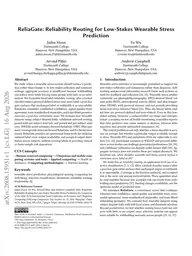
We study when a wearable stress system should surface a prediction rather than change it. In low-stakes reflection and summary settings, aggregate accuracy is insufficient because withholding can reduce error while leaving some people with little or no information. We formulate fixed-label reliability routing: after a locked classifier emits a protocol-defined stress/non-stress label, a post-hoc gate surfaces that unchanged label or withholds it as unavailable. ReliaGate assembles established confidence, signal-quality/trust, agreement, train-standardized atypicality, and train-fitted geometry cues into a post-hoc correctness score. We evaluate four wearable datasets using subject-disjoint folds, validation-selected routing, paired held-out-subject intervals, and pooled and per-subject analyses. WESAD point estimates favored ReliaGate, UBFC-Phys primary coverage/risk intervals favored ReliaGate, and E4 checks were mixed. ReliaGate provides an operational framework for studying surfaced-label error, output availability, and accepted-output distribution across subjects, without revising labels or providing clinical or finite-sample risk guarantees.
Verbatim from arXiv (opens in a new tab) · arXiv metadata (abstracts are released under CC0)
Results on ChatPPG leaderboards
All leaderboardsNo results from this paper on ChatPPG leaderboards yet. Browse the leaderboards.
Tasks & signals
Tasks
Signals
Devices
Keywords
Datasets used


How it works
Cite this paper
ReliaGate: Reliability Routing for Low-Stakes Wearable Stress Prediction. (2026). UbiComp Companion 2026. https://arxiv.org/abs/2608.15951
@inproceedings{reliagatereliabi2026reliagate,
  title         = {{ReliaGate: Reliability Routing for Low-Stakes Wearable Stress Prediction}},
  year          = {2026},
  booktitle     = {UbiComp Companion 2026},
  eprint        = {2608.15951},
  archivePrefix = {arXiv}
}Record updated