PaperarXiv:2503.08015
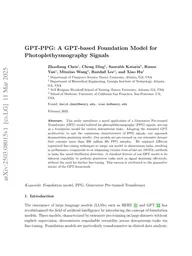
GPT-PPG: a GPT-based foundation model for photoplethysmography signals
Physiological Measurement
Key results1 SOTA
All results0.847
F1 score ↑
AFib detection · Stanford AF (DeepBeat)
GPT-PPG 1B
fine-tuned
Best comparison: SiamQuality 0.710
- GPT-PPG 1BTable 2 (source, opens in a new tab)
4.77BPM
MAE (BPM) ↓
Heart rate · PPG-DaLiA
fine-tuned
Best comparison: BeliefPPG 3.57
- GPT-PPG 1BTable 3 (source, opens in a new tab)
0.93breaths/min
MAE (breaths/min) ↓
Respiratory rate · BIDMC
fine-tuned
Best comparison: SiamQuality 0.89
- GPT-PPG 1BTable 2 (source, opens in a new tab)
4.98BPM
MAE (BPM) ↓
Heart rate · WESAD
fine-tuned
Best comparison: BeliefPPG 4.28
+ 1 more result
- GPT-PPG 1BTable 2 (source, opens in a new tab)
1.98BPM
MAE (BPM) ↓
Heart rate · IEEE SPC 2015
fine-tuned
Best comparison: BeliefPPG 1.75
Results as reported by the authors; not independently reproduced. A SOTA star marks the best value among results reported under the same evaluation protocol; ties go to the earlier publication.
Embed this badge (1 badge for READMEs and project pages)
 Markdown
[](https://chatppg.com/research/models/gpt-ppg#key-results)HTML<a href="https://chatppg.com/research/models/gpt-ppg#key-results"><img src="https://chatppg.com/research/badges/gpt-ppg--afib-stanford-ppg-f1.svg" alt="SOTA on ChatPPG: AFib detection · Stanford AF (DeepBeat)" height="20"></a>
TL;DR
GPT-PPG adapts the GPT architecture to continuous PPG signals, pretraining on more than 200 million 30-second samples and then fine-tuning for each task. It matched or beat earlier methods on several tasks, notably atrial fibrillation detection, and can denoise signals without extra fine-tuning.
- Architecture: GPT-style transformer
- Pretraining: 200M+ 30 s PPG samples
- Tasks: AF detection and others; denoising
- Teacher FM for PPG-Distill (Ni et al., NeurIPS TS4H 2025)
Abstract
This study introduces a novel application of a Generative Pre-trained Transformer (GPT) model tailored for photoplethysmography (PPG) signals, serving as a foundation model for various downstream tasks. Adapting the standard GPT architecture to suit the continuous characteristics of PPG signals, our approach demonstrates promising results. Our models are pre-trained on our extensive dataset that contains more than 200 million 30s PPG samples. We explored different supervised fine-tuning techniques to adapt our model to downstream tasks, resulting in performance comparable to or surpassing current state-of-the-art (SOTA) methods in tasks like atrial fibrillation detection. A standout feature of our GPT model is its inherent capability to perform generative tasks such as signal denoising effectively, without the need for further fine-tuning. This success is attributed to the generative nature of the GPT framework.
Verbatim from arXiv (opens in a new tab) · arXiv metadata (abstracts are released under CC0)
Results on ChatPPG leaderboards · 4
All leaderboards| Leaderboard | Method | Result | Rank |
|---|---|---|---|
| PulseDB v2.0 MAE (mmHg)Cuffless blood pressure estimation | GPT-PPG | 8.12MAE (mmHg), lower is better | #1 of 1 |
| PPG-DaLiA MAE (BPM)Heart rate estimation | GPT-PPG | 4.77MAE (BPM), lower is better | #8 of 19 |
| TROIKA MAE (BPM)Heart rate estimation | GPT-PPG | 1.98MAE (BPM), lower is better | #1 of 3 |
| WESAD MAE (BPM)Heart rate estimation | GPT-PPG | 4.98MAE (BPM), lower is better | #3 of 3 |
4 rows are credited to this paper. Ranks apply within each leaderboard only, as reported by the source.
Tasks & signals
Tasks
Signals
Devices
Keywords
Datasets used
 BIDMC PPG and Respiration (Pimentel 2016 / PhysioNet)53 subjects · PPG · ECG · SpO₂
 IEEE Signal Processing Cup 2015 (TROIKA)wrist PPG during intensive exerciseEvaluation12 subjects · PPG · ECG · IMU
 PPG-DaLiAPPG dataset for motion compensation / HREvaluation15 subjects · PPG · ECG · IMU
 PulseDB v2.0cleaned MIMIC-III + VitalDB cuffless-BP benchmark (MIMIC part ODbL; VitalDB part CC BY-NC-SA)Evaluation5,361 subjects · PPG · ECG · BP
 Stanford wrist PPG AF (DeepBeat)Torres-Soto & Ashley 2020, Synapse syn21985690PPG
 WESADWearable Stress and Affect DetectionEvaluation15 subjects · PPG · ECG · IMU
How it works
Cite this paper
Chen, Z., Ding, C., Kataria, S., Yan, R., Wang, M., Lee, R., & Hu, X. (2025). GPT-PPG: a GPT-based foundation model for photoplethysmography signals. Physiological Measurement. https://doi.org/10.1088/1361-6579/add988
Chen, Zhaoliang, Cheng Ding, Saurabh Kataria, Runze Yan, Minxiao Wang, Randall Lee, and Xiao Hu. 2025. "GPT-PPG: a GPT-based foundation model for photoplethysmography signals." Physiological Measurement. https://doi.org/10.1088/1361-6579/add988.
Chen, Z., Ding, C., Kataria, S., Yan, R., Wang, M., Lee, R. and Hu, X. (2025) 'GPT-PPG: a GPT-based foundation model for photoplethysmography signals', Physiological Measurement. doi: 10.1088/1361-6579/add988.
Chen, Zhaoliang, et al. "GPT-PPG: a GPT-based foundation model for photoplethysmography signals." Physiological Measurement, 2025. https://doi.org/10.1088/1361-6579/add988.
Z. Chen et al., "GPT-PPG: a GPT-based foundation model for photoplethysmography signals," Physiological Measurement, 2025, doi: 10.1088/1361-6579/add988.
@article{chen2025gptppg,
  title         = {{GPT-PPG: a GPT-based foundation model for photoplethysmography signals}},
  author        = {Chen, Zhaoliang and Ding, Cheng and Kataria, Saurabh and Yan, Runze and Wang, Minxiao and Lee, Randall and Hu, Xiao},
  year          = {2025},
  journal       = {Physiological Measurement},
  doi           = {10.1088/1361-6579/add988},
  eprint        = {2503.08015},
  archivePrefix = {arXiv}
}Added to the ChatPPG research hub