PaperarXiv:2610.13435
PPG-Bench: A Unified Benchmark for PPG Foundation Models
arXiv preprint
 (opens in a new tab)
Kulkarni, Arvasu et al., "PPG-Bench: A Unified Benchmark for PPG Foundation Models", arXiv:2610.13435, CC BY-NC-ND 4.0
Key results4 SOTA
All results7.39BPM
MAE (BPM) ↓
Heart rate · PPG-DaLiA
AnyPPG
linear probe on frozen embeddings
Best comparison: MOMENT 8.24
9.76BPM
MAE (BPM) ↓
Heart rate · WildPPG
AnyPPG
linear probe on frozen embeddings
Best comparison: PulsePPG 10.83
3.21BPM
MAE (BPM) ↓
Heart rate · PPG-BP
MOMENT
linear probe on frozen embeddings
Best comparison: AnyPPG 3.31
.543
Balanced accuracy ↑
Stress / affect · WESAD
AnyPPG
emotion classes · linear probe on frozen embeddings
Best comparison: MOMENT .504
Results as reported by the authors; not independently reproduced. A SOTA star marks the best value among results reported under the same evaluation protocol; ties go to the earlier publication.
Embed this badge (3 badges for READMEs and project pages)
 Markdown
[](https://chatppg.com/research/models/anyppg#key-results)HTML<a href="https://chatppg.com/research/models/anyppg#key-results"><img src="https://chatppg.com/research/badges/anyppg--hr-estimation-ppg-dalia-mae-bpm-ppg-bench-unified-benchmark-ppg-foundati.svg" alt="SOTA on ChatPPG: Heart rate · PPG-DaLiA" height="20"></a> Markdown
[](https://chatppg.com/research/models/anyppg#key-results)HTML<a href="https://chatppg.com/research/models/anyppg#key-results"><img src="https://chatppg.com/research/badges/anyppg--hr-estimation-wildppg-mae-bpm.svg" alt="SOTA on ChatPPG: Heart rate · WildPPG" height="20"></a> Markdown
[](https://chatppg.com/research/models/anyppg#key-results)HTML<a href="https://chatppg.com/research/models/anyppg#key-results"><img src="https://chatppg.com/research/badges/anyppg--stress-wesad-balanced-accuracy.svg" alt="SOTA on ChatPPG: Stress / affect · WESAD" height="20"></a>
TL;DR
PPG-Bench is an open benchmark that compares five public PPG foundation models on nine datasets and 26 tasks under four levels of adaptation, from linear probes to full fine-tuning. In 35.3% of the 68 task-regime combinations the foundation models showed no real advantage over a trivial baseline. In 83.8%, no PPG-specific model beat both simple pulse-rate-variability features and MOMENT.
- Models: 5 public PPG FMs
- Evaluation: 9 datasets, 26 tasks, 4 regimes
- Result: 35.3% of combinations show no FM advantage over baseline
Abstract
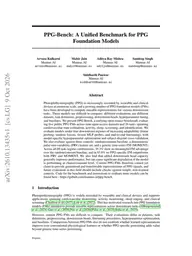
Photoplethysmography (PPG) is increasingly recorded by wearable and clinical devices at enormous scale, and a growing number of PPG foundation models (FMs) have been developed to compute reusable representations for various downstream tasks. These models are difficult to compare: different evaluations use different datasets, task definitions, preprocessing, downstream heads, hyperparameter tuning, and baselines. We present PPG-Bench, a unifying open-source benchmark evaluating five public PPG FMs across nine open-access datasets and 26 tasks spanning cardiovascular state estimation, activity, sleep, screening, and identification. We evaluate models under four downstream regimes of increasing adaptability (linear probing, random forests, frozen MLP probes, and end-to-end finetuning), with model-specific hyperparameter optimization and subject-disjoint cross-validation. We also evaluate against three controls: random/constant baseline, a deterministic pulse-rate-variability (PRV) feature set, and a generic time-series FM (MOMENT). Across all 68 task-regime combinations, 35.3% show no meaningful FM advantage over the random/constant baseline, and in 83.8% no PPG-specific FM outperforms both PRV and MOMENT. We also find that added downstream head capacity generally improves performance, but can cause significant degradation if the model is performing at chance/constant level. Current PPG FMs therefore cannot yet claim to provide generalised and transferrable representations of PPG signals, and future evaluation in this field should include checks against simple, non-learned controls. Code for the benchmark and instructions to evaluate more models can be found here - https://github.com/mannas-ai/ppg-bench.
Verbatim from arXiv (opens in a new tab) · arXiv metadata (abstracts are released under CC0)
Results on ChatPPG leaderboards · 9
All leaderboards| Leaderboard | Method | Result | Rank |
|---|---|---|---|
| Guilin / Liang 2018 MAE (mmHg)Cuffless blood pressure estimation | AnyPPG | 13.32MAE (mmHg), lower is better | #3 of 4 |
| Guilin / Liang 2018 MAE (BPM)Heart rate estimation | AnyPPG | 3.31MAE (BPM), lower is better | #1 of 1 |
| PPG-DaLiA MAE (BPM)Heart rate estimation | AnyPPG | 7.39MAE (BPM), lower is better | #13 of 19 |
| WildPPG MAE (BPM)Heart rate estimation | AnyPPG | 9.76MAE (BPM), lower is better | #2 of 2 |
| PPG-DaLiA MAE (BPM)Heart rate estimation | Pulse-PPGvia model Pulse-PPG | 8.936MAE (BPM), lower is better | #15 of 19 |
| PPG-DaLiA MAE (BPM)Heart rate estimation | AnyPPGvia model AnyPPG | 9.27MAE (BPM), lower is better | #17 of 19 |
| PPG-DaLiA MAE (BPM)Heart rate estimation | PaPaGei-Svia model PaPaGei-S | 15.22MAE (BPM), lower is better | #19 of 19 |
| WESAD AUROCMental workload assessment | Pulse-PPGvia model Pulse-PPG | 0.9687AUROC, higher is better | #2 of 7 |
| WESAD AUROCMental workload assessment | PaPaGei-Svia model PaPaGei-S | 0.8043AUROC, higher is better | #7 of 7 |
4 rows are credited to this paper; 5 more belong to models it introduces or evaluates. Ranks apply within each leaderboard only, as reported by the source.
Tasks & signals
Tasks
Signals
Devices
Keywords
Datasets used
 BIDMC PPG and Respiration (Pimentel 2016 / PhysioNet)53 subjects · PPG · ECG · SpO₂
 Brno University of Technology Smartphone PPG Database (BUT PPG)50 subjects · PPG · ECG
 DREAMTDataset for Real-time sleep stage EstimAtion using Multisensor wearable Technology100 subjects · PPG · IMU · EDA
 ECSMPEmotion, Cognition, Sleep Multimodal Physiological Signals89 subjects · PPG · ECG · IMU
 PPG-DaLiAPPG dataset for motion compensation / HREvaluation15 subjects · PPG · ECG · IMU
 PPG-BP Database (Guilin / Liang 2018)Evaluation219 subjects · PPG
 Real-World PPG Dataset (Siam et al. / Mendeley)35 subjects · PPG
 WESADWearable Stress and Affect Detection15 subjects · PPG · ECG · IMU
 WildPPGEvaluation16 subjects · PPG · ECG · IMU
Models
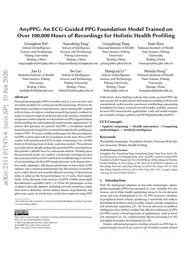
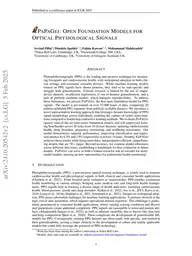
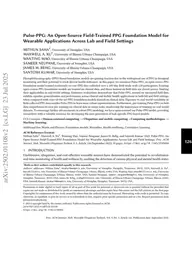
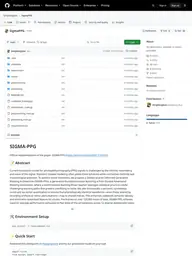
How it works
Cite this paper
Kulkarni, A., Jain, M., Mishra, A. R., Singh, S., & Panwar, S. (2026). PPG-Bench: A Unified Benchmark for PPG Foundation Models. arXiv preprint. https://arxiv.org/abs/2610.13435
Kulkarni, Arvasu, Mahir Jain, Aditya Ray Mishra, Sandeep Singh, and Siddharth Panwar. 2026. "PPG-Bench: A Unified Benchmark for PPG Foundation Models." arXiv preprint. https://arxiv.org/abs/2610.13435.
Kulkarni, A., Jain, M., Mishra, A. R., Singh, S. and Panwar, S. (2026) 'PPG-Bench: A Unified Benchmark for PPG Foundation Models', arXiv preprint. Available at: https://arxiv.org/abs/2610.13435
Kulkarni, Arvasu, et al. "PPG-Bench: A Unified Benchmark for PPG Foundation Models." arXiv preprint, 2026. https://arxiv.org/abs/2610.13435.
A. Kulkarni, M. Jain, A. R. Mishra, S. Singh, and S. Panwar, "PPG-Bench: A Unified Benchmark for PPG Foundation Models," arXiv preprint, 2026, [Online]. Available: https://arxiv.org/abs/2610.13435.
@misc{kulkarni2026ppgbench,
  title         = {{PPG-Bench: A Unified Benchmark for PPG Foundation Models}},
  author        = {Kulkarni, Arvasu and Jain, Mahir and Mishra, Aditya Ray and Singh, Sandeep and Panwar, Siddharth},
  year          = {2026},
  howpublished  = {arXiv preprint},
  eprint        = {2610.13435},
  archivePrefix = {arXiv}
}Record updated
Added to the ChatPPG research hub