What Is Photoplethysmography (PPG)? The Complete Technical Guide
A comprehensive technical guide to photoplethysmography (PPG) explaining how PPG sensors work, the physics of light-tissue interaction, transmission vs reflectance modes, signal components, and modern applications in wearables and clinical devices.
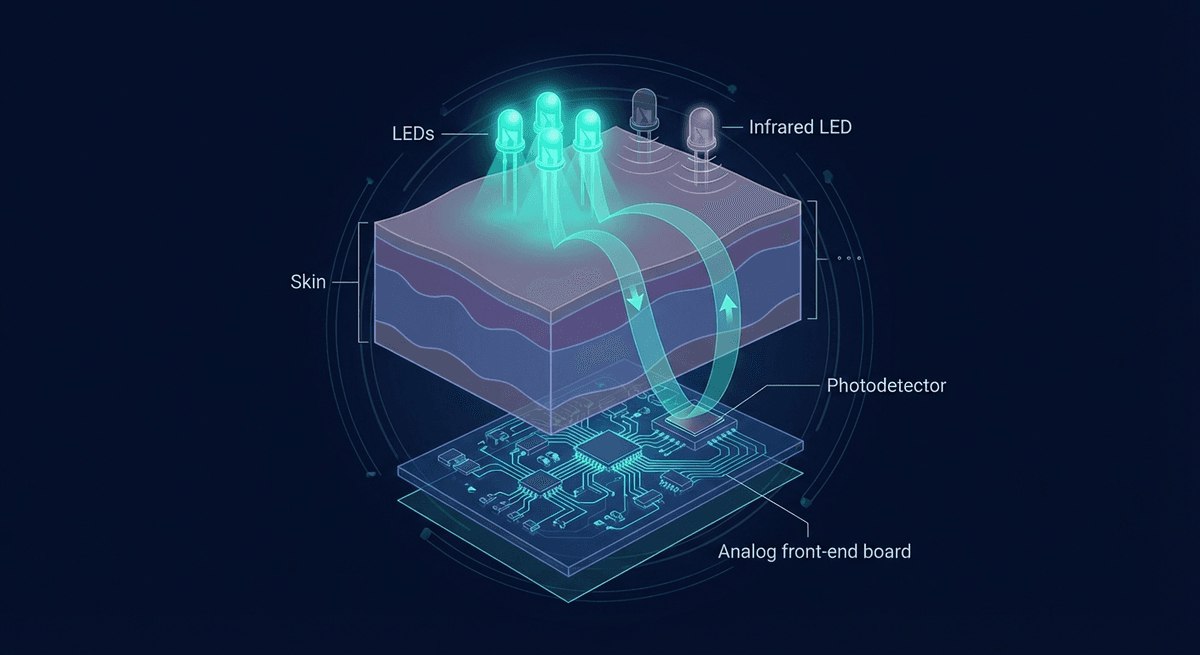
Photoplethysmography (PPG) is an optical measurement technique that detects blood volume changes in the microvascular bed of tissue by illuminating the skin with light and measuring the changes in light absorption. Every time your smartwatch shows your heart rate, every time a pulse oximeter clips onto your finger, and every time a hospital monitor tracks your oxygen saturation, the underlying technology is PPG. It is one of the most widely deployed biosensing technologies in the world, embedded in billions of consumer devices and clinical instruments.
This guide provides a complete technical explanation of how PPG works, from the fundamental physics of light-tissue interaction to the modern signal processing techniques that extract clinically meaningful data from what is, at its core, a remarkably simple optical measurement.
The Physics of Photoplethysmography
The word "photoplethysmography" breaks down into its Greek roots: photo (light), plethysmo (increase or fullness), and graphy (writing or recording). Literally, it means "recording changes in volume using light."
The Basic Measurement Principle
A PPG sensor consists of two core components: a light-emitting diode (LED) and a photodetector (typically a photodiode). The LED emits light at a specific wavelength into living tissue. As the light travels through the tissue, it is absorbed, scattered, and reflected by various tissue components including skin, bone, muscle, venous blood, arterial blood, and other connective tissues.
The key insight that makes PPG work is that arterial blood volume changes with each heartbeat. During systole (when the heart contracts), a pulse wave of blood enters the peripheral vasculature, increasing the local blood volume. During diastole (when the heart relaxes), blood volume decreases. Because blood, and specifically hemoglobin, is a strong absorber of light at the wavelengths PPG uses, these pulsatile changes in blood volume create pulsatile changes in light absorption.
The photodetector captures the transmitted or reflected light and converts it into an electrical signal. This signal contains the PPG waveform, which mirrors the blood volume pulse and carries information about cardiovascular function, blood oxygenation, and vascular health.
The Beer-Lambert Law Foundation
The theoretical underpinning of PPG is the Beer-Lambert law, which states that the absorbance of light passing through a medium is proportional to the concentration of the absorbing substance and the path length of the light through the medium. In the context of PPG:
- The absorbing substance is primarily hemoglobin in the blood
- The path length changes with pulsatile blood volume
- The concentration of hemoglobin remains relatively constant over short time scales
This means that changes in the detected light intensity can be attributed primarily to changes in the blood volume in the optical path. The Beer-Lambert law also provides the basis for SpO2 calculation, where the ratio of absorption at two different wavelengths reveals the proportion of oxygenated versus deoxygenated hemoglobin.
Transmission Mode vs. Reflectance Mode
PPG sensors come in two fundamental configurations, and the choice between them has significant implications for signal quality, device design, and measurement accuracy.
Transmission Mode PPG
In transmission mode, the LED and photodetector are placed on opposite sides of the tissue. Light from the LED passes through the entire tissue bed and is detected on the other side. This configuration is used in:
- Fingertip pulse oximeters (the most common clinical application)
- Earlobe sensors
- Neonatal foot sensors
Transmission mode requires a thin tissue site that light can fully traverse. The finger is ideal because it provides a relatively thin, highly perfused tissue bed with a good ratio of arterial blood to surrounding tissue. Transmission mode generally provides the highest signal-to-noise ratio and is the gold standard for clinical pulse oximetry.
Reflectance Mode PPG
In reflectance mode, the LED and photodetector are placed on the same side of the tissue, adjacent to each other. Light enters the tissue, penetrates to a depth dependent on the wavelength, and a portion is scattered back toward the surface where the photodetector captures it. This configuration is used in:
- Wrist-worn wearables (Apple Watch, Garmin, Fitbit, Samsung Galaxy Watch)
- Ring-form devices (Oura Ring, RingConn)
- Forehead sensors (used in some clinical monitoring scenarios)
- Chest-worn patches
Reflectance mode can be applied to virtually any body surface, which is why it dominates in consumer wearables. However, the signal is typically weaker and noisier than transmission mode because only a fraction of the emitted light is scattered back to the detector, and the optical path is more variable. To learn more about how different body locations affect PPG signals, see our guide on PPG sensor placement.
Wavelength Selection: Why Color Matters
The choice of LED wavelength is not arbitrary. Different wavelengths interact with tissue in fundamentally different ways, and modern PPG devices strategically use multiple wavelengths for different purposes.
Green Light (520-530 nm)
Green light is the primary wavelength for heart rate measurement in most wrist-based wearables. There are several reasons for this:
- Strong absorption by hemoglobin: Both oxygenated and deoxygenated hemoglobin absorb green light strongly, producing a high-amplitude pulsatile signal.
- Shallow penetration depth: Green light penetrates approximately 1-2 mm into tissue, meaning the signal comes primarily from superficial capillary beds. This reduces noise from deeper tissues and motion of underlying tendons and bone.
- Reduced motion artifact sensitivity: The shallow measurement depth makes green PPG somewhat less susceptible to certain types of motion artifact compared to deeper-penetrating wavelengths.
The downside of green light is that it cannot be used for SpO2 measurement because both hemoglobin species absorb green light similarly, providing no differentiation between oxygenated and deoxygenated blood.
Red Light (660 nm)
Red light penetrates deeper into tissue, approximately 3-5 mm. Its critical property for PPG is that deoxygenated hemoglobin absorbs significantly more red light than oxygenated hemoglobin. This differential absorption is the foundation of pulse oximetry.
Infrared Light (940 nm)
Infrared light penetrates the deepest into tissue, approximately 5-10 mm. Inversely to red light, oxygenated hemoglobin absorbs more infrared light than deoxygenated hemoglobin. By combining red and infrared measurements, a pulse oximeter can calculate the ratio of oxygenated to total hemoglobin, yielding the SpO2 value.
The Red-to-Infrared Ratio
The fundamental equation of pulse oximetry uses the R-ratio:
R = (AC_red / DC_red) / (AC_IR / DC_IR)
Where AC represents the pulsatile component and DC represents the baseline component at each wavelength. This ratio is mapped to SpO2 using empirical calibration curves. An R-ratio of approximately 0.4 corresponds to 100% SpO2, while an R-ratio of approximately 1.0 corresponds to about 85% SpO2. For a detailed breakdown of how this calculation works, see our SpO2 algorithm explanation.
Anatomy of a PPG Signal
The raw PPG signal contains multiple layers of information, each of which can be extracted and analyzed for different physiological parameters.
The DC Component
The DC (direct current) component represents the non-pulsatile baseline of the signal. It reflects absorption by:
- Skin pigmentation (melanin)
- Bone and connective tissue
- Venous blood (which changes volume slowly with respiration but not with each heartbeat)
- Baseline arterial blood volume
The DC component is relatively stable over short time periods and provides the reference against which pulsatile changes are measured. Changes in the DC level over longer time periods can reflect changes in venous return, tissue hydration, or sensor movement.
The AC Component
The AC (alternating current) component represents the pulsatile changes driven by cardiac activity. This is the most information-rich part of the PPG signal and contains:
-
Heart rate information: The fundamental frequency of the AC component directly reflects the heart rate. Peak-to-peak intervals in the PPG waveform correspond to inter-beat intervals (IBIs), from which heart rate variability can be derived.
-
Waveform morphology: The shape of each PPG pulse carries information about vascular compliance, blood pressure, and cardiac output. The dicrotic notch (a small dip in the descending portion of the waveform) reflects aortic valve closure and is related to arterial stiffness.
-
Respiratory modulation: Breathing causes periodic variations in intrathoracic pressure that modulate the PPG waveform in three ways: amplitude modulation (the size of pulses varies with breathing), baseline modulation (the DC level shifts), and frequency modulation (inter-beat intervals vary with respiration via respiratory sinus arrhythmia). These modulations can be extracted to estimate respiratory rate.
-
Blood oxygen information: When measured at two wavelengths (red and infrared), the relative pulsatile absorption reveals SpO2, as described above. For more on pulse oximeter accuracy, see our pulse oximeter readings chart.
What You Can Derive from PPG
The versatility of PPG is remarkable. From a single optical signal, modern algorithms can extract a wide range of physiological parameters:
Heart Rate (HR): The most straightforward derivation. Accuracy at rest is typically within 1-3 bpm of ECG. See our heart rate measurement guide for details.
Heart Rate Variability (HRV): The variation in time between successive heartbeats, measured from PPG pulse peak intervals. While ECG R-R intervals remain the gold standard for HRV, PPG-derived pulse-to-pulse intervals provide a reasonable approximation, especially during rest. Our HRV analysis algorithms page covers the technical details.
Blood Oxygen Saturation (SpO2): Using dual-wavelength PPG as described above. Accuracy depends heavily on sensor design and placement. Visit our blood oxygen level chart for reference ranges.
Respiratory Rate (RR): Extracted from the respiratory modulations of the PPG waveform. Accuracy is typically within 1-3 breaths per minute during rest.
Blood Pressure Estimation: An active area of research. Approaches include pulse transit time (PTT, requiring two sensors), pulse wave analysis (PWA, using the morphology of a single PPG waveform), and machine learning models trained on PPG features. Accuracy remains a significant challenge, and no PPG-only device has achieved full FDA clearance for cuffless blood pressure measurement without calibration. See our wearable blood pressure monitor guide for the current state of this technology.
Vascular Age and Arterial Stiffness: Features of the PPG waveform, particularly the stiffness index and reflection index derived from the second derivative of PPG (SDPPG), correlate with arterial stiffness and vascular aging.
Atrial Fibrillation Detection: The irregular rhythm and pulse amplitude variability characteristic of atrial fibrillation can be detected from PPG signals, and several consumer devices now offer AFib screening capabilities. Our AFib detection algorithm page explains how this works.
A Brief History of PPG
Photoplethysmography has a surprisingly long history:
1937: Alrick B. Hertzman, an American physiologist, published the first description of using light to measure blood volume changes in tissue. He used a simple photoelectric system to record pulsatile blood volume changes in the finger, establishing the foundational principle of PPG.
1940s-1970s: PPG remained primarily a research tool, used to study peripheral vascular physiology. Transmission-mode finger PPG became a standard technique in vascular research laboratories.
1974: Takuo Aoyagi, a Japanese bioengineer at Nihon Kohden, invented modern pulse oximetry by recognizing that the pulsatile component of light absorption at two wavelengths could be used to calculate oxygen saturation non-invasively. This insight transformed PPG from a research curiosity into a life-saving clinical technology.
1980s-1990s: Pulse oximetry became a standard of care in anesthesia, critical care, and emergency medicine. The WHO designated it an essential monitoring tool for safe surgery.
2014-present: Apple Watch launched with a PPG-based heart rate sensor, bringing PPG into the consumer mainstream. Since then, billions of PPG measurements are taken daily by consumer wearables worldwide. Samsung, Garmin, Fitbit, WHOOP, Oura, and dozens of other companies now build products around PPG technology.
Modern Applications
Consumer Wearables
The explosion of PPG in consumer devices has created an unprecedented stream of continuous health data. Modern wearable PPG sensors use multi-wavelength LED arrays (green, red, infrared, and sometimes yellow), multiple photodetectors, and sophisticated signal processing to measure heart rate, SpO2, and derived metrics 24 hours a day. Choosing the right wearable for your needs involves understanding the sensor specifications. See our guide on the best heart rate monitors for current recommendations.
Clinical Pulse Oximetry
Pulse oximeters remain the most critical clinical application of PPG, used in every hospital, ambulance, and operating room worldwide. Modern clinical pulse oximeters incorporate advanced signal processing, motion artifact rejection, and multi-wavelength systems that can detect carboxyhemoglobin and methemoglobin in addition to standard SpO2.
Remote PPG (rPPG)
One of the most exciting frontiers in PPG is camera-based remote photoplethysmography (rPPG). By analyzing subtle color changes in video of a person's face, algorithms can extract the PPG signal without any physical contact. The principle is the same: blood volume changes modulate light absorption in facial skin, and these changes are captured by a standard camera.
Applications of rPPG include contactless vital sign monitoring in neonatal intensive care units, driver drowsiness detection, telehealth vital sign assessment, and mental health screening through autonomic nervous system analysis. For a deeper dive into rPPG technology, see our remote PPG algorithms overview.
Emerging Research Applications
Active research areas in PPG include non-invasive glucose estimation (using multi-wavelength spectroscopic PPG), continuous blood pressure monitoring without calibration, hydration and fluid status assessment, anemia screening, and malaria detection. While most of these remain investigational, the sheer volume of PPG data being collected by consumer wearables is accelerating machine-learning-based discovery of new biomarkers from PPG signals.
Limitations and Challenges
Despite its versatility, PPG has important limitations:
- Motion artifact remains the primary challenge for wearable PPG, particularly during vigorous exercise.
- Skin pigmentation can affect signal quality, particularly for SpO2 measurement, as documented in recent equity studies.
- Poor perfusion from cold, vasoconstriction, or cardiovascular disease weakens the PPG signal.
- Ambient light interference can introduce noise, though modern sensors use ambient light subtraction techniques.
- Individual variability in tissue composition, skin thickness, and vascular anatomy means no single calibration works perfectly for everyone.
Ongoing advances in multi-wavelength sensing, adaptive signal processing, and machine learning are steadily improving PPG accuracy and expanding its capabilities. The technology that began with Hertzman's simple photoelectric measurement in 1937 continues to evolve into one of the most powerful non-invasive biosensing platforms available.
Frequently Asked Questions
Refer to the FAQ section above for answers to the most common questions about photoplethysmography, including what PPG measures, how it compares to ECG, its accuracy for heart rate, the role of different wavelengths, and the future of PPG technology.
Frequently Asked Questions
- What does a PPG sensor actually measure?
- A PPG sensor measures volumetric changes in blood within the microvasculature of tissue. It does this by emitting light (typically green, red, or infrared) into the skin and detecting how much light is absorbed or reflected back. As the heart beats and pushes blood through the vessels, the blood volume in the tissue changes, which modulates the amount of light absorbed. The resulting signal contains a pulsatile AC component (reflecting cardiac-driven blood volume changes) and a steady DC component (reflecting non-pulsatile tissue, venous blood, and baseline arterial volume).
- What is the difference between PPG and ECG?
- PPG and ECG measure fundamentally different things. ECG (electrocardiography) measures the electrical activity of the heart using electrodes on the skin, providing timing information about cardiac depolarization and repolarization. PPG measures the mechanical consequence of the heartbeat, specifically the blood volume pulse as it arrives at the peripheral tissue. ECG excels at detecting arrhythmias and cardiac conduction abnormalities, while PPG provides information about blood oxygen saturation, vascular tone, and peripheral perfusion that ECG cannot.
- How accurate is PPG for measuring heart rate?
- PPG-based heart rate measurement is highly accurate under controlled conditions, typically within 1-3 beats per minute of ECG-derived heart rate during rest. Accuracy degrades during vigorous physical activity due to motion artifacts, though modern multi-sensor wearables with advanced signal processing algorithms have significantly improved exercise accuracy. Studies show that wrist-based PPG devices achieve mean absolute errors of 2-5 bpm during moderate exercise and 5-15 bpm during high-intensity or high-motion activities like weightlifting.
- Why do PPG sensors use different light wavelengths?
- Different wavelengths penetrate tissue to different depths and interact differently with blood components. Green light (520-530 nm) is strongly absorbed by blood and penetrates shallowly, making it ideal for heart rate measurement at the wrist where the signal comes from superficial capillaries. Red (660 nm) and infrared (940 nm) light penetrate deeper into tissue and are used together for SpO2 measurement because oxygenated and deoxygenated hemoglobin absorb these wavelengths differently, enabling the calculation of blood oxygen saturation.
- What is the future of PPG technology?
- The future of PPG includes cuffless continuous blood pressure monitoring using pulse wave analysis, non-invasive glucose estimation (still in early research), advanced atrial fibrillation detection, mental stress and autonomic nervous system assessment, hydration monitoring, and camera-based remote PPG that can extract vital signs from video of a person's face. Multi-wavelength PPG arrays with 5 or more wavelengths could enable detection of additional blood analytes. Integration with AI and machine learning is expected to unlock new biomarkers from PPG signals.