Activity counts measure attention, not model quality. Missing counts are unknown. Publication status follows the linked source; a listed venue alone does not confirm peer review.
Patient-level PPG↔EHR contrastive foundation-style encoder (KDD 2026). Anchors long PPG windows to LLM-distilled clinical semantics from MC-MED ED data; reports strong AF/HR/RR/BP transfer vs SiamQuality / GPT-PPG / PaPaGei.
Signals
PPG, Text
Parameters
130M
Form factor
clinical_ED_PPG_pretrain_wearable_eval
Year
2026
Caveat
the paper's BIDMC respiratory-rate MAE of 0.11 has no stated units and comes from 5-fold CV with no held-out test set, so ChatPPG does not rank it
Architecture
Pretrained PPG patch encoder (type not named in the paper) + ResNet-18 local encoder on [PPG, dPPG, d2PPG] at fine-tune, gated fusion; MedCPT text tower for the PPG-EHR contrastive loss
Pretrained PPG patch encoder (type not named in the paper) + ResNet-18 local encoder on [PPG, dPPG, d2PPG] at fine-tune, gated fusion; MedCPT text tower for the PPG-EHR contrastive loss
The paper reports a BIDMC respiratory-rate MAE of 0.11 ± 0.05 without stating units, from 5-fold cross-validation on 80/20 subject-disjoint splits with no separate held-out test set, and compares it with baseline numbers copied from earlier papers rather than re-run. Its blood-pressure table labels CAP's own split as random although the text describes subject-disjoint splits. ChatPPG does not rank CAP's respiratory-rate or blood-pressure results against other results.
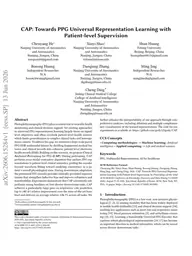
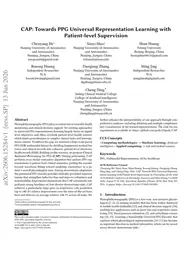
Photoplethysmography (PPG) plays a central role in wearable health monitoring and clinical decision support. Yet existing approaches to universal PPG representation learning largely focus on signal-level objectives and often overlook patient-level health context, which limits generalization to complex clinical tasks and heterogeneous cohorts. To address this gap, we construct a large-scale paired PPG-EHR multimodal dataset by distilling fragmented medical histories and clinical records into cohesive, patient-level electronic health records (EHR). Building on this resource, we propose Clinical Anchored Pretraining for PPG (CAP). During pretraining, CAP performs cross-modal contrastive alignment that anchors PPG representations to patient-level clinical semantics, guiding the encoder beyond waveform fitting toward modeling consistency in a patient's overall physiological state. During downstream adaptation, the pretrained PPG encoder provides clinically grounded representations that strengthen inductive bias and improve robustness and transferability. Experiments demonstrate that CAP consistently outperforms strong baselines on four diverse downstream tasks. CAP achieves a particularly large gain on respiratory rate prediction (up to +87.6% relative improvement over the state-of-the-art baseline) and delivers an average relative +26.7% across all tasks. We further enhance the interpretability of our approach through comprehensive analyses, including ablations and multiple complementary visualizations of the learned representations. The code for our experiments is available at: https://github.com/gody123gody/CAP .
Verbatim fromarXiv· arXiv metadata (abstracts are released under CC0)
How it works
Datasets linked in the hub; pretraining vs evaluation roles follow the paper.
Architecture
Pretrained PPG patch encoder (type not named in the paper) + ResNet-18 local encoder on [PPG, dPPG, d2PPG] at fine-tune, gated fusion; MedCPT text tower for the PPG-EHR contrastive loss
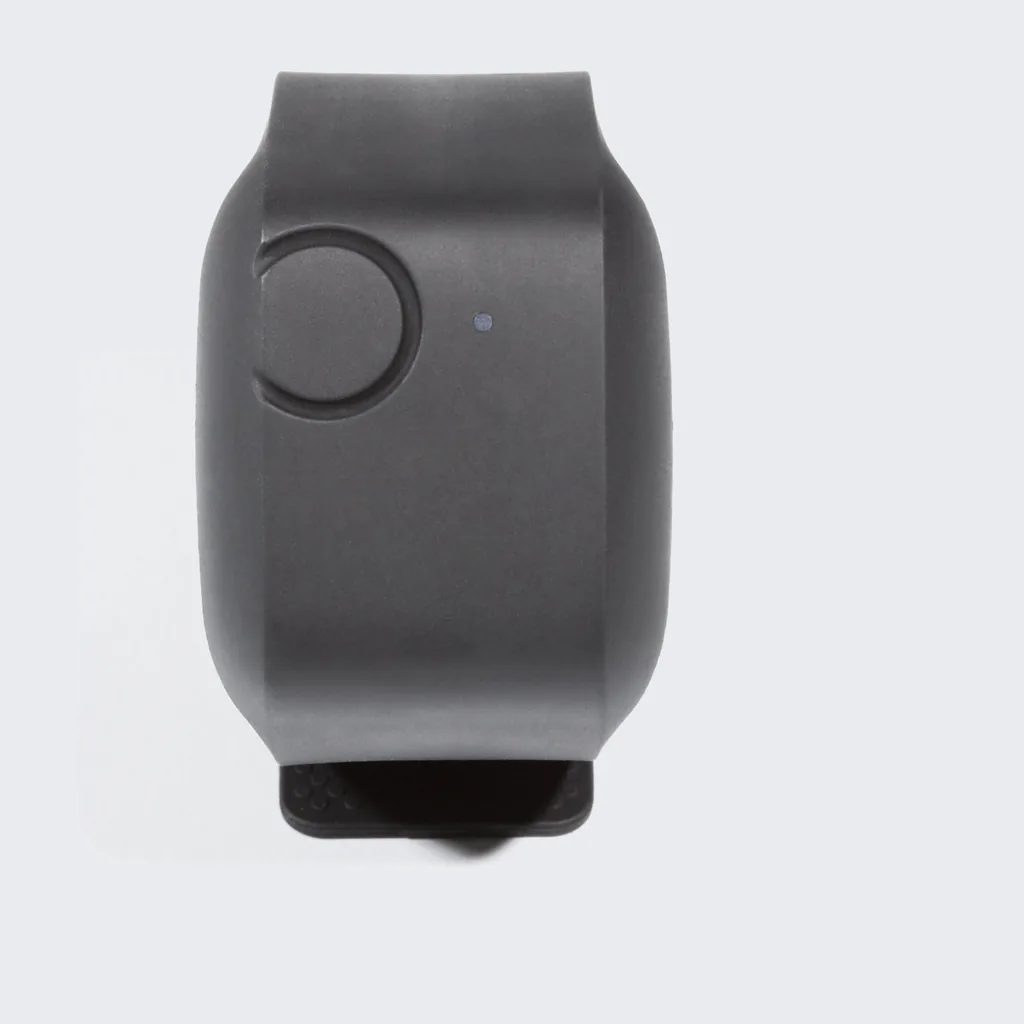
Full photo credits and licences are on each device page. An icon means we have no openly licensed or manufacturer-cleared photo of that exact device yet.
Cite the publication recorded for this model. Check it against the publisher before submitting.
He, C., Shao, X., Huang, S., Huang, B., Zhang, D., Jing, M., & Ding, C. (2026). CAP: Towards PPG Universal Representation Learning with Patient-level Supervision. KDD 2026 , Aug 9–13, 2026. https://doi.org/10.1145/3770855.3818881
He, Chenyang, Xinyi Shao, Shun Huang, Bosong Huang, Daoqiang Zhang, Ming Jing, and Cheng Ding. 2026. "CAP: Towards PPG Universal Representation Learning with Patient-level Supervision." KDD 2026 , Aug 9–13, 2026. https://doi.org/10.1145/3770855.3818881.
He, C., Shao, X., Huang, S., Huang, B., Zhang, D., Jing, M. and Ding, C. (2026) 'CAP: Towards PPG Universal Representation Learning with Patient-level Supervision', KDD 2026 , Aug 9–13, 2026. doi: 10.1145/3770855.3818881.
He, Chenyang, et al. "CAP: Towards PPG Universal Representation Learning with Patient-level Supervision." KDD 2026 , Aug 9–13, 2026, 2026. https://doi.org/10.1145/3770855.3818881.
C. He et al., "CAP: Towards PPG Universal Representation Learning with Patient-level Supervision," KDD 2026 , Aug 9–13, 2026, 2026, doi: 10.1145/3770855.3818881.
@inproceedings{he2026cap,
  title         = {{CAP: Towards PPG Universal Representation Learning with Patient-level Supervision}},
  author        = {He, Chenyang and Shao, Xinyi and Huang, Shun and Huang, Bosong and Zhang, Daoqiang and Jing, Ming and Ding, Cheng},
  year          = {2026},
  booktitle     = {KDD 2026 , Aug 9–13, 2026},
  doi           = {10.1145/3770855.3818881},
  eprint        = {2606.15284},
  archivePrefix = {arXiv}
}
History
Record updated
Added to the ChatPPG research hub
Newsletter
Get new PPG datasets, papers and models
Get alerts when CAP is benchmarked on new datasets, plus the weekly digest.
New datasets, papers and models
Practical guides from the hub
Unsubscribe anytime
The waveform is an illustration of a PPG pulse, not a recording.