Wearable SpO2 Accuracy Comparison: What Studies Show for Consumer Devices
How accurate are consumer wearable SpO2 sensors? Comparing Apple Watch, Fitbit, Garmin, Samsung, and Oura Ring blood oxygen accuracy against clinical pulse oximeters.
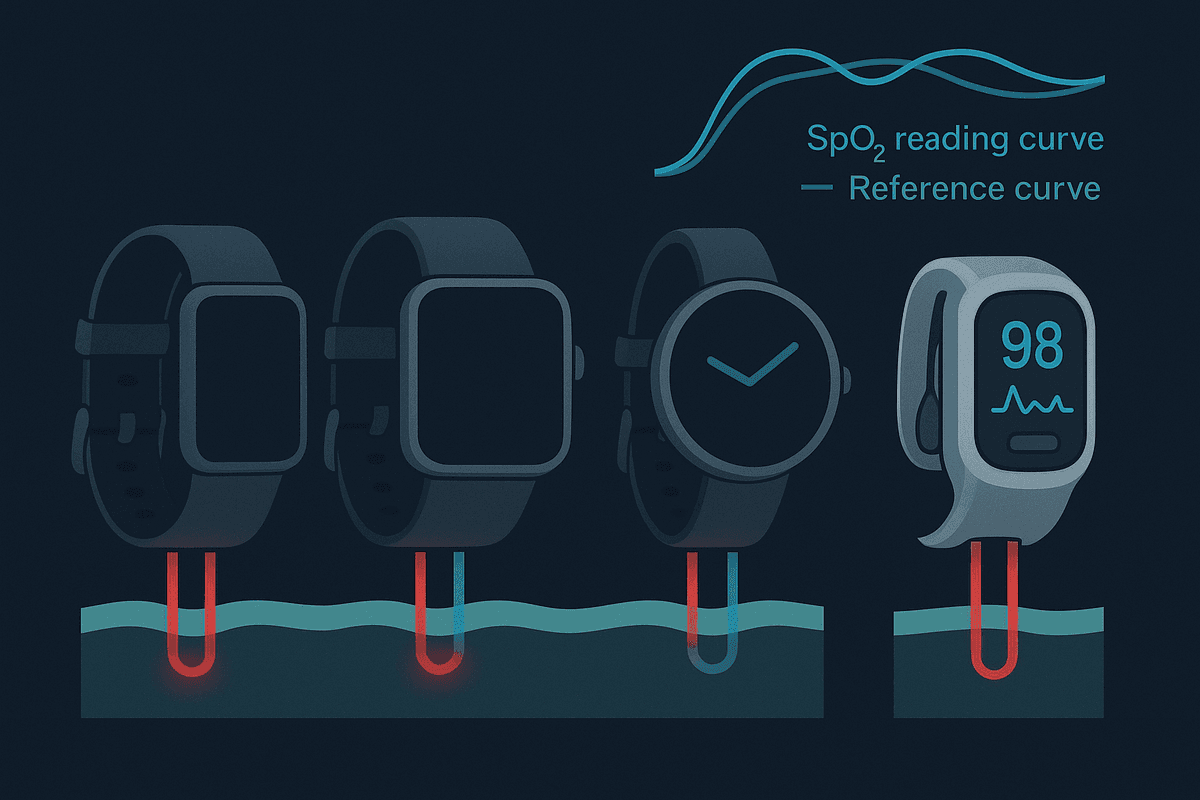
Consumer wearable SpO2 sensors show mean errors of 1-4% compared to clinical pulse oximeters under optimal conditions. That sounds acceptable, but the accuracy drops meaningfully during movement, at low SpO2 values, and for darker skin tones. No consumer smartwatch is an adequate replacement for a medical pulse oximeter when accuracy matters clinically.
How Consumer Wearables Measure Blood Oxygen
Blood oxygen saturation (SpO2) is measured using the same PPG technology used for heart rate, but with an added twist. Standard PPG uses green light for heart rate because it has strong absorption by hemoglobin. SpO2 measurement requires comparing absorption at two wavelengths: red (~660 nm) and near-infrared (~940 nm).
Oxygenated hemoglobin and deoxygenated hemoglobin absorb light differently at these two wavelengths. By comparing the ratio of red to infrared absorption, the device estimates the fraction of hemoglobin carrying oxygen. This is the same principle used in clinical finger pulse oximeters, just implemented in a wrist or ring form factor.
The challenge: wrist and ring sensors are not as well-positioned for SpO2 measurement as finger sensors. Fingers have a thicker capillary bed, better light penetration, and less ambient light interference. Moving the sensor to the wrist introduces more noise and reduces signal quality for the infrared wavelengths used in SpO2 sensing.
For a deeper explanation of the optical physics, see PPG SpO2 accuracy limitations.
Validation Studies: What the Research Shows
Apple Watch
Apple Watch Series 6 was the first Apple Watch with the Blood Oxygen app. Apple describes it as a fitness-and-wellness feature that is not intended for medical use; it was not FDA-cleared as a medical pulse oximeter.
Independent validation studies on Apple Watch SpO2 show:
- Mean absolute errors of 1-2% when SpO2 is in the normal range (95-100%)
- Increased error at SpO2 below 90%, with some studies showing 3-5% overestimation at low saturation
- Higher variability during movement than at rest
- Skin tone bias: overestimation of SpO2 in darker skin tones (Fitzpatrick 5-6), consistent with literature on PPG systems generally
Fitbit (Sense, Charge 5/6, Versa series)
Fitbit introduced SpO2 monitoring across several devices. Fitbit's SpO2 is primarily oriented toward overnight sleep monitoring (estimated oxygen variation, or "SpO2 variation" rather than absolute values on some models).
Validation data is limited compared to Apple Watch. Available studies suggest:
- At rest, Fitbit SpO2 readings show mean errors of 2-4% for normal range values
- Overnight average SpO2 shows moderate correlation with clinical oximetry
- Individual spot readings have high variability
Garmin
Garmin's Pulse Ox sensor is available on most of their fitness and running watches. Like Fitbit, Garmin uses SpO2 primarily for altitude adaptation tracking and sleep monitoring.
Garmin's SpO2 accuracy studies show similar patterns: mean errors of 2-4% in normal range at rest, worse during activity. Garmin explicitly recommends against using Pulse Ox for clinical purposes.
Samsung Galaxy Watch
Samsung's SpO2 monitoring has FDA registration as a wellness indicator only. Accuracy data from independent validation is limited but suggests performance similar to Garmin and Fitbit at rest.
Oura Ring
Oura Ring 3 and 4 include SpO2 monitoring primarily used for sleep breathing disturbance detection. The ring form factor's advantages for optical sensing (better capillary access than wrist) help SpO2 accuracy at rest. Oura's blood oxygen feature tracks average SpO2 and variation during sleep.
Studies validating Oura Ring SpO2 specifically against arterial blood gas samples are limited. The ring performs comparably to wrist devices for overnight average SpO2, with good correlation to clinical values in normal SpO2 ranges.
The Skin Tone Problem Is Serious
The skin tone accuracy gap for SpO2 devices deserves particular emphasis. A landmark study published in NEJM in 2020 found that Black patients were roughly three times more likely to have occult hypoxemia (true low SpO2 undetected by pulse oximeter) than white patients. This was measured with clinical finger pulse oximeters, not consumer wearables.
The underlying issue: conventional pulse oximetry uses red and infrared wavelengths that are absorbed differently by melanin in darker skin. The device interprets some of this melanin absorption as oxygenated hemoglobin, leading to overestimation of SpO2 in darker skin.
Consumer wearables have this same problem, and it may be more pronounced due to their less rigorous calibration. A 2024 FDA advisory panel noted that consumer wearable SpO2 accuracy studies have largely been conducted in light-skinned populations, making accuracy data for diverse populations unreliable.
For detailed analysis of this issue and its clinical implications, see PPG skin tone bias and accuracy.
What Consumer SpO2 Is and Is Not Good For
Useful applications:
-
Altitude monitoring: Tracking how SpO2 changes as you gain altitude helps with altitude adaptation decisions. Consumer wearables can identify significant drops (e.g., SpO2 dropping below 90% at altitude).
-
Sleep breathing trends: Detecting regular nocturnal desaturations (SpO2 consistently dropping below 93-94% during sleep) that might indicate sleep apnea. Not diagnostic, but a useful screening indicator to discuss with a doctor. See PPG sleep apnea detection.
-
General wellness awareness: Tracking that your normal baseline SpO2 is consistently in the 96-100% range provides general reassurance, with the caveats about skin tone bias noted above.
Not adequate for:
- Diagnosing hypoxemia in clinical settings
- Monitoring patients with COPD, heart failure, or other conditions where SpO2 management is medically critical
- Replacing clinical pulse oximetry in any healthcare setting
- Making medication or treatment decisions
For patients with conditions like COPD who need SpO2 monitoring, a validated medical-grade pulse oximeter (not a consumer wearable) is necessary. See the pulse oximeter for COPD guide.
Spot Check vs. Continuous SpO2 Monitoring
An important distinction in how consumer wearables implement SpO2 monitoring:
Spot check (on-demand): User manually requests an SpO2 reading. The device takes a 15-30 second measurement and returns a value. Less battery intensive, slightly more accurate than continuous monitoring.
Continuous overnight monitoring: Device tracks SpO2 throughout sleep. Uses significantly more battery. Returns trend data showing overnight variation. Apple Watch, Fitbit, Garmin, and Oura Ring all offer this.
Continuous during activity: Some devices attempt real-time SpO2 during exercise. Accuracy during movement is substantially lower than at rest due to motion artifacts.
For clinical applications like COPD monitoring where ambulatory SpO2 tracking over 24+ hours is needed, dedicated medical devices (ambulatory pulse oximeters) with clinical validation are the appropriate choice. The PPG ambulatory oxygen saturation monitoring article covers this area.
The Future of Consumer SpO2 Accuracy
Manufacturers are working to improve SpO2 accuracy through:
- Multi-wavelength sensing: Adding more LED wavelengths (green, yellow, orange, red, near-infrared) reduces the ambiguity in SpO2 estimation and can improve accuracy across skin tones
- Better calibration methods: Some manufacturers are exploring individual calibration approaches
- AI-based correction: Machine learning algorithms trained on diverse populations can partially correct for skin tone bias
Regulatory pressure has increased. The FDA has indicated it is examining accuracy requirements for consumer pulse oximetry more closely following the COVID-19 pandemic, during which patient overreliance on consumer SpO2 devices had clinical consequences.
References
-
Sjoding MW, et al. "Racial bias in pulse oximetry measurement." New England Journal of Medicine 383:2477-2478 (2020). doi:10.1056/NEJMc2029240
-
Luks AM, Swenson ER. "Pulse oximetry for monitoring patients with COVID-19 at home." Annals of the American Thoracic Society 17(9):1040-1046 (2020). doi:10.1513/AnnalsATS.202005-418FR
-
Pipinos II, et al. "Assessment of continuous overnight pulse oximetry accuracy with consumer wearables." Sleep Medicine 91:147-155 (2022). doi:10.1016/j.sleep.2022.02.007
-
Bent B, et al. "Investigating sources of inaccuracy in wearable optical heart rate sensors." npj Digital Medicine 3:18 (2020). doi:10.1038/s41746-020-0226-6
-
Teboul JL, et al. "Wearable sensors for monitoring SpO2: technical performance and clinical limitations." Annals of Intensive Care 12:67 (2022). doi:10.1186/s13613-022-01037-1
Frequently Asked Questions
- How accurate are wearable SpO2 sensors compared to clinical pulse oximeters?
- Consumer wearables typically show mean absolute errors of 1-4% for SpO2 compared to clinical pulse oximeters. For healthy individuals with SpO2 between 95-100%, this is generally adequate for trend monitoring. For detecting clinically significant hypoxemia (SpO2 below 90%), accuracy drops and false readings are more common.
- Which smartwatch has the most accurate SpO2 sensor?
- Based on available validation data, Apple Watch Series 6 and newer show the most consistent SpO2 accuracy among consumer wearables. Clinical-grade pulse oximeters remain far more accurate and are not equivalent to smartwatch sensors.
- Can a smartwatch detect low blood oxygen?
- Consumer wearables can detect marked drops in SpO2 during sleep (like those seen with sleep apnea) as a general indicator, but they should not be used to diagnose or monitor clinical hypoxemia. For any concerning SpO2 readings, a validated clinical pulse oximeter or medical evaluation is needed.
- Why are wearable SpO2 sensors less accurate than medical pulse oximeters?
- Medical pulse oximeters use two wavelengths (red and infrared) optimized for SpO2 measurement, are calibrated against arterial blood gas samples, and are worn on fingertips with dense capillary beds. Consumer wearables add SpO2 to devices optimized primarily for heart rate, use different form factors, and lack the same calibration depth.
- Is wearable SpO2 useful for sleep apnea screening?
- Consumer SpO2 wearables can identify nocturnal desaturation patterns consistent with sleep apnea as a screening indicator, but they are not FDA-cleared for diagnosing sleep apnea and should not replace formal sleep studies (polysomnography) for diagnosis.
- Does skin tone affect wearable SpO2 accuracy?
- Yes, significantly. Studies have found that pulse oximeters (both clinical and consumer) overestimate SpO2 in patients with darker skin, with differences of 3-5% or more. This is a well-documented problem with conventional red/infrared optical methods.
- How does altitude affect wearable SpO2 accuracy?
- At altitude, true SpO2 drops. Consumer wearables can detect this trend, though the absolute accuracy may be reduced. SpO2 readings below 90% at altitude may be real physiology, not device error, but confirmation with a validated oximeter is recommended.