Paperdoi:10.7507/1001-5515.202606042
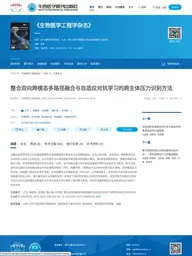
A cross-subject stress recognition method integrating bidirectional cross-modal multi-path fusion and adaptive adversarial learning (WESAD; in Chinese)
Sheng Wu Yi Xue Gong Cheng Xue Za Zhi (J Biomed Eng) 43(5):938-946, 2026-10-25
TL;DR
This Journal of Biomedical Engineering article proposes multimodal stress recognition with bidirectional cross-modal multi-path fusion and subject-adversarial learning on WESAD. The English abstract reports 91.58 percent cross-subject accuracy with ablation studies. Exact WESAD channels, the binary versus multi-class label scheme, and the cross-subject split protocol are not stated in the English abstract; the full text is in Chinese.
- Form factor: chest/wrist (WESAD)
Abstract
Multimodal physiological signal-based stress recognition faces challenges in cross-modal correlation modeling and limited cross-subject generalization. To address these issues, this paper proposes a cross-modal interaction and adversarial learning-based stress recognition method. First, a bidirectional cross-modal-cross-view multi-path fusion module is designed, which enables multimodal feature interaction and aggregation through six cross-modal pairwise combinations, multi-path modeling, and adaptive gating. Furthermore, a subject adversarial learning mechanism based on state-adaptive gradient reversal is proposed to dynamically adjust the adversarial strength and suppress subject-specific information in the fused representations. Meanwhile, a joint optimization strategy integrating classification, six-view contrastive learning, and subject adversarial learning is constructed to collaboratively enhance stress discriminability, cross-view consistency, and subject invariance. Experiments conducted on the publicly available Wearable Stress and Affect Detection (WESAD) dataset demonstrate that the proposed method achieves a cross-subject recognition accuracy of 91.58%. Comparative and ablation studies further validate its effectiveness in cross-subject stress recognition. This study provides a new solution for cross-modal information fusion and subject-invariant representation learning in multimodal physiological signal-based stress recognition and offers methodological references for the development of wearable intelligent stress monitoring systems.
Verbatim from Europe PMC (opens in a new tab) · Abstract via Europe PMC; © the authors/publisher
Results on ChatPPG leaderboards · 1
All leaderboards| Leaderboard | Method | Result | Rank |
|---|---|---|---|
| WESAD accuracyStress detection (acute / prolonged / affect) | A cross-subject stress recognition method integr | 0.9158accuracy, higher is better | #1 of 2 |
1 row is credited to this paper. Ranks apply within each leaderboard only, as reported by the source.
Tasks & signals
Tasks
Signals
Devices
Keywords
Datasets

How it works
Cite this paper
APA
A cross-subject stress recognition method integrating bidirectional cross-modal multi-path fusion and adaptive adversarial learning (WESAD; in Chinese). (2026). Sheng Wu Yi Xue Gong Cheng Xue Za Zhi. https://doi.org/10.7507/1001-5515.202606042
BibTeX
@article{wangcrosssubject2026crosssubject,
  title         = {{A cross-subject stress recognition method integrating bidirectional cross-modal multi-path fusion and adaptive adversarial learning (WESAD; in Chinese)}},
  year          = {2026},
  journal       = {Sheng Wu Yi Xue Gong Cheng Xue Za Zhi},
  doi           = {10.7507/1001-5515.202606042}
}
Built from the hub record. Check it against the publisher before submitting.
Added to the ChatPPG research hub