Cite this dataset
CLAS [Data set]. (n.d.). ieee-dataport. https://doi.org/10.21227/ybsw-yr53
@misc{clasclas,
  title         = {{CLAS}},
  howpublished  = {ieee-dataport},
  doi           = {10.21227/ybsw-yr53}
}Cognitive Load, Affect and Stress (Shimmer ECG/PPG/EDA)
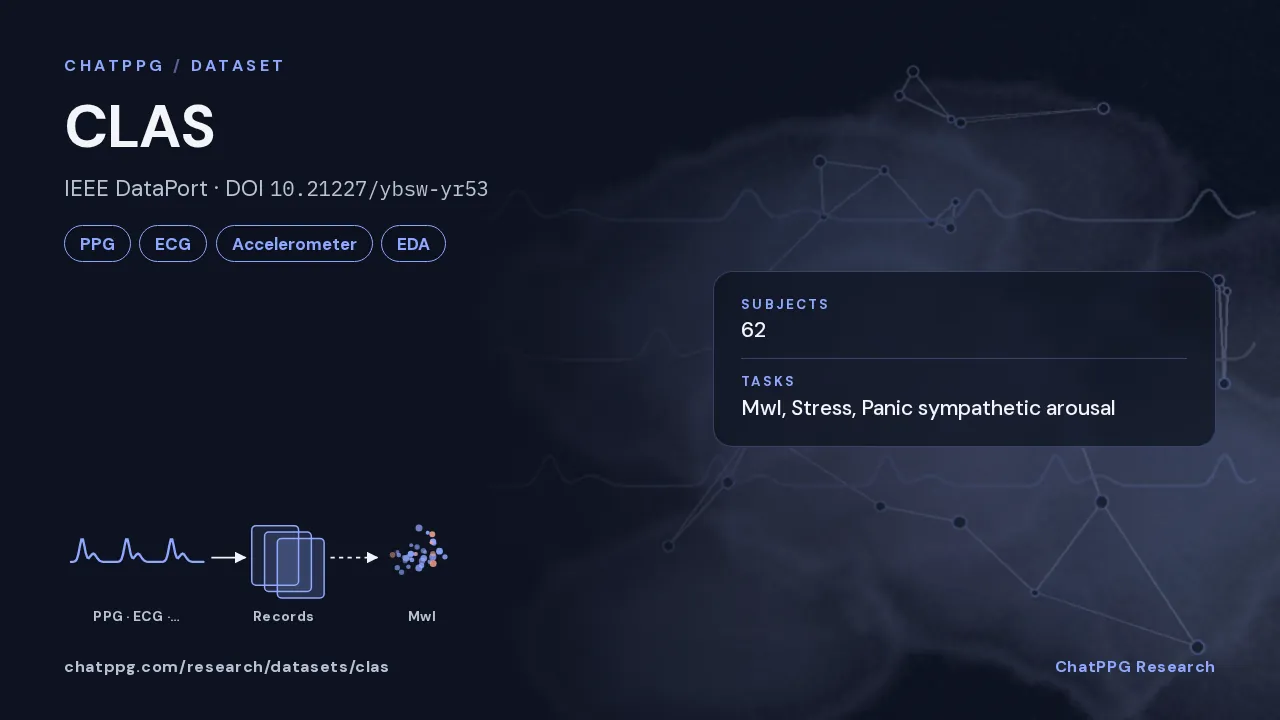
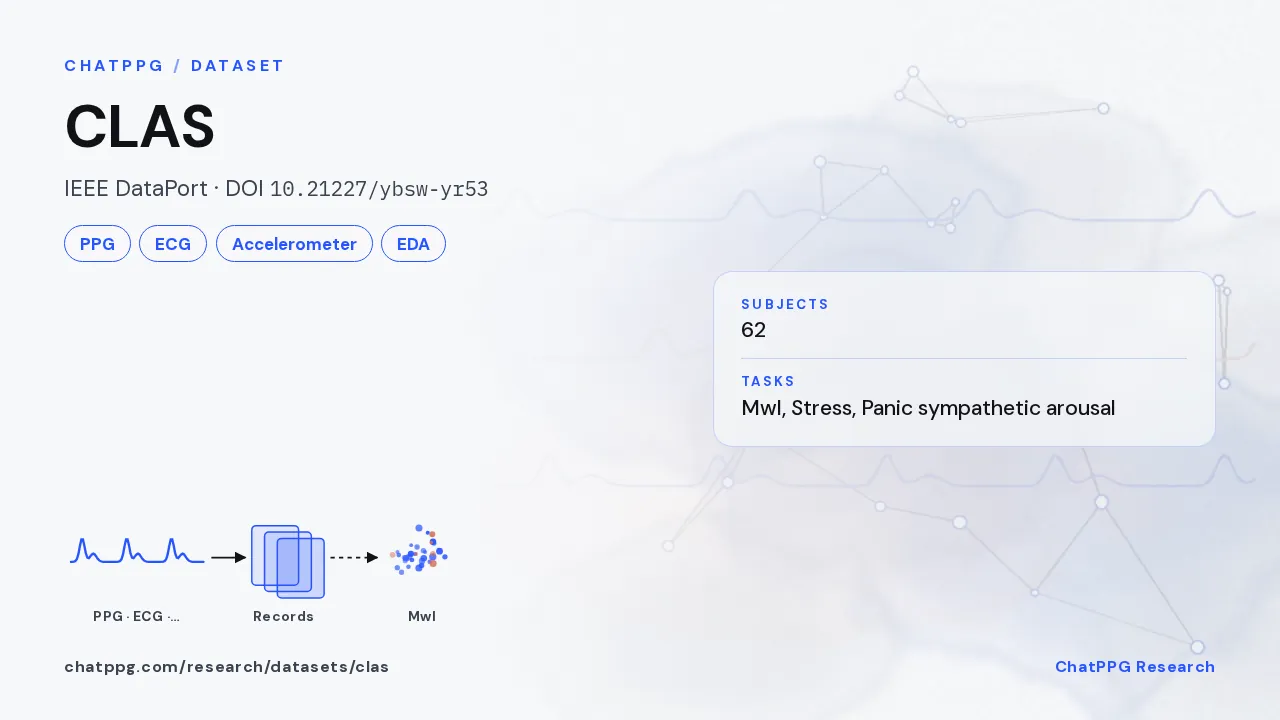
CLAS (Cognitive Load, Affect and Stress) supports automated recognition of emotion, stress, and cognitive load. Authors: Markova / Ganchev / Kalinkov (TU Varna). Paper: BIA-2019 10.1109/BIA48344.2019.8967457.
The CLAS (Cognitive Load, Affect and Stress) dataset was conceived as a freelyaccessible repository which is purposely developed to support research on the automated assessment of certain states of mind and the emotional condition of a person. This resource is intended to support RTD activities aiming at the development of intelligent human computer interaction (HCI) interfaces that incorporate functionalities allowing for the automated recognition of human emotions, the automated detection of stress conditions, the automated assessment of the degree of concentration, cognitive load, and momentary cognitive capacity, and can account for some personality traits related to the ability to quickly solve logical and mathematical problems under strict time constraints. The dataset consists of synchronized recordings of physiological signals, such as Electrocardiography (ECG), Plethysmography (PPG), ElectroDermal Activity (EDA), as well as accelerometer data, and metadata of 62 healthy volunteers, which were recorded while involved in three interactive tasks and two perceptive tasks. The interactive tasks aim to elicit different types of cognitive effort and included solving sequences of Math problems, Logic problems and the Stroop test. The perceptive tasks make use of images and audio-video stimuli, purposely selected to evoke emotions in the four quadrants of the arousalvalence space.
Verbatim fromDataCite· Licence: https://creativecommons.org/licenses/by/4.0
No model in the hub reports results on this dataset yet.
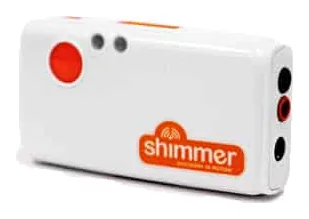
Full photo credits and licences are on each device page. An icon means we have no openly licensed or manufacturer-cleared photo of that exact device yet.
| Task | Dataset | Metric | Value | Rank |
|---|---|---|---|---|
| Emotion recognition (valence/arousal) | CLAS | f1_score ↑ | 0.63 | #1 / 2 |
| Emotion recognition (valence/arousal) | CLAS | f1_score ↑ | 0.61 | #2 / 2 |
| Emotion recognition (valence/arousal) | CLAS | f1_score ↑ | 0.70 | #1 / 2 |
| Emotion recognition (valence/arousal) | CLAS | f1_score ↑ | 0.66 | #2 / 2 |
| Emotion recognition (valence/arousal) | CLAS | f1_score ↑ | 0.459 | #1 / 2 |
| Emotion recognition (valence/arousal) | CLAS | f1_score ↑ | 0.408 | #2 / 2 |
#131 of 186 most-used datasets by published papers and models · #65 of 88 PPG · #59 of 78 ECG · #59 of 84 IMU · #11 of 15 EDA
CLAS has data from 62 subjects, as listed in its research record.
CLAS includes PPG, ECG, accelerometer and EDA data. Raw waveforms are included.
Research tasks it supports: mental workload assessment and stress detection. Reference labels: stress and mental workload.
It is hosted on IEEE DataPort at https://ieee-dataport.org/open-access/database-cognitive-load-affect-and-stress-recognition. No licence is recorded for it here, so check the terms on the source page before you use it.
CLAS [Data set]. (n.d.). ieee-dataport. https://doi.org/10.21227/ybsw-yr53
@misc{clasclas,
title = {{CLAS}},
howpublished = {ieee-dataport},
doi = {10.21227/ybsw-yr53}
}Cite the dated snapshot 2026-10 for a fixed, reproducible version. Please also cite the original publications listed above.
ChatPPG. (2026). CLAS: dataset record (Version 2026-10) [Data set]. ChatPPG Research Hub. https://chatppg.com/research/datasets/clas
@misc{chatppg_dataset_clas,
  author       = {{ChatPPG}},
  title        = {{CLAS: dataset record}},
  year         = {2026},
  month        = nov,
  version      = {2026-10},
  howpublished = {\url{https://chatppg.com/research/datasets/clas}},
  note         = {ChatPPG Research Hub, Snapshot 2026-10, https://chatppg.com/research/snapshots/2026-10}
}cff-version: 1.2.0 message: "If you use this resource, please cite it as below." type: dataset title: "CLAS: dataset record" authors: - name: "ChatPPG" url: "https://chatppg.com/research/datasets/clas" repository-artifact: "https://chatppg.com/research/snapshots/2026-10" version: "2026-10" date-released: "2026-11-20"
Record updated
 Cross-Modal Correlation Fusion for End-to-End ECG–PPG Stress ClassificationSame task: Mental workloadFrontiers in Artificial Intelligence and A · 2026
 ESCOLARSame task: Mental workloadEmotiBit academic stress + cognitive load26 subjects · PPG · IMU · EDA
 WARM-VRSame task: Mental workloadEmpatica E4 BVP/EDA/TEMP/ACC + Polar H10 ECG during VR stress and multisensory relaxation (n=28)28 subjects · PPG · ECG · IMU