Activity counts measure attention, not model quality. Missing counts are unknown. Publication status follows the linked source; a listed venue alone does not confirm peer review.
LODO pretraining + subject-disjoint fine-tune on 5 HAR benchmarks: mean macro-F1 0.724 vs 0.688 scratch; HHAR 0.823 vs 0.741; held-out device +0.066; 50% channel removal keeps 73.8% vs 64.1%. No board row until per-dataset tables are checked.
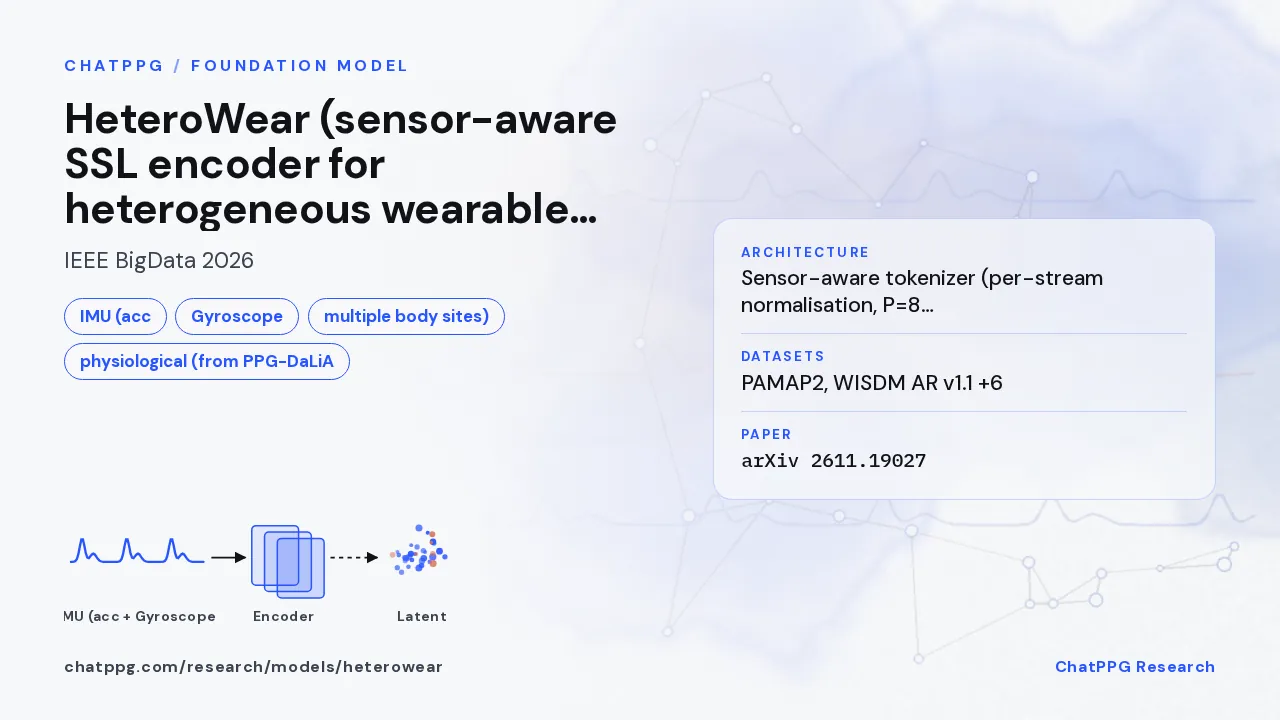
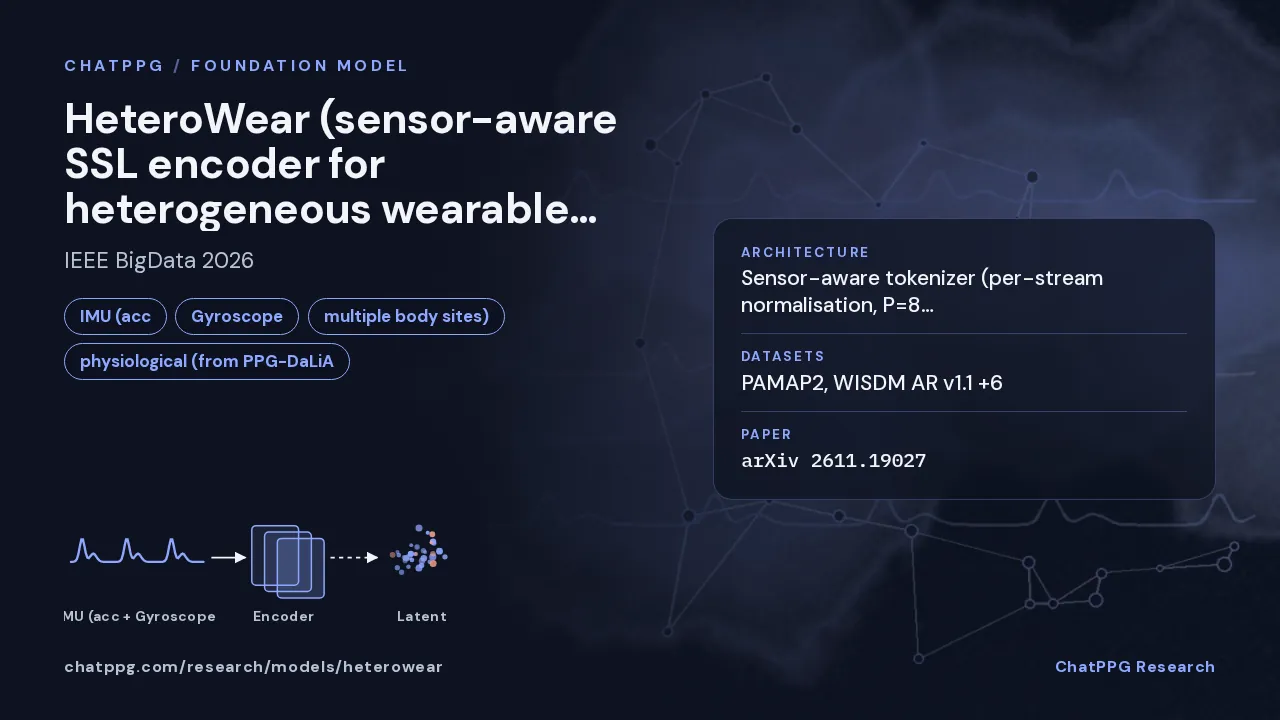
Self-supervised learning for wearable sensing is usually confined to a single dataset or device family, leaving open whether representations transfer across heterogeneous sensor configurations and whether gains come from pretraining rather than architecture or richer sensor input. We present HeteroWear, a sensor-aware self-supervised framework pretrained on an eight-dataset wearable corpus (173 subjects, 358,261 windows) spanning inertial and physiological signals across body locations, devices, and sampling rates. HeteroWear separates within-sensor temporal modeling from cross-sensor relational modeling using sensor-context embeddings, temporal and cross-sensor Transformers, and latent cross-attention fusion. Training combines structured sensor dropout, cross-configuration consistency, and per-axis masked sensor modeling; missing sensors are omitted rather than reconstructed. Under leave-one-dataset-out pretraining and subject-disjoint evaluation on PAMAP2, WISDM, HHAR, HARTH, and UCI-HAR, HeteroWear improves mean macro-F1 from 0.688 to 0.724 over the identical architecture trained from scratch, with the largest gain on HHAR (0.823 versus 0.741), and achieves the highest macro-F1 on four of five benchmarks relative to single-accelerometer supervised baselines. Held-out-device evaluation yields a mean +0.066 macro-F1 improvement. Under 50% test-time channel removal, HeteroWear retains 73.8% of full-channel performance versus 64.1% for the same architecture trained from scratch without sensor dropout. Ablations show that structured sensor dropout primarily drives robustness, while cross-configuration consistency and sensor-context encoding contribute to transfer.
Verbatim fromarXiv· arXiv metadata (abstracts are released under CC0)
Key results
0.724
F1
LODO pretraining + subject-disjoint fine-tune on 5 HAR benchmarks: mean macro-F1 0.724 vs 0.688 scratch
How it works
Datasets linked in the hub; pretraining vs evaluation roles follow the paper.
Full photo credits and licences are on each device page. An icon means we have no openly licensed or manufacturer-cleared photo of that exact device yet.
Cite the publication recorded for this model. Check it against the publisher before submitting.
Mohammadpour, Y., & Shaeri, P. (2026). HeteroWear: Sensor-Aware Self-Supervised Learning for Heterogeneous Wearable Activity Recognition. IEEE BigData 2026. https://arxiv.org/abs/2611.19027
Mohammadpour, Yasaman and Pouya Shaeri. 2026. "HeteroWear: Sensor-Aware Self-Supervised Learning for Heterogeneous Wearable Activity Recognition." IEEE BigData 2026. https://arxiv.org/abs/2611.19027.
Mohammadpour, Y. and Shaeri, P. (2026) 'HeteroWear: Sensor-Aware Self-Supervised Learning for Heterogeneous Wearable Activity Recognition', IEEE BigData 2026. Available at: https://arxiv.org/abs/2611.19027
Mohammadpour, Yasaman, and Pouya Shaeri "HeteroWear: Sensor-Aware Self-Supervised Learning for Heterogeneous Wearable Activity Recognition." IEEE BigData 2026, 2026. https://arxiv.org/abs/2611.19027.
Y. Mohammadpour and P. Shaeri, "HeteroWear: Sensor-Aware Self-Supervised Learning for Heterogeneous Wearable Activity Recognition," IEEE BigData 2026, 2026, [Online]. Available: https://arxiv.org/abs/2611.19027.
@article{mohammadpour2026heterowear,
  title         = {{HeteroWear: Sensor-Aware Self-Supervised Learning for Heterogeneous Wearable Activity Recognition}},
  author        = {Mohammadpour, Yasaman and Shaeri, Pouya},
  year          = {2026},
  journal       = {IEEE BigData 2026},
  eprint        = {2611.19027},
  archivePrefix = {arXiv}
}
History
Added to the ChatPPG research hub
Newsletter
Get new PPG datasets, papers and models
Get alerts when HeteroWear (sensor-aware SSL encoder for heterogeneous wearable HAR) is benchmarked on new datasets, plus the weekly digest.
New datasets, papers and models
Practical guides from the hub
Unsubscribe anytime
The waveform is an illustration of a PPG pulse, not a recording.