Paperdoi:10.3389/fphys.2026.1881803
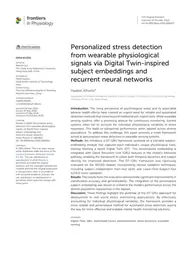
Personalized stress detection from wearable physiological signals via Digital Twin-inspired subject embeddings and recurrent neural networks
Frontiers in Physiology, published 2026-10-15
 (opens in a new tab)
Hadeel Alharbi, "Personalized stress detection from wearable physiological signals via Digital Twin-inspired subject embeddings and recurrent neural networks", doi:10.3389/fphys.2026.1881803, CC BY 4.0
TL;DR
A GRU over wearable signals plus a trainable per-subject embedding (the "latent digital twin") fused into the inference path. Evaluated on WESAD with subject-independent splits and LOSO.
- Form factor: multi-site
Abstract
Introduction
The rising prevalence of psychological stress and its associated adverse health effects have created an urgent need for reliable and automated detection methods that move beyond traditional self-report tools. While wearable sensing systems offer a promising avenue for continuous monitoring, current systems often fail to account for individual physiological variability in stress responses. This leads to suboptimal performance when applied across diverse populations. To address this challenge, this paper presents a novel framework aimed at personalized stress detection in wearable sensing systems.
Methods
We introduce a DT-GRU framework centered on a trainable subject-embedding module that captures each individual’s unique physiological traits, thereby forming a latent Digital Twin (DT). This personalized embedding is integrated with Gated Recurrent Unit (GRU) features in the model's inference pathway, enabling the framework to utilize both temporal dynamics and subject identity for improved detection. The DT-GRU framework was rigorously evaluated on the WESAD dataset, incorporating various validation techniques, including subject-independent train-test splits and Leave-One-Subject-Out (LOSO) cross-validation.
Results
The results from the evaluation demonstrate significant improvements in classification accuracy and generalizability. The integration of the personalized subject-embedding was shown to enhance the model’s performance across the diverse population represented in the dataset.
Discussion
These findings highlight the potential of the DT-GRU approach for deployment in real-world stress monitoring applications. By effectively accounting for individual physiological variability, the framework provides a more reliable and personalized method for automated stress detection, paving the way for more effective and scalable mental health monitoring solutions.
Verbatim from the publisher's DOI record (opens in a new tab) · Publisher licence: https://creativecommons.org/licenses/by/4.0/
Results on ChatPPG leaderboards
All leaderboardsNo results from this paper on ChatPPG leaderboards yet. Browse the leaderboards.
Tasks & signals
Tasks
Signals
Devices
Keywords
Datasets used

How it works
Cite this paper
Alharbi, H. (2026). Personalized stress detection from wearable physiological signals via Digital Twin-inspired subject embeddings and recurrent neural networks. Frontiers in Physiology. https://doi.org/10.3389/fphys.2026.1881803
Alharbi, Hadeel. 2026. "Personalized stress detection from wearable physiological signals via Digital Twin-inspired subject embeddings and recurrent neural networks." Frontiers in Physiology. https://doi.org/10.3389/fphys.2026.1881803.
Alharbi, H. (2026) 'Personalized stress detection from wearable physiological signals via Digital Twin-inspired subject embeddings and recurrent neural networks', Frontiers in Physiology. doi: 10.3389/fphys.2026.1881803.
Alharbi, Hadeel "Personalized stress detection from wearable physiological signals via Digital Twin-inspired subject embeddings and recurrent neural networks." Frontiers in Physiology, 2026. https://doi.org/10.3389/fphys.2026.1881803.
H. Alharbi, "Personalized stress detection from wearable physiological signals via Digital Twin-inspired subject embeddings and recurrent neural networks," Frontiers in Physiology, 2026, doi: 10.3389/fphys.2026.1881803.
@article{alharbi2026personalized,
  title         = {{Personalized stress detection from wearable physiological signals via Digital Twin-inspired subject embeddings and recurrent neural networks}},
  author        = {Alharbi, Hadeel},
  year          = {2026},
  journal       = {Frontiers in Physiology},
  doi           = {10.3389/fphys.2026.1881803}
}Added to the ChatPPG research hub