PaperarXiv:2610.07499
Source-Learned Reliance for Selective Test-Time Adaptation of Multimodal Time Series (CARAT)
arXiv preprint
 (opens in a new tab)
Mohapatra, Payal et al., "Source-Learned Reliance for Selective Test-Time Adaptation of Multimodal Time Series", arXiv:2610.07499, CC BY 4.0
TL;DR
Test-time adaptation for multimodal wearables when individual streams (wrist BVP/PPG, ACC, EDA, temp, chest ECG…) become noisy or drop out. During source training an asymmetric modality-dropout curriculum drops each modality in proportion to its windowed input-projection gradient norm; the terminal per-modality dropout rate is frozen as a reliance profile. At deployment a lightweight one-class detector (FITS reconstruction residuals + log-spectral distance vs.
- Form factor: wrist
Abstract
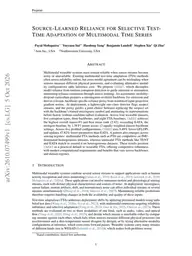
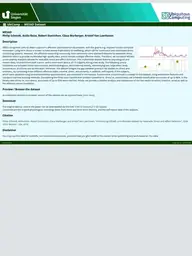
Multimodal wearable systems must remain reliable when sensor streams become noisy or unavailable. Existing multimodal test-time adaptation (TTA) methods often assess reliability online, but cross-modal agreement can be misleading when sensors measure different physical processes, and evaluating alternative modality configurations adds inference cost. We propose CARAT, which decouples model reliance from runtime corruption detection to guide omission or attenuation, amortizing reliance estimation through source training. An asymmetric modality-dropout curriculum prepares a missingness-resilient backbone for omission and derives a frozen, backbone-specific reliance proxy from windowed input-projection gradient norms. At deployment, a lightweight one-class detector flags suspect streams, and the proxy guides a joint choice between replacing the suspect set with the backbone's trained missingness symbol and attenuating its representations before fusion, without candidate-subset evaluation. Across four wearable datasets, five corruption types, three backbones, and eight TTA baselines, CARAT achieves the highest overall macro-F1 and best mean rank (2.42), exceeding EATA, the strongest baseline, by 1.58 F1 points across 12 equally weighted dataset-backbone settings. Across five profiled configurations, CARAT uses 9.49% fewer GFLOPs and updates 47.82% fewer parameters than EATA. A pattern also emerges across sensing regimes: multimodal TTA methods such as PTA are competitive on IMU-dominated homogeneous datasets, whereas unimodal TTA methods like TENT and EATA match or exceed it on heterogeneous datasets. These results position CARAT as a practical default to wearable TTA, offering competitive robustness with modest computational requirements and benefits that vary across backbones and dataset regimes.
Verbatim from arXiv (opens in a new tab) · arXiv metadata (abstracts are released under CC0)
Results on ChatPPG leaderboards
All leaderboardsNo results from this paper on ChatPPG leaderboards yet. Browse the leaderboards.
Tasks & signals
Tasks
Signals
Devices
Keywords
Datasets used

How it works
Cite this paper
Mohapatra, P., Sui, Y., Yang, H., Lundell, B., Xia, S., & Zhu, Q. (2026). Source-Learned Reliance for Selective Test-Time Adaptation of Multimodal Time Series (CARAT). arXiv preprint. https://arxiv.org/abs/2610.07499
Mohapatra, Payal, Yueyuan Sui, Haodong Yang, Benjamin Lundell, Stephen Xia, and Qi Zhu. 2026. "Source-Learned Reliance for Selective Test-Time Adaptation of Multimodal Time Series (CARAT)." arXiv preprint. https://arxiv.org/abs/2610.07499.
Mohapatra, P., Sui, Y., Yang, H., Lundell, B., Xia, S. and Zhu, Q. (2026) 'Source-Learned Reliance for Selective Test-Time Adaptation of Multimodal Time Series (CARAT)', arXiv preprint. Available at: https://arxiv.org/abs/2610.07499
Mohapatra, Payal, et al. "Source-Learned Reliance for Selective Test-Time Adaptation of Multimodal Time Series (CARAT)." arXiv preprint, 2026. https://arxiv.org/abs/2610.07499.
P. Mohapatra, Y. Sui, H. Yang, B. Lundell, S. Xia, and Q. Zhu, "Source-Learned Reliance for Selective Test-Time Adaptation of Multimodal Time Series (CARAT)," arXiv preprint, 2026, [Online]. Available: https://arxiv.org/abs/2610.07499.
@misc{mohapatra2026sourcelearned,
  title         = {{Source-Learned Reliance for Selective Test-Time Adaptation of Multimodal Time Series (CARAT)}},
  author        = {Mohapatra, Payal and Sui, Yueyuan and Yang, Haodong and Lundell, Benjamin and Xia, Stephen and Zhu, Qi},
  year          = {2026},
  howpublished  = {arXiv preprint},
  eprint        = {2610.07499},
  archivePrefix = {arXiv}
}Added to the ChatPPG research hub