Wearable guides
Google Pixel Watch 3: Optical Sensor
Pixel Watch 3 uses a multi-path optical heart-rate sensor, red and infrared sensors for SpO2 estimates, ECG-compatible electrical sensors, a cEDA skin-conductance sensor and a skin-temperature sensor. The photograph is the 2024 polished-silver Pixel Watch 3.
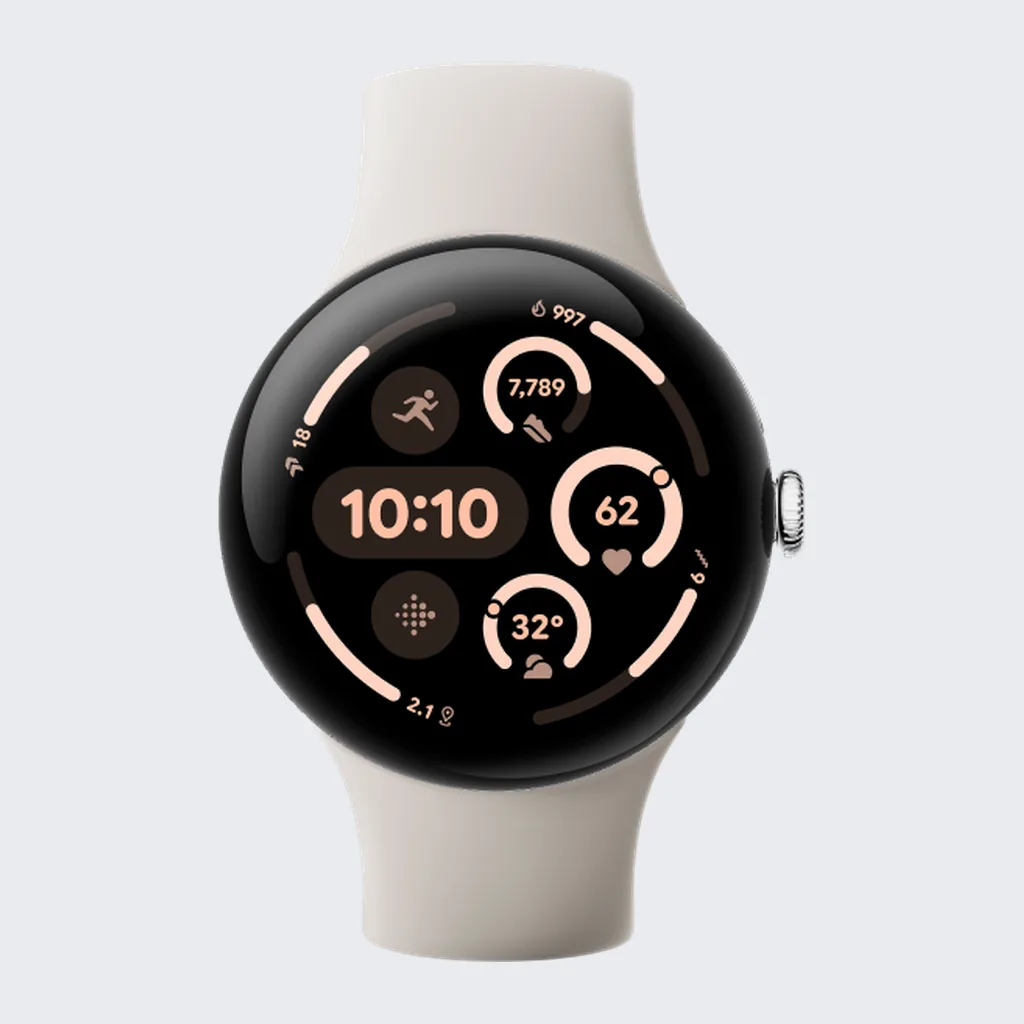
Google’s Pixel Watch specifications list a multi-path optical heart-rate sensor, red and infrared sensors for blood-oxygen estimates, electrical sensors compatible with ECG, a continuous electrodermal activity (cEDA) sensor and skin temperature (Google: Pixel Watch specifications). The watch pairs with Android phones.
Google quotes up to 24 hours with the always-on display and up to 36 hours in Battery Saver mode, a 5 ATM plus IP68 water rating, and weights of 31 g (41 mm) and 37 g (45 mm) without a band.
The photograph is a Pixel Watch 3 with a polished silver case and a porcelain band, from Google’s 2024 product image. It is not a later Pixel Watch. This guide does not add accuracy figures. The evidence table below shows rows already in the ChatPPG accuracy database, and each row names the model that was tested.
Sourced figures
Every number in this guide comes from the source linked beside it. Each study result applies to that study's devices, participants and protocol only.
Pixel Watch 3 manufacturer specifications: multi-path optical heart rate, red and infrared SpO2, ECG-compatible electrical sensors, cEDA and skin temperature; up to 24 hours with always-on display (36 hours Battery Saver); 5 ATM + IP68; 31 g (41 mm) and 37 g (45 mm) without a band.
What published studies show
Results quoted from 3 published validation studies, each against a clinical reference. A result applies to the model and protocol tested, not to every model the brand sells. From the wearable accuracy database (v1.0.0).
Heart rate during exercise2 studies
| Device tested | Result | Reference | Sample | Study |
|---|---|---|---|---|
| Google Pixel Watch 2mixed rest/stress/walking | 4.9 bpmMean absolute error | ECG chest strap (Zephyr BioHarness / | n = 45, Rest, cognitive stress, steady and intermittent walking in neutral/ | Gielen et al. (2026)Funding not reported |
| Google Pixel Watch 3 | 2.73%Mean absolute percentage error | ECG chest strap (Polar H7/ | n = 34, Maximal treadmill test | Lambe et al. (2026)Maker funded |
- Google Pixel Watch 24.9 bpm
Mean absolute error, mixed rest/stress/walking · vs ECG chest strap (Zephyr BioHarness / Faros) · n = 45, Rest, cognitive stress, steady and intermittent walking in neutral/hot/cold chambers
Gielen et al. (2026) Funding not reported
- Google Pixel Watch 32.73%
Mean absolute percentage error · vs ECG chest strap (Polar H7/H10) · n = 34, Maximal treadmill test
Lambe et al. (2026) Maker funded
Sleep stages (4-stage)1 study
| Device tested | Result | Reference | Sample | Study |
|---|---|---|---|---|
| Google Pixel Watch | κ = 0.4Cohen's kappa | Polysomnography (PSG) | n = 30, Two Korean sleep centres, in-lab PSG | Lee et al. (2023)Independent |
| Google Pixel Watch | 63.5%Epoch-by-epoch agreement | Polysomnography (PSG) | n = 30, Two Korean sleep centres, in-lab PSG | Lee et al. (2023)Independent |
- Google Pixel Watchκ = 0.4
Cohen's kappa · vs Polysomnography (PSG) · n = 30, Two Korean sleep centres, in-lab PSG
Lee et al. (2023) Independent
- Google Pixel Watch63.5%
Epoch-by-epoch agreement · vs Polysomnography (PSG) · n = 30, Two Korean sleep centres, in-lab PSG
Lee et al. (2023) Independent
VO2max estimate1 study
Only maker-funded evidence for Pixel Watch on this metric.
| Device tested | Result | Reference | Sample | Study |
|---|---|---|---|---|
| Google Pixel Watch 3 | 8.65% (bias −0.53 mL/kg/min)Mean absolute percentage error | Indirect calorimetry | n = 34, Free-living VO2max estimate vs maximal treadmill test | Lambe et al. (2026)Maker funded |
- Google Pixel Watch 38.65% (bias −0.53 mL/kg/min)
Mean absolute percentage error · vs Indirect calorimetry · n = 34, Free-living VO2max estimate vs maximal treadmill test
Lambe et al. (2026) Maker funded
Energy expenditure (calories)1 study
Only maker-funded evidence for Pixel Watch on this metric.
| Device tested | Result | Reference | Sample | Study |
|---|---|---|---|---|
| Google Pixel Watch 3 | 15.02%Mean absolute percentage error | Indirect calorimetry | n = 34, Maximal treadmill test | Lambe et al. (2026)Maker funded |
- Google Pixel Watch 315.02%
Mean absolute percentage error · vs Indirect calorimetry · n = 34, Maximal treadmill test
Lambe et al. (2026) Maker funded
Google Pixel Watch 3: Optical Sensor Comparisons
Frequently Asked Questions
Which Pixel Watch is in the photograph?
Pixel Watch 3, polished silver case with a porcelain band, from Google’s 2024 product image. It is not a later Pixel Watch.
Does this page add new heart-rate results?
No. Any validation rows are the ones already in the ChatPPG accuracy database. Each row names the model that was tested.