Sleep and breathing
Sleep Apnea and Sleep-Disordered Breathing
Sleep-disordered breathing is a group of conditions in which breathing is shallow or stops during sleep. The most common is obstructive sleep apnea, when the airway closes while the chest and diaphragm keep trying. Central sleep apnea is a pause with no effort to breathe. Severity on a sleep study is reported as the apnea-hypopnea index, or AHI. A home sleep apnea test usually reports a related index called the REI. A watch or ring can estimate related signals such as pulse, movement or overnight oxygen. It does not score AHI, and none of these numbers is a diagnosis.
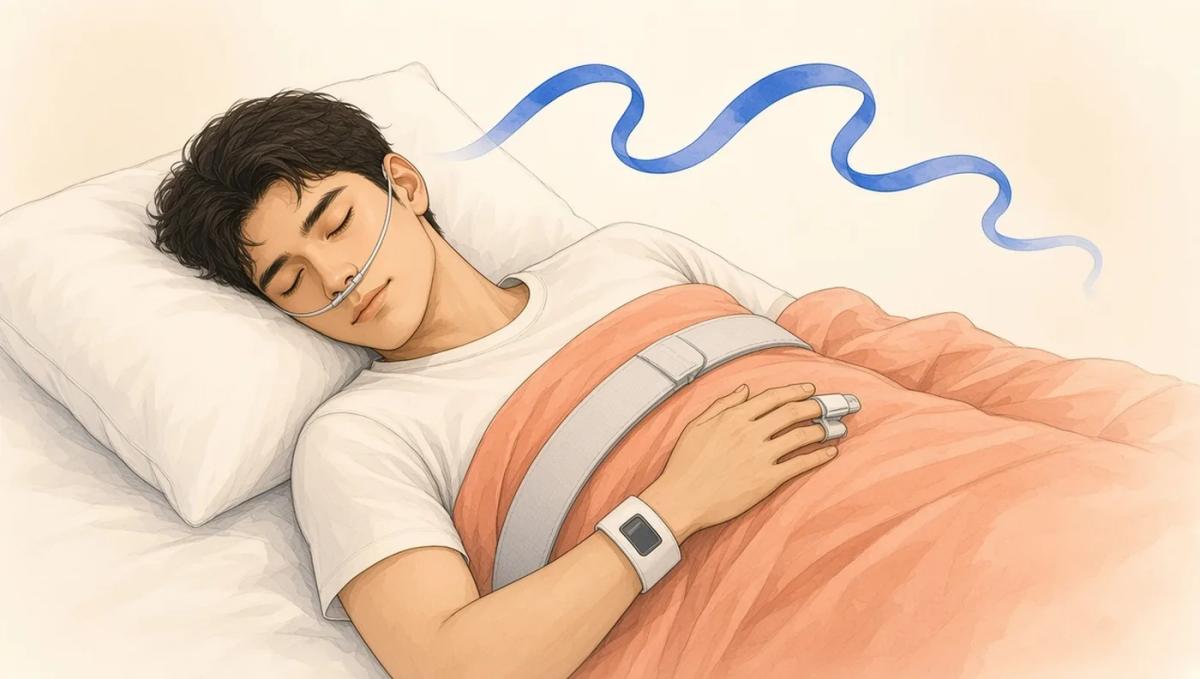
What the terms mean
Sleep-disordered breathing covers events in which airflow drops or stops during sleep. Obstructive sleep apnea (OSA) is a blocked or narrowed airway while respiratory effort continues. Central sleep apnea (CSA) is a pause in which the effort to breathe stops too. Scorers tell the two apart by whether effort belts move during the event. A hypopnea is shallower breathing, not a full stop, and it counts only when it is paired with an oxygen dip or an arousal, depending on the scoring rule.
This page is a map: definitions, the main metrics, how tests differ, and how optical sensors fit. It does not tell you whether you have sleep apnea, and it does not recommend a device or a treatment. Talk to a clinician about snoring, gasping, unrefreshing sleep or daytime sleepiness.
The PPG for sleep apnea detection page stays on the optical-method angle. Research results sit on the sleep apnea and AHI leaderboards.
How breathing events are scored
The rate used on a lab sleep study is the apnea-hypopnea index (AHI): apneas plus hypopneas, divided by hours of sleep. In adults, the 2009 AASM guideline sets severity bands with the related respiratory disturbance index (Epstein et al., Journal of Clinical Sleep Medicine, 2009):
Mild: 5 or more, and under 15, events per hour.
Moderate: 15 or more, up to 30 events per hour.
Severe: more than 30 events per hour.
The 2017 AASM diagnostic testing guideline uses the same 5, 15 and 30 cut points (Kapur et al., Journal of Clinical Sleep Medicine, 2017). The number alone does not make the diagnosis: as that guideline summarizes ICSD-3, obstructive sleep apnea means an obstructive RDI of 5 or more per hour with typical symptoms, or 15 or more without them.
Interactive · adult cut points, not a personal score
Where an adult AHI (or RDI) sits in the AASM severity bands
12 events per hour — mild (5 to under 15). Mild is 5 or more, and under 15, events per hour on the 2009 AASM adult guideline (written there with the RDI).
A home sleep apnea test usually cannot see sleep from EEG, so it divides by recording time and reports a respiratory event index (REI). The 2017 guideline notes that a home test can sit below the AHI a lab would have scored. Which hypopnea rule is used (a 3% desaturation or arousal versus a 4% desaturation) also moves the number; that is spelled out on the hypopnea page.
The oxygen desaturation index (ODI) counts oxygen dips per hour. It is not interchangeable with AHI. Overnight ranges, as opposed to daytime charts, are on normal SpO2 while sleeping.
How a lab study, a home test and a wearable differ
Polysomnography in a lab is the standard diagnostic test in the 2017 guideline. A technically adequate home test is an option for uncomplicated adults whose signs point to moderate to severe OSA; the guideline recommends a lab study when a home test is negative, inconclusive or technically inadequate, and when central apnea is a concern.
| Test | What it usually records | Index | What it is for |
|---|---|---|---|
| In-lab polysomnography (PSG) | EEG, eye movements, chin EMG, airflow, effort, SpO2, ECG, position | AHI (events per hour of sleep) | Standard diagnostic sleep study |
| Type III home sleep apnea test (HSAT) | Airflow, effort, SpO2, often heart rate or position; usually no EEG | REI (events per hour of recording) | Limited-channel home study in selected adults |
| Consumer wearable | PPG and movement, sometimes SpO2 | Vendor estimate, not AHI | Trends and, on some devices, a notification. Not a diagnosis |
Interactive · typical channels, not a named device
What a lab study, a home test and a wearable usually record
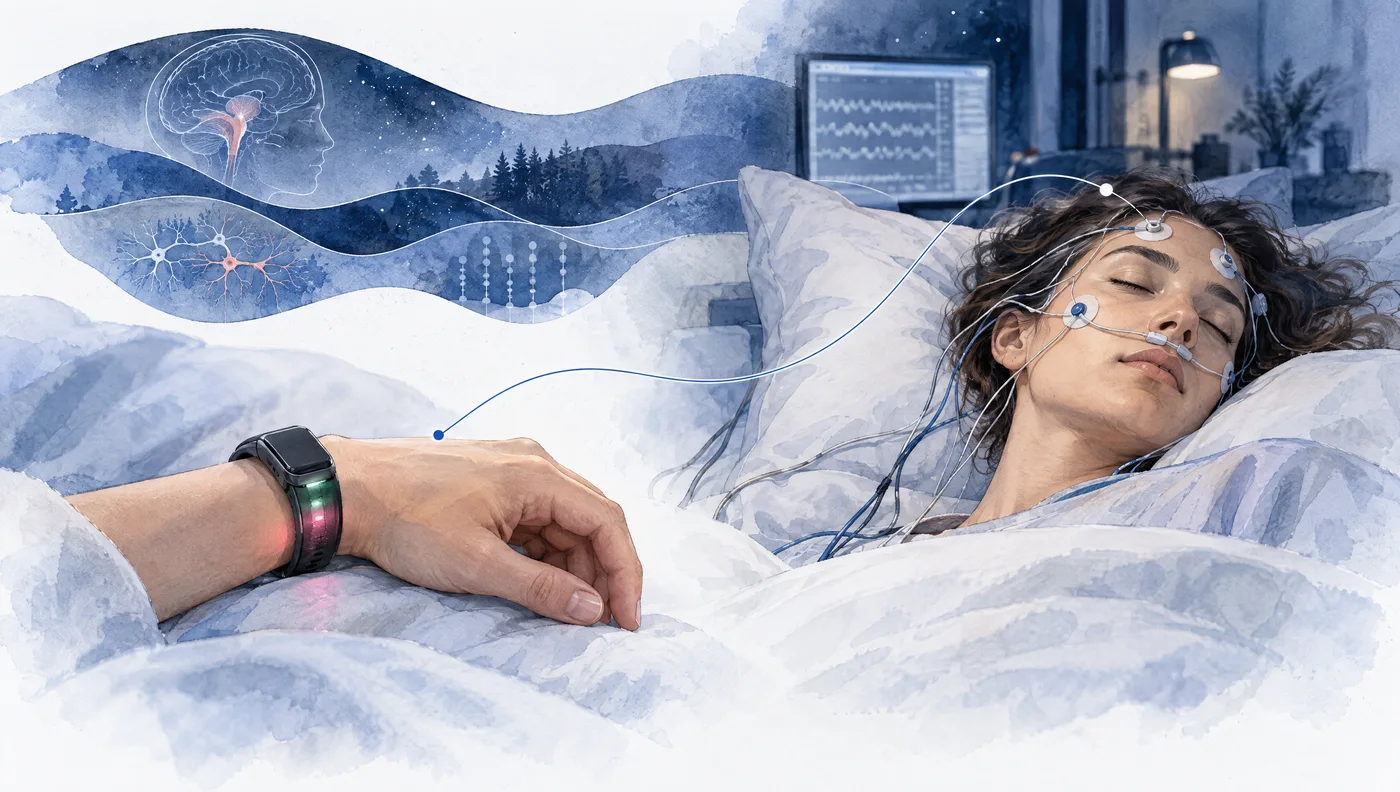
Polysomnography is the standard diagnostic test in the 2017 AASM guideline. EEG, eye movements and chin EMG also let scorers time sleep, so AHI is events per hour of sleep. Highlighted: EEG (brain waves), EOG (eye movements), Chin EMG, Airflow, Breathing effort belts, SpO2 (oxygen), ECG, Movement / position.
Consumer device evidence — whether a named watch or ring agrees with a sleep study — is reviewed on Sensor Bio's wearable sleep apnea research. Overnight wearable oxygen accuracy is covered in Is SpO2 accurate at night?. This site does not treat a wearable number as a sleep-study result.
How PPG, oxygen and movement relate
Photoplethysmography is an optical pulse signal. From it, a device can estimate heart rate, pulse-rate variability and, with a second wavelength, SpO2. An accelerometer supplies movement for sleep-versus-wake and, on many wearables, a sleep-stage estimate. Those estimates are not the same as AASM sleep staging from EEG, eye movements and chin EMG.
PPG methods for apnea detection are collected on PPG for sleep apnea detection and in PPG sleep apnea detection. Wearable AHI approximation, with its limits, is Can PPG approximate AHI?. Staging accuracy against polysomnography is compared on sleep tracker accuracy and in PPG sleep tracking.
A wearable can be useful for trends. It cannot replace a scored sleep study, and it is a poor place to look for central apnea, which is defined by absent effort.
Research datasets and boards
Public sleep recordings used to train and test algorithms are listed on sleep datasets, including NSRR cohorts such as SHHS, MESA and the newer WSC, SOF, NCHSDB, HomePAP, PATS and MNC cards, plus PhysioNet sets such as Sleep-EDF Expanded and DREAMT. Wrist-specific staging sets stay on wearable sleep staging datasets.
Published algorithm results are on the sleep apnea, AHI and sleep staging leaderboards. Those boards are research comparisons, not clinical rankings and not buying advice.
References
Epstein, L. J., Kristo, D., Strollo, P. J., Jr., Friedman, N., Malhotra, A., Patil, S. P., … Weinstein, M. D. (2009). Clinical guideline for the evaluation, management and long-term care of obstructive sleep apnea in adults. *Journal of Clinical Sleep Medicine*, 5(3), 263–276. doi:10.5664/jcsm.27497
Kapur, V. K., Auckley, D. H., Chowdhuri, S., Kuhlmann, D. C., Mehra, R., Ramar, K., & Harrod, C. G. (2017). Clinical practice guideline for diagnostic testing for adult obstructive sleep apnea: An American Academy of Sleep Medicine clinical practice guideline. *Journal of Clinical Sleep Medicine*, 13(3), 479–504. doi:10.5664/jcsm.6506
American Academy of Sleep Medicine. *The AASM Manual for the Scoring of Sleep and Associated Events*, Version 3 (2023). Paid member manual; no DOI. This page cites the 2009 and 2017 open guidelines for cut points and test choice rather than quoting the paid manual's rule text.
Research on this site
Public datasets, leaderboards and topic guides linked from this hub. Leaderboards are research comparisons, not diagnostic rankings.
Frequently Asked Questions
What is sleep apnea?
Sleep apnea is a disorder in which breathing stops or becomes very shallow during sleep. The usual form is obstructive sleep apnea, a blocked or narrowed airway with continued effort to breathe. Central sleep apnea is a pause with no effort. It is identified on a sleep study, not by a wearable number.
What is the difference between obstructive and central sleep apnea?
In obstructive sleep apnea the airway closes while the chest and abdomen keep trying. In central sleep apnea the effort to breathe stops too. Sleep scorers use airflow and effort belts to tell the two apart. A home test and a wearable can miss central events. The guide is /learn/central-sleep-apnea.
What is AHI?
AHI, the apnea-hypopnea index, is apneas plus hypopneas per hour of sleep, scored on a sleep study. Adult AASM bands (Epstein et al., 2009, doi:10.5664/jcsm.27497) are mild from 5 to under 15 events per hour, moderate from 15 to 30, and severe above 30. A home test reports REI. Details are on /learn/ahi.
How is sleep apnea diagnosed?
The 2017 AASM guideline (Kapur et al., doi:10.5664/jcsm.6506) names in-lab polysomnography as the standard diagnostic test. A technically adequate home sleep apnea test is an option for some uncomplicated adults at increased risk of moderate to severe OSA. A wearable estimate is not a diagnosis. See /blog/home-sleep-apnea-test-vs-polysomnography.
What is a home sleep apnea test?
A home sleep apnea test, or HSAT, is a limited-channel study done outside the lab, usually with airflow, effort and oxygen sensors and without EEG. Its result is typically an REI, events per hour of recording, which can underestimate a lab AHI. The comparison is /blog/home-sleep-apnea-test-vs-polysomnography.
Can a smartwatch detect sleep apnea?
A watch or ring can estimate related signals (pulse, movement, sometimes SpO2) and some devices offer a notification feature. That is not the same as a scored AHI on a sleep study, and it is not a diagnosis. Published device evidence is reviewed at sensorbio.com/the-signal/wearable-sleep-apnea-research/. ChatPPG's method pages start at /conditions/sleep-apnea.