Polar Heart Rate Monitor vs Smartwatch: Accuracy Comparison
Polar chest straps vs smartwatch heart rate accuracy: why ECG-based sensing beats optical PPG during exercise, and when a smartwatch is good enough.
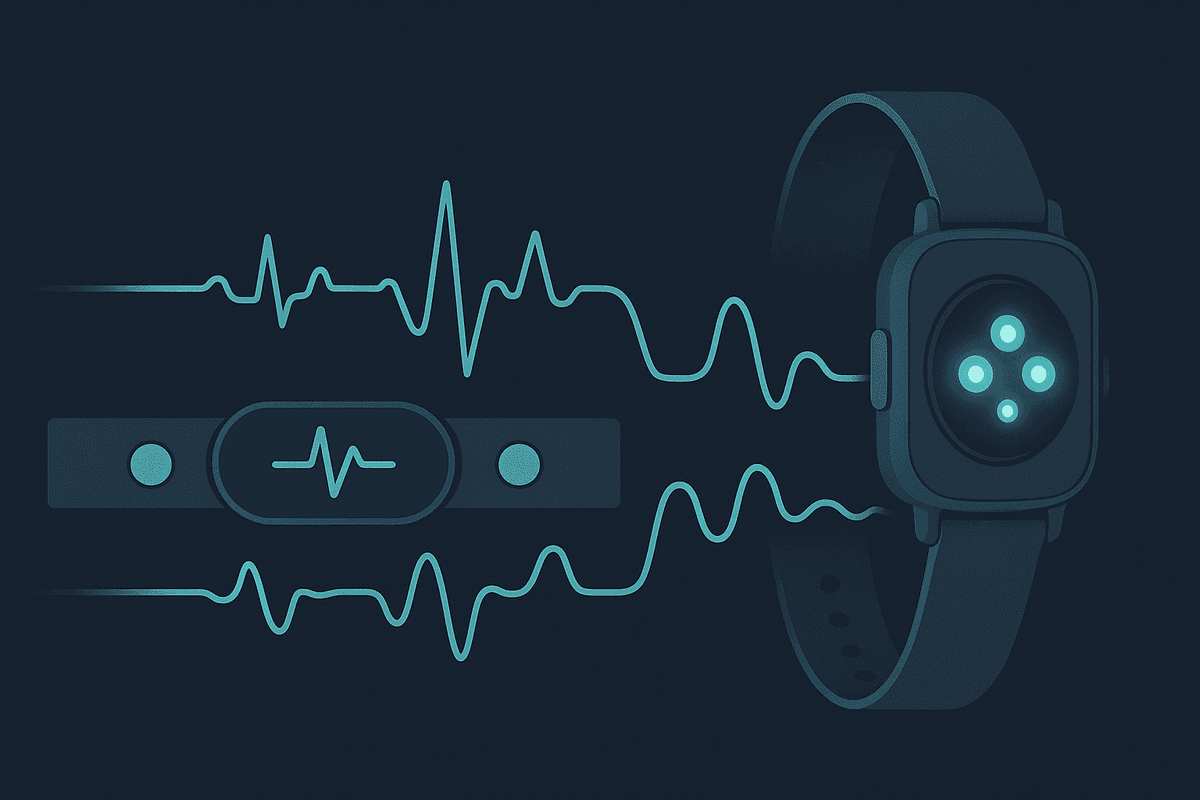
Polar chest strap heart rate monitors are significantly more accurate than any smartwatch during exercise. The Polar H10 measures electrical cardiac signals, not optical blood flow, giving mean errors under 2 BPM even during sprints. Smartwatches using optical PPG sensors show 5-15+ BPM errors during vigorous activity. For casual use and resting monitoring, modern smartwatches are good enough.
Two Fundamentally Different Technologies
This comparison is not really Polar versus Apple Watch or Polar versus Garmin. It is about two completely different sensing technologies.
Polar chest straps use cardiac electrical sensing: When your heart contracts, it generates electrical impulses that travel through your body. Chest straps detect these impulses through electrode contacts on the skin over the chest. This is essentially a simplified, single-lead ECG. The signal is unaffected by arm movement, light, skin pigmentation, or body composition.
Smartwatches use photoplethysmography (PPG): A green LED shines into the wrist skin and a photodetector measures how much light is absorbed. Blood pulses through with each heartbeat, changing light absorption rhythmically. This optical signal is converted to heart rate. PPG technology is highly sensitive to motion, skin tone, wrist contact, and ambient light.
The accuracy difference is a direct consequence of this fundamental technology difference, not brand quality or price.
Accuracy Data: Polar H10 vs. Major Smartwatches
The Polar H10 is widely used as a reference device in academic research comparing wearable accuracy. Here is what independent studies report:
At rest (seated or lying down):
- Polar H10: < 1 BPM MAE
- Apple Watch: 2-4 BPM MAE
- Garmin: 2-4 BPM MAE
- Samsung Galaxy Watch: 2-5 BPM MAE
- Fitbit: 2-5 BPM MAE
During walking / light activity:
- Polar H10: < 1 BPM MAE
- Apple Watch: 3-6 BPM MAE
- Garmin: 3-6 BPM MAE
- Samsung: 4-7 BPM MAE
- Fitbit: 4-8 BPM MAE
During running at moderate pace (130-150 BPM):
- Polar H10: < 2 BPM MAE
- Apple Watch: 5-8 BPM MAE
- Garmin: 5-10 BPM MAE
- Samsung: 8-12 BPM MAE
- Fitbit: 10-15 BPM MAE
During vigorous exercise / HIIT (160-180+ BPM):
- Polar H10: < 2 BPM MAE
- Apple Watch: 8-14 BPM MAE
- Garmin: 8-14 BPM MAE
- Samsung: 10-18 BPM MAE
- Fitbit: 12-20 BPM MAE
Numbers are representative ranges based on published studies and vary by individual, device generation, and methodology.
Why Motion Artifact Crushes Wrist PPG Accuracy During Vigorous Exercise
The physics of the problem are straightforward. Motion artifacts in PPG occur when mechanical movement creates optical noise in the sensor. During vigorous exercise, the arm swings and the wrist twists, causing:
- Sensor movement relative to skin (the sensor shifts position slightly with each stride)
- Muscle vibration changes tissue optical properties
- Venous pooling and flushing from position changes
All of these create signal components that the algorithm must separate from the true cardiac signal. The problem intensifies at high intensities because:
- The magnitude of motion increases
- The frequency of motion overlaps with typical exercise heart rates (cadence lock problem)
- Sweating changes skin optical properties dynamically
A chest strap sits over the sternum, moves with the chest as a unit, and detects electrical signals that no amount of limb movement can contaminate. There is no optical path to disrupt.
The Cadence Lock Problem Explained
One specific accuracy failure mode worth understanding: cadence lock. During running, your arm swings at roughly the same frequency as your stride. For most runners, this is 160-180 steps per minute, which is also 160-180 BPM, a typical vigorous running heart rate.
When a wrist PPG sensor is saturated with motion artifact from arm swing at 170 steps per minute, it can mistake the step rhythm for a 170 BPM heart rate. The reading looks stable and plausible, which makes it deceptive. Your actual heart rate might be 160 BPM, 175 BPM, or 185 BPM, but the watch stubbornly shows 170.
Manufacturers like Garmin specifically tune algorithms to detect and reject cadence lock by monitoring the relationship between accelerometer frequency and optical signal frequency. This helps but does not eliminate the problem. See PPG motion artifact detection for the algorithm details.
A Polar H10 chest strap never experiences cadence lock. Electrical cardiac signals have nothing to do with arm cadence.
Using Both Together: The Smart Athlete Setup
You do not have to choose. Most serious athletes who use GPS watches for tracking also pair them with a Polar H10 or similar chest strap for accurate heart rate data:
Setup: Connect the Polar H10 to your smartwatch or cycling computer via Bluetooth. The watch displays and records the chest strap's heart rate data while also capturing GPS, pace, power, and other metrics.
Result: You get the navigation, smart notifications, and fitness ecosystem of a modern smartwatch combined with the clinical-grade heart rate accuracy of an electrode-based chest strap.
Compatible combinations:
- Polar H10 + Apple Watch (via third-party apps or workout apps that accept Bluetooth HR)
- Polar H10 + Garmin (native Bluetooth/ANT+ support)
- Polar H10 + Samsung Galaxy Watch (Bluetooth GATT)
- Polar H10 + Suunto, COROS, Wahoo computers (universal support)
The Polar H10 also stores up to 200 hours of training data internally and connects to the Polar Flow app for detailed analysis.
Does the Type of Exercise Change the Accuracy Gap?
Yes, the gap between chest strap and wrist PPG varies by activity:
Cycling (indoor or outdoor): Wrists are relatively stable on handlebars. Wrist PPG accuracy during cycling is meaningfully better than during running. Mean errors of 4-8 BPM during moderate cycling versus 8-15 BPM during running at similar heart rates.
Swimming: Both wrist PPG and most chest straps struggle with swimming. The Polar Verity Sense armband works better for swimming than either wrist or chest placements. Some wrist devices (Apple Watch) use accelerometer-based stroke detection to estimate heart rate during swimming with moderate accuracy.
Weightlifting: Mixed results for both. During controlled resistance exercises, wrist PPG can be acceptable. During exercises with tight grip (deadlift, pull-ups), wrist motion spikes and accuracy drops for wrist devices.
HIIT and circuit training: Worst case for wrist PPG. Rapid alternation between intense movement and rest creates lag in optical HR readings. The wrist device often shows your heart rate returning to baseline as the next interval begins, missing the true peak.
When a Smartwatch Is Good Enough
Not everyone needs a chest strap. For these use cases, a quality smartwatch is sufficient:
- General fitness monitoring and step counting
- Monitoring resting heart rate and overnight trends
- Zone-based training at low to moderate intensities where exact HR matters less
- Casual workout tracking where trends matter more than precision
- Medical monitoring of resting heart rate as supplementary data
A smartwatch becomes insufficient when:
- You are targeting specific heart rate zones during intervals
- Your training plan is designed around precise HR ranges
- You are a competitive athlete where marginal training decisions matter
- You are monitoring heart rate for medical purposes
For a broader comparison of how different consumer devices measure up against clinical standards, see PPG clinical grade vs consumer wearables, and for more on what sports performance tracking looks like with high-accuracy data, see PPG sports performance metrics.
References
-
Gillinov S, et al. "Variable accuracy of wearable heart rate monitors during aerobic exercise." Medicine & Science in Sports & Exercise 49(8):1697-1703 (2017). doi:10.1249/MSS.0000000000001284
-
Wallen MP, et al. "Accuracy of heart rate watches: implications for weight management." PLOS ONE 11(5):e0154420 (2016). doi:10.1371/journal.pone.0154420
-
Stahl SE, et al. "How accurate are the wrist-based heart rate monitors during walking and running activities? Are they accurate enough?" BMJ Open Sport & Exercise Medicine 2(1):e000106 (2016). doi:10.1136/bmjsem-2015-000106
-
Navalta JW, et al. "Accuracy of Wrist-Worn Heart Rate Monitors during Hospital Transport Activities." Journal of Medical Systems 44(5):93 (2020). doi:10.1007/s10916-020-01558-z
-
Hermand E, et al. "Reliability and accuracy of five consumer-grade HR monitors for sport and recreational physical activity." Sensors 21(16):5670 (2021). doi:10.3390/s21165670
Frequently Asked Questions
- Is a Polar heart rate monitor more accurate than a smartwatch?
- Yes, significantly. Polar chest straps use electrical heart sensing (equivalent to ECG) rather than optical PPG. Mean errors are under 2 BPM at all exercise intensities. Smartwatches using optical PPG show 5-15+ BPM errors during vigorous exercise.
- How accurate is the Polar H10 chest strap?
- The Polar H10 is considered the gold standard for consumer heart rate monitoring. Studies show less than 1-2 BPM mean absolute error against ECG reference across all exercise intensities. It is often used as the reference device in wearable accuracy studies.
- Can I use a Polar chest strap with my smartwatch?
- Yes. Most smartwatches (Apple Watch, Garmin, Samsung) and fitness apps support Bluetooth (GATT HRM) connections to chest straps. The watch displays the chest strap HR data while still recording GPS and other metrics.
- Why is a chest strap more accurate than an optical wrist sensor?
- Chest straps detect electrical signals produced by the heart (like ECG electrodes). These signals are unaffected by motion artifacts from arm movement. Optical wrist sensors detect light absorption changes in blood flow, which are contaminated by wrist movement during exercise.
- Is the Polar H10 worth it if I already have a smartwatch?
- For casual fitness tracking, your smartwatch is probably sufficient. If you train with heart rate zones, do interval training, or want precise workout data, the Polar H10 paired with your smartwatch gives you the best of both worlds.
- Does Polar make wrist-based heart rate monitors?
- Yes. Polar Vantage, Ignite, and Pacer series watches use wrist-based optical PPG sensors. These are more accurate than Fitbit but still less accurate than Polar's own chest straps during vigorous exercise.
- What is the accuracy difference between Polar H10 and Apple Watch during running?
- During vigorous running, Polar H10 mean error is typically under 2 BPM versus ECG. Apple Watch mean error during vigorous running is typically 6-12 BPM. The gap widens further during HIIT or sprint intervals.