PaperarXiv:2603.03331
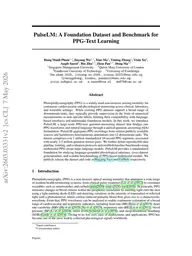
PulseLM: A Foundation Dataset and Benchmark for PPG-Text Learning

arXiv preprint
 (opens in a new tab)
Pham, Hung Manh et al., "PulseLM: A Foundation Dataset and Benchmark for PPG-Text Learning", arXiv:2603.03331, CC BY 4.0
Key results1 SOTA
All results72.8%
Exact-match accuracy (%) ↑
PPG question answering · PulseLM (16 datasets, in-domain)
Qwen2.5-7B-Instruct + PulsePPG encoder
12 closed-form QA categories · in-domain · LoRA fine-tuning, frozen PPG encoder
Best comparison: LLaMA3.1-8B + PulsePPG 70.6
Results as reported by the authors; not independently reproduced. A SOTA star marks the best value among results reported under the same evaluation protocol; ties go to the earlier publication.
Embed this badge (1 badge for READMEs and project pages)
 Markdown
[](https://chatppg.com/research/models/pulselm#key-results)HTML<a href="https://chatppg.com/research/models/pulselm#key-results"><img src="https://chatppg.com/research/badges/pulselm--ppg-qa-pulselm-benchmark-exact-match-pct.svg" alt="SOTA on ChatPPG: PPG question answering · PulseLM (16 datasets, in-domain)" height="20"></a>
TL;DR
Singapore Management University / Cambridge team aggregates 16 public PPG datasets (clinical, lab, and in-the-wild — fingertip, ear, and wrist) into a single harmonized 10-second/125Hz format, then converts existing labels (HR, HRV, BP category, SQI, stress/affect, sleep-disordered breathing, AF, arrhythmia, SpO2, RR) into ~2.5 million natural-language question-answer pairs across 12 task categories. This is a dataset-and-benchmark paper, not a new pretraining method — no novel encoder or SSL objective is proposed. Baseline results use existing multimodal PPG-aware LLMs (PPG encoder + LoRA fine-tuned LLaMA/Qwen) on the QA format.
Abstract
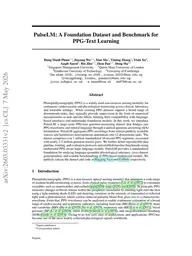
Photoplethysmography (PPG) is a widely used non-invasive sensing modality for continuous cardiovascular and physiological monitoring across clinical, laboratory, and wearable settings. While existing PPG datasets support a broad range of downstream tasks, they typically provide supervision in the form of numerical measurements or task-specific labels, limiting their compatibility with language-based interfaces and multimodal foundation models. In this work, we introduce PulseLM, a large-scale PPG-text question-answering dataset that bridges raw PPG waveforms and natural language through a unified question-answering (QA) formulation. PulseLM aggregates PPG recordings from sixteen publicly available sources and harmonizes heterogeneous annotations into 12 downstream tasks. The dataset comprises over 1 million standardized 10-second PPG segments, associated with nearly 2.5 million question-answer pairs. We further define reproducible data pipeline, training, and evaluation protocols and establish baseline benchmarks using multimodal PPG-aware large language models. PulseLM provides a standardized foundation for studying language-grounded physiological inference, cross-dataset generalization, and scalable benchmarking of PPG-based multimodal models. We publicly release the dataset and code at https://huggingface.co/datasets/Manhph2211/PulseLM and https://github.com/manhph2211/PULSE-LM, respectively.
Verbatim from arXiv (opens in a new tab) · arXiv metadata (abstracts are released under CC0)
Results on ChatPPG leaderboards · 6
All leaderboards| Leaderboard | Method | Result | Rank |
|---|---|---|---|
| AFPPGECG exact match (PulseLM QA)Atrial fibrillation detection | PulseLM | 0.861exact match, higher is better | #1 of 1 |
| MIMIC PERform exact match (PulseLM QA)Atrial fibrillation detection | PulseLM | 0.750exact match, higher is better | #1 of 1 |
| PPG-DaLiA exact match (PulseLM QA HR 3-class)Heart rate estimation | PulseLM | 0.862exact match, higher is better | #1 of 1 |
| WESAD exact match (PulseLM QA)Mental workload assessment | PulseLM | 0.497exact match, higher is better | #1 of 1 |
| PPG-DaLiA MAE (BPM)Heart rate estimation | PaPaGei-Svia model PaPaGei-S | 15.22MAE (BPM), lower is better | #19 of 19 |
| WESAD AUROCMental workload assessment | PaPaGei-Svia model PaPaGei-S | 0.8043AUROC, higher is better | #7 of 7 |
4 rows are credited to this paper; 2 more belong to models it introduces or evaluates. Ranks apply within each leaderboard only, as reported by the source.
Tasks & signals
Tasks
Signals
Devices
Keywords
Datasets used
 Long-term ECG and wrist PPG with annotated AF episodes (AFPPGECG)39 subjects · PPG · ECG · IMU
 BIDMC PPG and Respiration (Pimentel 2016 / PhysioNet)53 subjects · PPG · ECG · SpO₂
 EarSetmulti-modal in-ear green/red/IR PPG + IMU30 subjects · PPG · ECG · IMU
 MIMIC PERformCharlton PPG/ECG/RESP ICU beat-detection benchmarks (+ AF subset)35 subjects · PPG · ECG · BP
 PPG-DaLiAPPG dataset for motion compensation / HR15 subjects · PPG · ECG · IMU
 PPGArrhythmia (Liu 2022)public valid/test subset only91 subjects · PPG
 PulseLM: PPG-text QA foundation dataset and benchmark (1.08 M 10-s PPG segments from 16 public sources, 2.48 M QA pairs)PPG
 SDBPhone Oximeter pediatric sleep-disordered breathing (Garde 2014)146 subjects · PPG · SpO₂
 Sensors Aguirre 2021PPG→ABP morphology (MIMIC-III processed)1,195 subjects · PPG · BP
 UQVitalSignsUniversity of Queensland anesthesia vital signs32 subjects · PPG · ECG · SpO₂
- UTSA-PPGmultimodal wrist+finger PPG HR/HRV (Xu 2025)12 subjects · PPG · ECG · IMU
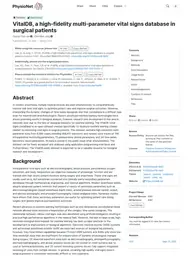 VitalDBintraoperative multi-parameter vitals (PhysioNet mirror)6,388 subjects · PPG · ECG · BP
Models
How it works
Cite this paper
PulseLM: A Foundation Dataset and Benchmark for PPG-Text Learning. (2026). arXiv preprint. https://doi.org/10.48550/arXiv.2603.03331
@misc{pulselmppgtextqa2026pulselm,
  title         = {{PulseLM: A Foundation Dataset and Benchmark for PPG-Text Learning}},
  year          = {2026},
  howpublished  = {arXiv preprint},
  doi           = {10.48550/arXiv.2603.03331},
  eprint        = {2603.03331},
  archivePrefix = {arXiv}
}Record updated