Activity counts measure attention, not model quality. Missing counts are unknown. Publication status follows the linked source; a listed venue alone does not confirm peer review.
KID-PPG is a knowledge-informed deep model for wrist-PPG heart-rate estimation that combines adaptive linear filtering, deep probabilistic inference and data augmentation to address motion artifact, signal degradation and physiological plausibility. On PPG-DaLiA it achieved a mean absolute error of 2.85 beats per minute, better than prior reproducible methods reported in the paper. IEEE TBME 2024; arXiv 2405.09559.
Signals
PPG, IMU
Form factor
Wrist
License
GPL-3.0
Year
2024
Architecture
Per-subject/activity adaptive linear filter (2-layer linear conv on 3-axis ACC, subtracted from PPG) -> CNN (Attention-model base) with temporal attention over consecutive 8 s windows -> 2-unit Gaussian head (mu, sigma); paper Sec. II / Fig. 5
Per-subject/activity adaptive linear filter (2-layer linear conv on 3-axis ACC, subtracted from PPG) -> CNN (Attention-model base) with temporal attention over consecutive 8 s windows -> 2-unit Gaussian head (mu, sigma); paper Sec. II / Fig. 5
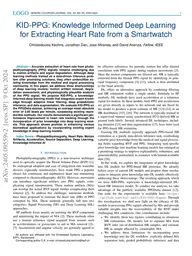
Accurate extraction of heart rate from photoplethysmography (PPG) signals remains challenging due to motion artifacts and signal degradation. Although deep learning methods trained as a data-driven inference problem offer promising solutions, they often underutilize existing knowledge from the medical and signal processing community. In this paper, we address three shortcomings of deep learning models: motion artifact removal, degradation assessment, and physiologically plausible analysis of the PPG signal. We propose KID-PPG, a knowledge-informed deep learning model that integrates expert knowledge through adaptive linear filtering, deep probabilistic inference, and data augmentation. We evaluate KID-PPG on the PPGDalia dataset, achieving an average mean absolute error of 2.85 beats per minute, surpassing existing reproducible methods. Our results demonstrate a significant performance improvement in heart rate tracking through the incorporation of prior knowledge into deep learning models. This approach shows promise in enhancing various biomedical applications by incorporating existing expert knowledge in deep learning models.
Verbatim fromarXiv· arXiv metadata (abstracts are released under CC0)
Datasets linked in the hub; pretraining vs evaluation roles follow the paper.
Architecture
Per-subject/activity adaptive linear filter (2-layer linear conv on 3-axis ACC, subtracted from PPG) -> CNN (Attention-model base) with temporal attention over consecutive 8 s windows -> 2-unit Gaussian head (mu, sigma); paper Sec. II / Fig. 5
Full photo credits and licences are on each device page. An icon means we have no openly licensed or manufacturer-cleared photo of that exact device yet.
Cite the publication recorded for this model. Check it against the publisher before submitting.
Kechris, C., Dan, J., Miranda, J., & Atienza, D. (2024). KID-PPG: Knowledge Informed Deep Learning for Extracting Heart Rate from a Smartwatch. arXiv preprint. https://doi.org/10.1109/TBME.2024.3477275
Kechris, Christodoulos, Jonathan Dan, Jose Miranda, and David Atienza. 2024. "KID-PPG: Knowledge Informed Deep Learning for Extracting Heart Rate from a Smartwatch." arXiv preprint. https://doi.org/10.1109/TBME.2024.3477275.
Kechris, C., Dan, J., Miranda, J. and Atienza, D. (2024) 'KID-PPG: Knowledge Informed Deep Learning for Extracting Heart Rate from a Smartwatch', arXiv preprint. doi: 10.1109/TBME.2024.3477275.
Kechris, Christodoulos, et al. "KID-PPG: Knowledge Informed Deep Learning for Extracting Heart Rate from a Smartwatch." arXiv preprint, 2024. https://doi.org/10.1109/TBME.2024.3477275.
C. Kechris, J. Dan, J. Miranda, and D. Atienza, "KID-PPG: Knowledge Informed Deep Learning for Extracting Heart Rate from a Smartwatch," arXiv preprint, 2024, doi: 10.1109/TBME.2024.3477275.
@misc{kechris2024kidppg,
  title         = {{KID-PPG: Knowledge Informed Deep Learning for Extracting Heart Rate from a Smartwatch}},
  author        = {Kechris, Christodoulos and Dan, Jonathan and Miranda, Jose and Atienza, David},
  year          = {2024},
  howpublished  = {arXiv preprint},
  doi           = {10.1109/TBME.2024.3477275},
  eprint        = {2405.09559},
  archivePrefix = {arXiv}
}
History
Added to the ChatPPG research hub
Newsletter
Get new PPG datasets, papers and models
Get alerts when KID-PPG is benchmarked on new datasets, plus the weekly digest.
New datasets, papers and models
Practical guides from the hub
Unsubscribe anytime
The waveform is an illustration of a PPG pulse, not a recording.
Software: KID-PPG is listed in Wearable Signal Tools, with its licence, commercial use and last commit.