Datasets linked in the hub; pretraining vs evaluation roles follow the paper.
- Pretraining data
- Author-claimed 3.0 million hours prepared from 12 publicly available research datasets, 25,000+ people, split by person. The Datasets section lists 16 corpora plus the PhysioNet umbrella citation; which 12 make up the 3.0 million hours is not stated.
- Architecture
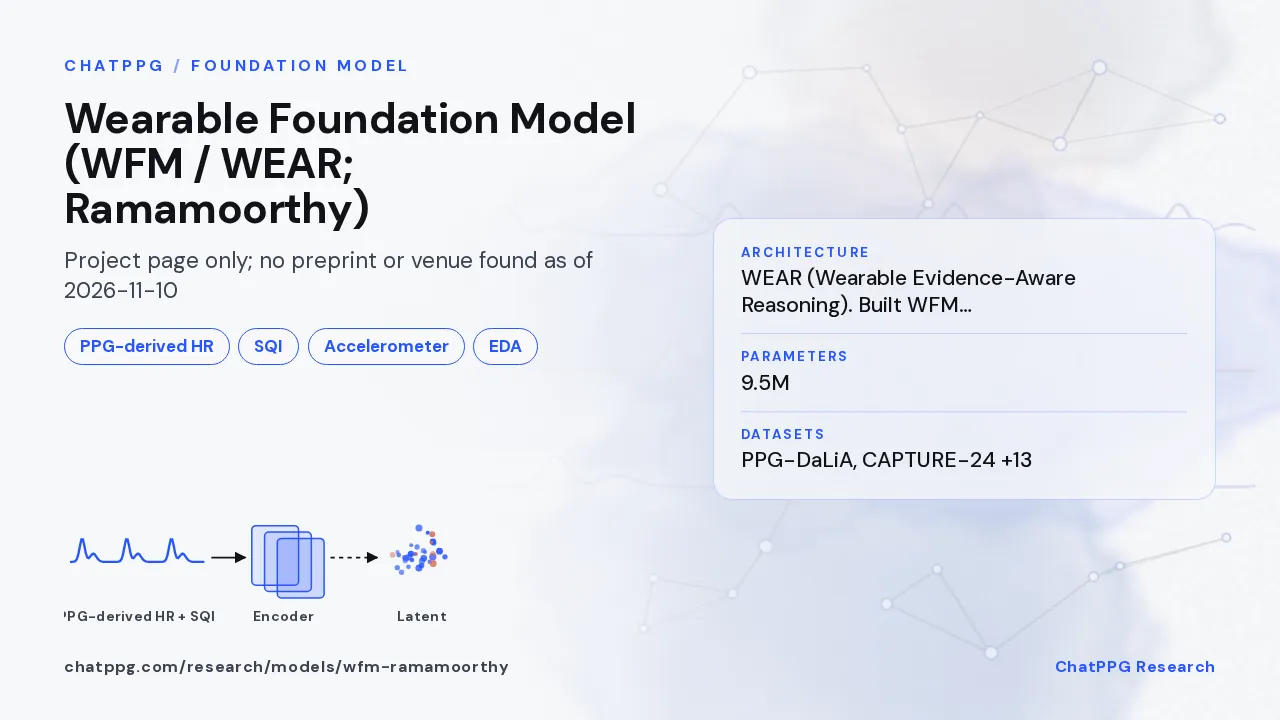
- WEAR (Wearable Evidence-Aware Reasoning). Built WFM encoder/decoders: 10-minute window of 18 derived channels × 60 steps (0.1 Hz); 9 channel-pairs × 10 one-minute patches = 90 tokens × 256-d; Sensor Transformer is 4 layers, 4 heads, width 256, with learned pooling for a match embedding; text decoder 3 causal layers width 256; multimodal decoder 3 layers with cross-attention to the 90 sensor tokens + tied LM head; forecast head is a 512-unit layer over the 256-d pooled sensor vector plus a 36-d wrist summary (18 channel means + 18 observed flags), producing low/mid/high pinball forecasts for heart rate, HRV, movement and glucose at two horizons. Training losses already built: symmetric InfoNCE match, next-token caption CE, pinball forecast. Architecture page marks the WEAR evidence store, exact tools, memory, question encoder, reasoning core (planned 4-layer width-256 Transformer), claim verifier, claim bank and composed outputs as 'Not built yet'; event heads 'in progress'.
- Inputs
- PPG, IMU, EDA, Temp, HR, HRV, Text
- Approach
- sensor language · project page · no code · no weights · quality gating · RMIT