Why Does Your Heart Rate Increase After Eating? What Wearables Show
Your heart rate can rise after a meal as blood shifts to your gut. Here's what the research shows, how long it can last, and what a new Apple wrist-PPG study found.
- Heart Rate
- HR
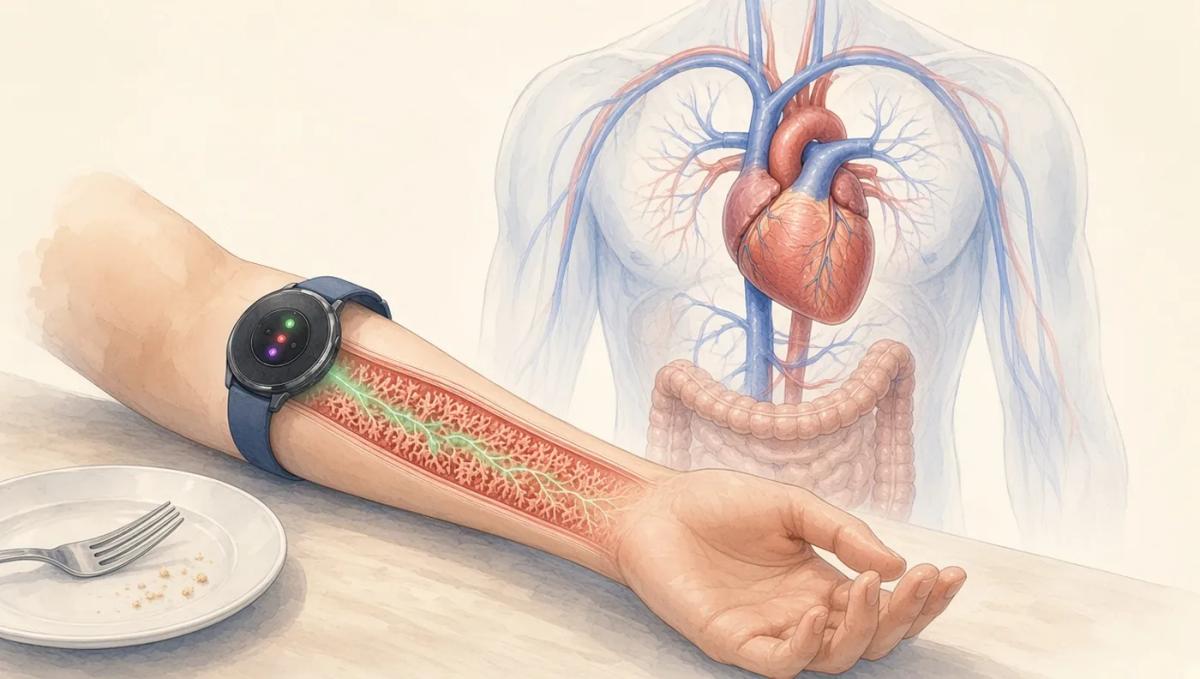
Short answer: Eating makes your circulation work harder. After a meal, blood flow to your gut climbs, and your heart pumps more blood per minute to cover it. In one study of healthy young adults, cardiac output rose 22% to 32% within 30 minutes of a meal, and flow in the main artery to the gut rose by 87% to 122% (Sidery et al., 1991). That paper's abstract doesn't report heart rate directly, so we can't quote a typical bump in beats per minute. If your pulse stays high, races, or comes with symptoms, that's a reason to see a clinician.
Plenty of people notice their watch showing a higher pulse after a meal and want to know what it means. This post covers what a meal does to your circulation, what the evidence says about carbs versus fat, how that differs from the blood pressure drop some older adults get after eating, and what a new Apple study says your wrist sensor may be picking up. For general ranges, see our resting heart rate chart and normal heart rate by age.
What happens to your circulation after a meal
Digestion is work, and blood carries the supplies. The superior mesenteric artery is the main vessel feeding your small intestine, and after eating, more blood flows through it. The heart has to supply that flow without taking too much from the rest of the body.
The clearest numbers come from Sidery and colleagues, who gave healthy volunteers (mean age 23, range 19 to 39) a high-carbohydrate or a high-fat meal and measured their circulation on separate occasions (Sidery et al., 1991). Here is what the abstract reports:
Interactive · published values from one study (Sidery 1991)
What a meal does to your circulation: more output, much more blood to the gut
95% confidence interval of the increase (l/min)
What it shows: Cardiac output rose 32% 30 minutes after a high-carbohydrate meal and 22% after a high-fat meal in healthy young adults. Both meals raised cardiac output by roughly a fifth to a third; the meal types differed in how the blood was shared out, not in whether the heart pumped more.
Data table (Sidery 1991 abstract)
| Measure | Meal | Time | Rise | 95% CI of the increase |
|---|---|---|---|---|
| Cardiac output | High-carb | 30 min after the meal | +32% | 0.32 to 1.64 l/min |
| Cardiac output | High-fat | 30 min after the meal | +22% | 0.30 to 1.96 l/min |
| Gut artery flow (superior mesenteric artery) | High-carb | 15 min after the meal | +87% | 119 to 258 ml/min |
| Gut artery flow (superior mesenteric artery) | High-fat | 45 min after the meal | +122% | 138 to 392 ml/min |
Cardiac output is the volume of blood the heart pumps each minute. It equals heart rate times the volume pumped per beat:
So a 22% to 32% rise in output has to come from a faster pulse, a larger stroke volume, or both. The Sidery abstract doesn't say which one carried the change, and we couldn't open the full text. That's why this post doesn't put a bpm figure on "how much your heart rate goes up after eating."
How long does it last?
No source we opened gives a standard duration for a post-meal heart rate rise. What the Sidery study does give is a timeline for blood flow over the first hour. Gut artery flow was reported at 15 minutes after the carbohydrate meal and at 45 minutes after the fat meal. Calf blood flow fell after both meals, returned to fasting levels after the carbohydrate meal, and stayed low for the 60 minutes measured after the fat meal.
Interactive schematic · states from Sidery 1991, not to scale
Where the blood goes: step through the first hour after a meal
Heart · cardiac output
+32% vs fasting
Gut · superior mesenteric artery flow
Not reported at this time
Calf · blood flow
Back at fasting levels
What it shows: Calf flow fell at 15 min, then returned to fasting levels. The gut artery rise came at 15 minutes in the abstract, and cardiac output was reported at 30 minutes for both meals. Blood is being shared out differently after the two meals, even though the heart pumps more after both.
Two things follow. The response isn't a single spike; different parts of the body change on different schedules. And it depends on what you ate.
Carbs versus fat
The same study found that the two meals shifted blood differently even though cardiac output rose after both (Sidery et al., 1991):
Scroll horizontally if needed
| High-carbohydrate meal | High-fat meal | |
|---|---|---|
| Cardiac output at 30 min | +32% (95% CI of the increase +0.32 to +1.64 l/min) | +22% (95% CI +0.30 to +1.96 l/min) |
| Gut artery flow | +87% at 15 min (95% CI +119 to +258 ml/min) | +122% at 45 min (95% CI +138 to +392 ml/min) |
| Calf blood flow | Fell at 15 min, then returned to fasting levels | Fell and stayed low for 60 min |
| Glucose, insulin, norepinephrine | Rose more | Rose less |
The authors summarize it as different regional vascular responses despite similar cardiac output increases. Norepinephrine, a stress hormone, rose more after the carbohydrate meal. The abstract doesn't connect that rise to heart rate, so we won't either.
Is a heart rate of 100 or 120 after eating normal?
We can't give you a safe number. None of the papers we opened sets a threshold for heart rate after a meal, and what's typical for you depends on your resting baseline, fitness, medications, and what else you were doing. Our dangerous heart rate chart lays out general ranges and when each one calls for care.
What we can say is when to stop reading and get help:
- Get urgent care for chest pain or pressure, fainting or near-fainting, trouble breathing, or a very fast or irregular heartbeat.
- See a clinician if a racing or pounding heartbeat after meals keeps coming back, lasts long after you finish eating, or comes with dizziness or weakness.
- Don't start, stop or change any medication because of a watch reading.
A wrist sensor can show that your pulse rose. It can't tell you why. Causes of a fast heartbeat range from harmless to serious, and sorting them out takes an exam and often an ECG.
The other direction: blood pressure that drops after meals
Heart rate isn't the only thing that moves after eating. In some older adults, blood pressure falls. Postprandial hypotension is defined as a drop in systolic blood pressure of 20 mmHg or more after a meal, and it can cause fainting, falls, dizziness, weakness, angina and stroke (Jansen & Lipsitz, 1995). The review calls it distinct from orthostatic hypotension and probably more common, and particularly common in older people with high blood pressure.
The mechanism isn't fully understood. Jansen and Lipsitz list several possible contributors, including inadequate sympathetic nervous system compensation for blood pooling in the gut, impaired baroreflex function, and inadequate rises in cardiac output.
Scroll horizontally if needed
| Heart rate and output rise after a meal | Postprandial hypotension | |
|---|---|---|
| What happens | Cardiac output and gut blood flow rise | Systolic blood pressure falls by 20 mmHg or more |
| Who was studied | Healthy young adults (Sidery 1991) | Mostly older adults and people with autonomic failure (Jansen & Lipsitz 1995) |
| Symptoms | Not reported in the abstract | Dizziness, weakness, falls, fainting, angina |
| What your watch can show | A pulse that runs above your usual | A pulse reading, not a blood pressure reading |
| What to do | Compare with your baseline; get help for red-flag symptoms | See a clinician, especially after falls or fainting |
If you are older and feel lightheaded after meals, a pulse reading isn't enough. A cuff reading before and after eating gives your clinician something to work with. Our blood pressure chart explains the categories.
What your smartwatch sees after a meal
The newest evidence comes from Apple's research group. In a paper published November 7, 2026, Verrier and colleagues trained a language model on 1.1 million meals to align wrist photoplethysmography (PPG) with meal descriptions (Verrier et al., 2026). PPG is the green-light sensor on the back of a watch; our PPG heart rate sensor guide explains how it works. The authors report that:
- PPG recorded near a meal carries a meal-specific signal beyond individual traits, and the signal weakens farther from meals;
- adding PPG increased AUC by 11% for a caloric-intake proxy and for satiety, across held-out and independent cohorts.
The authors frame wearable PPG as something that may augment text-based food logging, not replace it. It doesn't mean a watch can name what you ate. Three caveats apply. This is a research model, not an Apple Watch feature. All the authors are Apple employees and own Apple stock, and a provisional patent application covers the work. And we could read only the abstract and front matter of the paper, so we can't tell you which PPG features carry the signal. Our hub card for the paper tracks it, and the Apple Watch device page lists the sensor.
For context from earlier work, Bent and colleagues at Duke gave 16 people with normal-high blood sugar or prediabetes a wrist wearable (an Empatica E4) and a continuous glucose monitor for 8 to 10 days. From more than 25,000 paired measurements plus food logs, they could detect personalized glucose deviations with up to 84% accuracy and predict glucose values with up to 87% accuracy (Bent et al., 2021). Wearable-derived features made up 49.3% of the top features in the prediction models, and food-log features made up 37.0%. It is a small study, and it shows the signal is there to be studied, not that a watch can replace a glucose sensor. Our glucose monitor watch and PPG glucose monitoring posts cover that field, and how accurate Apple Watch calories are shows how meal-related estimates fare today.
Using your wearable to see your own pattern
You can't diagnose anything from a watch, but you can collect something useful to bring to an appointment.
- Learn your baseline. Note your resting heart rate on calm mornings for a week or two. See how to lower resting heart rate for what moves it.
- Sit still after eating. Motion makes wrist PPG harder to read, so check your pulse while seated rather than during a walk.
- Write down the variables. Meal size and timing, what you ate and drank, and how you felt. A pattern across a dozen meals says more than one reading.
- Look at the trend with HRV. Heart rate variability can shift alongside heart rate, which is useful context but not a diagnosis.
- Bring the log to your clinician if the pattern bothers you, and mention any dizziness, palpitations or falls. If you have diabetes, ask how meals and glucose should figure in what you track.
This article is educational and not medical advice.
References
- Sidery MB, Macdonald IA, Cowley AJ, Fullwood LJ. Cardiovascular responses to high-fat and high-carbohydrate meals in young subjects. American Journal of Physiology. 1991;261(5):H1430-H1436. doi:10.1152/ajpheart.1991.261.5.H1430
- Jansen RW, Lipsitz LA. Postprandial hypotension: epidemiology, pathophysiology, and clinical management. Annals of Internal Medicine. 1995;122(4):286-295. doi:10.7326/0003-4819-122-4-199502150-00009
- Verrier K, Nazaret A, Futoma J, Miller AC, Sapiro G. Wrist photoplethysmography encodes dietary information. npj Digital Medicine. Published November 7, 2026. doi:10.1038/s41746-026-03425-4
- Bent B, Cho PJ, Henriquez M, et al. Engineering digital biomarkers of interstitial glucose from noninvasive smartwatches. npj Digital Medicine. 2021. doi:10.1038/s41746-021-00465-w
Frequently Asked Questions
- Is it normal for your heart rate to go up after eating?
- A meal does make your circulation work harder. In a study of healthy young adults, cardiac output rose 32% 30 minutes after a high-carbohydrate meal and 22% after a high-fat meal, and blood flow in the main artery to the gut rose by 87% to 122%. Cardiac output is heart rate times stroke volume, so a faster pulse is one way the heart can deliver that extra output. That study's abstract doesn't report heart rate itself, so we can't give you a typical number of beats per minute.
- How long does heart rate stay elevated after eating?
- We found no study we could open that gives a standard duration. Sidery and colleagues tracked healthy young adults for 60 minutes after a meal and saw gut blood flow rise within 15 to 45 minutes depending on the meal, and calf blood flow stay low for the full 60 minutes after a high-fat meal. Your own watch data, compared with your resting baseline, will tell you more about your pattern than any general figure.
- Is a heart rate of 120 after eating normal?
- We can't say what is normal for you, and no source we opened gives a safe cut-off after meals. A pulse of 120 while you are sitting still after eating is worth mentioning to a clinician, especially if it keeps happening, lasts long after you finish, or comes with chest pain, fainting, shortness of breath, or a pounding or irregular rhythm. Get urgent help for those symptoms rather than waiting on a wearable.
- Why does my heart race after eating sugar or carbs?
- In Sidery's study, a high-carbohydrate meal raised cardiac output by 32% at 30 minutes, and glucose, insulin and norepinephrine rose more after the carbohydrate meal than after the fat meal. The abstract doesn't say whether that explains a racing heart in any one person, and it didn't measure heart rate. If it happens often or feels frightening, talk with a clinician.
- Can a big meal cause heart palpitations?
- Palpitations are a symptom with many possible causes, and the studies we opened don't link meal size to palpitations. What they show is that eating shifts blood flow toward the gut. If you notice a pounding, skipping or irregular heartbeat after meals, especially with dizziness or chest discomfort, see a clinician and ask whether you need an ECG or longer rhythm monitoring.
- Can my smartwatch tell what I ate?
- Not today. In November 2026 researchers at Apple reported that wrist photoplethysmography (PPG) recorded near a meal carries a meal-specific signal, and adding it raised AUC by 11% for a caloric-intake proxy and for satiety. That is a research result from a model trained on 1.1 million meals, not a feature of the Apple Watch, and all the authors are Apple employees.
- When should I worry about a fast heart rate after meals?
- Seek urgent care for chest pain, fainting or near-fainting, trouble breathing, or a very fast or irregular heartbeat. Make an appointment if a racing pulse after eating keeps recurring, if you feel dizzy or weak after meals, or if you are an older adult who has had falls. Don't change medication on your own. A wearable can show a pattern, but it can't diagnose the cause.
Related articles
How to Lower Resting Heart Rate: What the Trials Show
How to lower resting heart rate, based on a meta-analysis of 191 exercise trials: how many BPM endurance training and yoga took off, plus sleep, alcohol and what else moves it.
Fitbit Heart Rate Accuracy: What Studies Show
How accurate is Fitbit heart rate? Validation studies across Charge 6, Sense 2, Versa 4 and Inspire 3, and how skin tone, fit and exercise type change it.
Heart Rate Variability (HRV) Chart by Age: Normal Ranges & What They Mean
Comprehensive HRV reference data by age group with normative RMSSD values from clinical research. Understand what normal HRV looks like at every age, why it declines, and how to interpret your wearable's HRV readings.
How Accurate Is Apple Watch Blood Oxygen? What Studies Show
Apple Watch blood oxygen tracks a clinical oximeter at rest but often gives no reading during exercise. What 2026 study data show, including skin tone.
How Accurate Are WHOOP Calories? What Studies Show
WHOOP estimates calories from heart rate, and independent tests are scarce. In a Stanford test of seven wrist devices, none got calorie error under 20%.
Devices in this article
Research records with the datasets, papers and published validation results for each device.