PaperarXiv:2610.23555
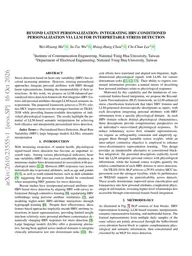
Beyond Latent Personalization: Integrating HRV-Conditioned Personalization via LLM for Interpretable Stress Detection
arXiv 2610.23555v1 (eess.SP), submitted 2026-10-16
Open code
Key results
All results- BLP (HRV-conditioned LLM personalization)Table 4 (source, opens in a new tab)
0.261
MCC ↑
Stress / affect · TILES-2018
HRV features + LLM-generated physiological interpretation
- BLP (HRV-conditioned LLM personalization)Table 4 (source, opens in a new tab)
0.614
MCC ↑
Stress / affect · WESAD
chest ECG-derived HRV · HRV features + LLM-generated physiological interpretation
Results as reported by the authors; not independently reproduced. A SOTA star marks the best value among results reported under the same evaluation protocol; ties go to the earlier publication.
TL;DR
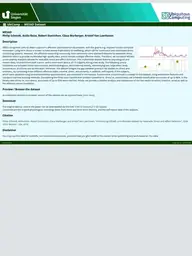
Idea: rather than learning a latent "personal" embedding, turn each subject's HRV and personal attributes (age, sex, work/lifestyle fields) into text. Per-domain prompts go to Qwen3.5-9B, which writes four domain-specific descriptions (time-domain, frequency-domain, multi-scale RR, multi-scale dRR HRV). Qwen3-Embedding-0.6B encodes them into four 1024-d vectors.
- Form factor: other
Abstract
Stress detection based on heart rate variability (HRV) has received increasing attention. However, existing personalized approaches integrate personal attributes with HRV through latent representations, limiting the interpretability of their interactions. In this work, we propose an LLM-enhanced personalized stress detection framework that integrates HRV features and personal attributes through LLM-based semantic interpretation. The proposed framework achieves a 29.9% relative MCC improvement over the strongest baseline on TILES-2018 while providing human-readable descriptions of individual physiological responses. The results highlight the potential of LLM-based semantic interpretation for achieving both effective and interpretable personalized stress detection.
Verbatim from arXiv (opens in a new tab) · arXiv metadata (abstracts are released under CC0)
Results on ChatPPG leaderboards · 2
All leaderboards| Leaderboard | Method | Result | Rank |
|---|---|---|---|
| TILES-2018 accuracyStress detection (acute / prolonged / affect) | BLP | 0.631accuracy, higher is better | #1 of 1 |
| WESAD accuracyStress detection (acute / prolonged / affect) | BLP | 0.823accuracy, higher is better | #2 of 2 |
2 rows are credited to this paper. Ranks apply within each leaderboard only, as reported by the source.
Tasks & signals
Tasks
Signals
Devices
Keywords
Datasets

How it works
Cite this paper
APA
Ma, W.-H., Wu, Y.-T., Chou, H.-H., & Lee, C.-C. (2026). Beyond Latent Personalization: Integrating HRV-Conditioned Personalization via LLM for Interpretable Stress Detection. arXiv 2610.23555v1 , submitted 2026-10-16. https://arxiv.org/abs/2610.23555
BibTeX
@misc{ma2026beyond,
  title         = {{Beyond Latent Personalization: Integrating HRV-Conditioned Personalization via LLM for Interpretable Stress Detection}},
  author        = {Ma, Wei-Hsiang and Wu, Ya-Tse and Chou, Hsing-Hang and Lee, Chi-Chun},
  year          = {2026},
  howpublished  = {arXiv 2610.23555v1 , submitted 2026-10-16},
  eprint        = {2610.23555},
  archivePrefix = {arXiv}
}
Built from the hub record. Check it against the publisher before submitting.
Added to the ChatPPG research hub