BVP Datasets for Wrist PPG Models: WESAD, PPG-DaLiA and GalaxyPPG
Blood volume pulse datasets such as WESAD, PPG-DaLiA and GalaxyPPG store Empatica BVP. What that means for polarity, preprocessing and model evaluation.
- PPG & Signal Processing
- PPG
Short answer: Many public wrist datasets used for stress, affect and heart-rate work store an Empatica "BVP" channel. That file is a processed, single-channel PPG waveform at 64 Hz, usually centred near zero, not raw multi-wavelength photodiode data. Models trained on it learn that processed shape. Moving those models to raw wrist PPG takes an explicit polarity check, matched filters and sampling rates, and a clear list of what the BVP channel never contained: a DC level, per-wavelength streams and SpO2 inputs.
If you have opened WESAD, PPG-DaLiA, GalaxyPPG or a similar Empatica E4 dataset, you have met BVP.csv. Despite the name, it is not a second vital sign. It is wrist photoplethysmography (PPG) under a psychophysiology name, after a proprietary processing step. Our PPG vs BVP guide explains the term and why traces can be upside down. This follow-up covers what the labelling means for preprocessing, training and evaluation when your target device records raw wrist PPG.
This article is educational and is not medical advice.
What a BVP channel is and is not
Empatica describes the E4 BVP as "the primary output from the E4 PPG sensor", obtained "by a proprietary algorithm that combines the light signals observed during both green and red exposure", at a fixed 64 Hz (Empatica blog). The export is a single column of values. The E4 specification lists two green and two red LEDs, two photodiodes and a motion artefact removal algorithm that "combines different light wavelengths" (E4 tech specs). BVP.csv gives you neither separate green and red streams nor a labelled DC level.
For anyone building models, that has three consequences:
- One processed channel. Features that need per-wavelength inputs cannot be recovered from BVP alone.
- Centred near zero. Without a DC level you cannot compute an AC/DC ratio or perfusion index from the export as written.
- Relative units. For cross-device work, treat amplitudes as arbitrary. The E4 sheet gives a sensor output resolution of 0.9 nW per digit, while at least one third-party importer describes the data as volts (MindWare KB0053). Neither is millilitres of blood or mmHg.
The datasets describe the channel in their own documentation:
- WESAD (Schmidt et al. 2018) has 15 subjects. Its readme describes
BVP.csvas "Data from photoplethysmograph (PPG)", sampled at 64 Hz, and says the derivedHR.csvandIBI.csvfiles should be ignored (UCI). - PPG-DaLiA (Reiss et al. 2019) has 15 subjects. It uses the same E4 wrist BVP at 64 Hz, with chest ECG as the heart-rate reference, recorded during daily-life activities (UCI).
- GalaxyPPG (Park et al. 2025) has 24 participants. It places Empatica E4 BVP next to raw Galaxy Watch5 PPG (25 Hz) and Polar H10 ECG, under CC BY 4.0 (Zenodo). It is the clearest public side-by-side of a processed BVP channel and raw wrist counts.
- UBFC-Phys (Sabour et al. 2023) ships wristband files named like
bvp_s*_T*.csv. We have not confirmed its sampling rate here, so check the dataset documentation. - Wearable Device Dataset (E4 stress and exercise) on PhysioNet also stores Empatica E4 BVP.
What these datasets share is the name, not identical preprocessing.
Thought Technology's HRV manual equates "Blood Volume Pulse (BVP, also called photoplethysmography)" with PPG and gives the unit as "relative (%)" (Thought Technology). That history explains the filename. It does not tell you which filters, sign convention or wavelength mix produced the column you are about to feed a network.
Licences
Licence terms differ between datasets and sometimes between copies. The original University of Siegen terms for WESAD and PPG-DaLiA allow scientific, non-commercial use with credit (see our WESAD and PPG-DaLiA cards), while the UCI page for PPG-DaLiA lists CC BY 4.0. Where terms conflict, follow the stricter one. GalaxyPPG and the Em and Teoh EmbracePlus dataset are both CC BY 4.0, which makes them easier to use for public figures with attribution. That is why every figure on this page comes from GalaxyPPG or the EmbracePlus dataset and none from WESAD or PPG-DaLiA.
Polarity: check the sign of every file
Blood absorbs light. When arterial volume under the sensor rises in systole, less light reaches the photodiode, so the raw detector output dips. Many displays invert the trace so systole points up. Reisner and colleagues stated the convention in 2008: "by convention, the photoplethysmogram is inverted so that it correlates positively with blood volume" (Reisner et al. 2008).
Public exports do not all follow one rule. Two datasets publish enough to show the difference:
Scroll horizontally if needed
| Signal | Stored polarity | Source |
|---|---|---|
| Raw Galaxy Watch5 PPG (GalaxyPPG) | Systole down; invert before analysis | Park et al. 2025: the Galaxy Watch signals "are provided as raw signals and must be inverted prior to analysis, as the device uses a reflective-type PPG sensor" |
Empatica E4 BVP.csv in GalaxyPPG |
Systole up | Same GalaxyPPG release (CC BY 4.0); see Figure 1 of the PPG vs BVP guide for participant P02 |
| Empatica EmbracePlus BVP export (firmware 4.19.2) | Systole down relative to device peaks | Em and Teoh dataset README: "multiply by -1 before peak detection"; the polarity check found the inversion in all 18 of 18 sessions |
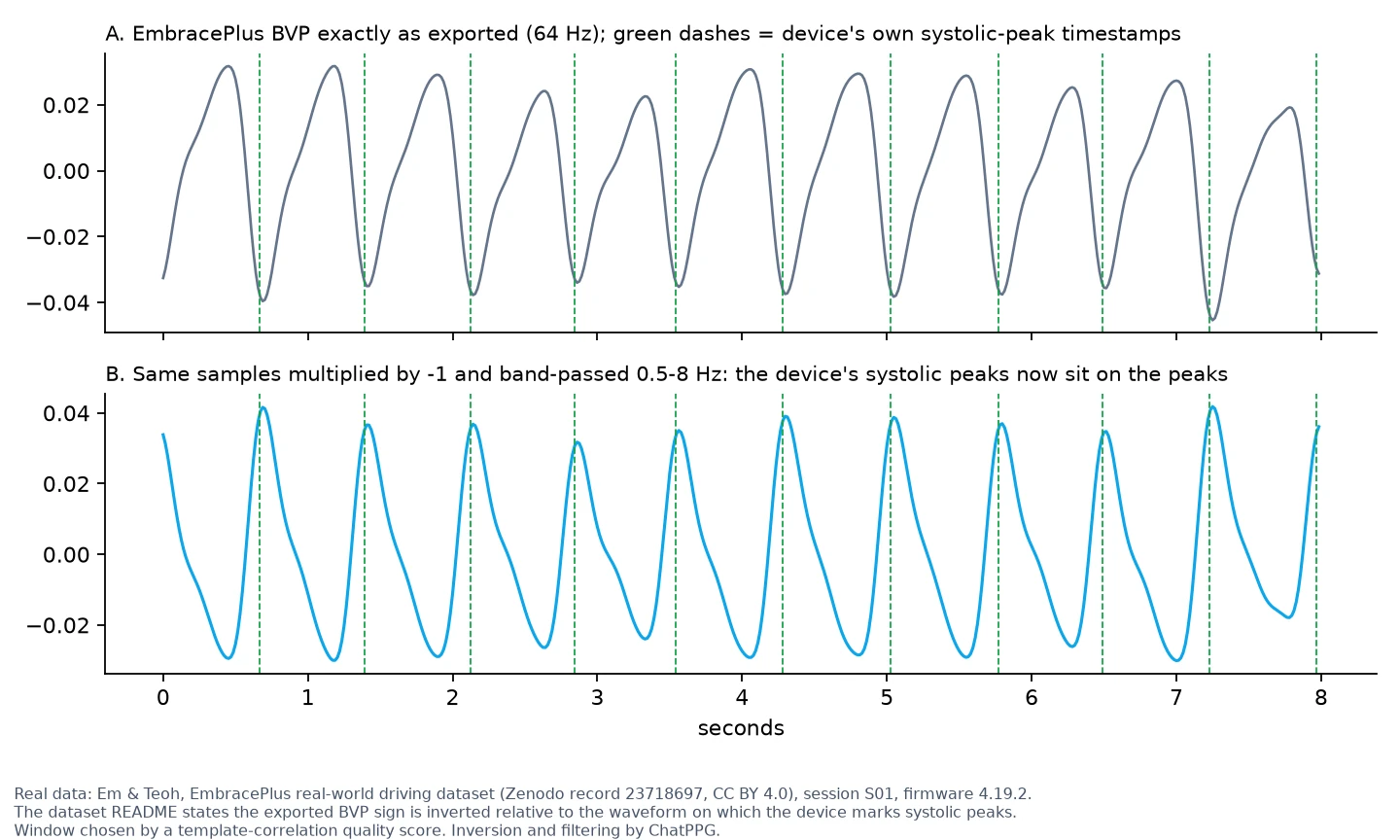
Figure 1. Real data from Em and Teoh's EmbracePlus driving dataset (Zenodo 23718697, CC BY 4.0), session S01. Green dashes are the device's own systolic-peak timestamps. Inversion and filtering by ChatPPG.
A sign error like this is enough to break a training run. A detector that expects upright peaks will mark troughs on an inverted file and shift every beat time by about the length of the upstroke. Do not generalise the GalaxyPPG E4 result to every E4 dataset, and do not generalise the EmbracePlus finding beyond firmware 4.19.2 and that one public export. Check each file.
Before you train or evaluate:
- Band-pass a resting window and compare the steepest rise with the steepest fall. In an upright beat the upstroke is steeper, so the ratio of the two slopes is above 1.
- If the device provides beat timestamps (EmbracePlus systolic peaks) or you have ECG, average the optical signal around those times and confirm you see peaks, not troughs.
- Record the result in metadata, for example
polarity: systole_up, method: slope_ratio, per file rather than once per dataset name.
The PPG vs BVP guide has the Python polarity check and an interactive explorer with real traces. For pipelines, the rule is shorter: never infer the sign from the filename "BVP".
Moving from BVP to raw wrist PPG
A model pretrained on E4-style BVP has seen a filtered, combined pulse at 64 Hz (systole-up in the GalaxyPPG E4 export, though you should re-check yours). A raw wrist PPG stream is a different signal, and closing the gap is mostly data engineering.
Match the sign. Apply the same polarity convention on both sides before any shared peak detector or morphology loss.
Match the band. Empatica's BVP is already processed. Raw counts need a documented band-pass filter, and often an inversion, before they resemble it. Write the filter corners into the training card so later runs can reproduce them.
Resample on purpose. E4 BVP is 64 Hz, while target devices often sample at other rates; the Galaxy Watch5 PPG in GalaxyPPG is 25 Hz. Resample with an explicit anti-aliasing step rather than silently training across mismatched rates.
Map channels honestly. BVP is one combined pulse channel. Do not treat it as a stand-in for a red or infrared channel, and note that multi-wavelength losses that assume independent colour channels have no counterpart in a single BVP file.
When the target device exports raw multi-wavelength PPG, you can apply and document each of these steps yourself. Sensor Bio V2, for instance, streams unfiltered green, red and infrared PPG plus accelerometer data, sampled at 50 Hz by default and configurable to 25 or 100 Hz (V2 specification).
Do not ask BVP data for DC-dependent targets. SpO2 ratio-of-ratios methods and perfusion-style features need per-wavelength signals with their DC levels, and E4 BVP does not provide them. Pretraining on BVP can still help with beat timing and pulse-shape priors, but it cannot supply optical information the export never recorded.
Evaluation
Public BVP datasets are convenient and small, so how you evaluate is part of the result.
Split by subject. WESAD and PPG-DaLiA each have 15 subjects. Random window splits put the same person in training and test sets and inflate scores that then fail on new wrists. Prefer leave-one-subject-out or a held-out group of subjects.
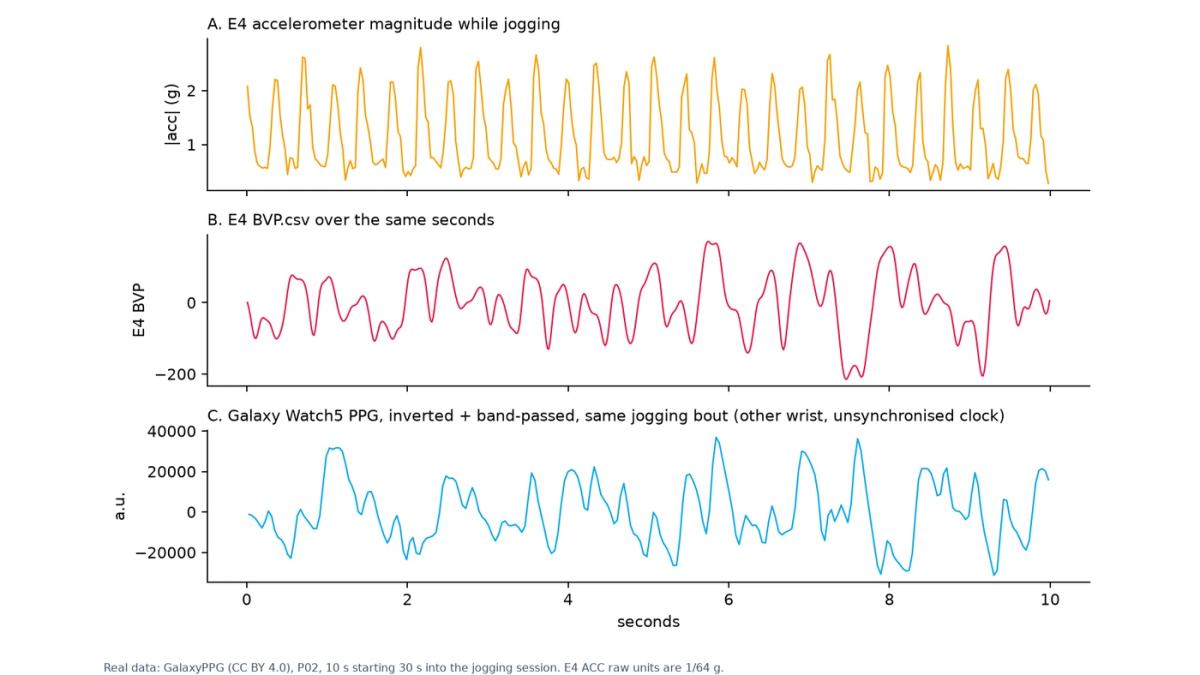
Report rest and motion separately. Empatica's own E4 specification says heart rate data estimated from its PPG sensor are "not suitable for running or physical activity" (E4 tech specs). GalaxyPPG's jogging data show the same limit in practice (Figure 2): step-rate motion shows up in both the E4 BVP and the watch PPG, and the pulse can no longer be read beat by beat. A single pooled MAE hides the failure mode a field deployment meets first. See motion artifact detection for screening methods.
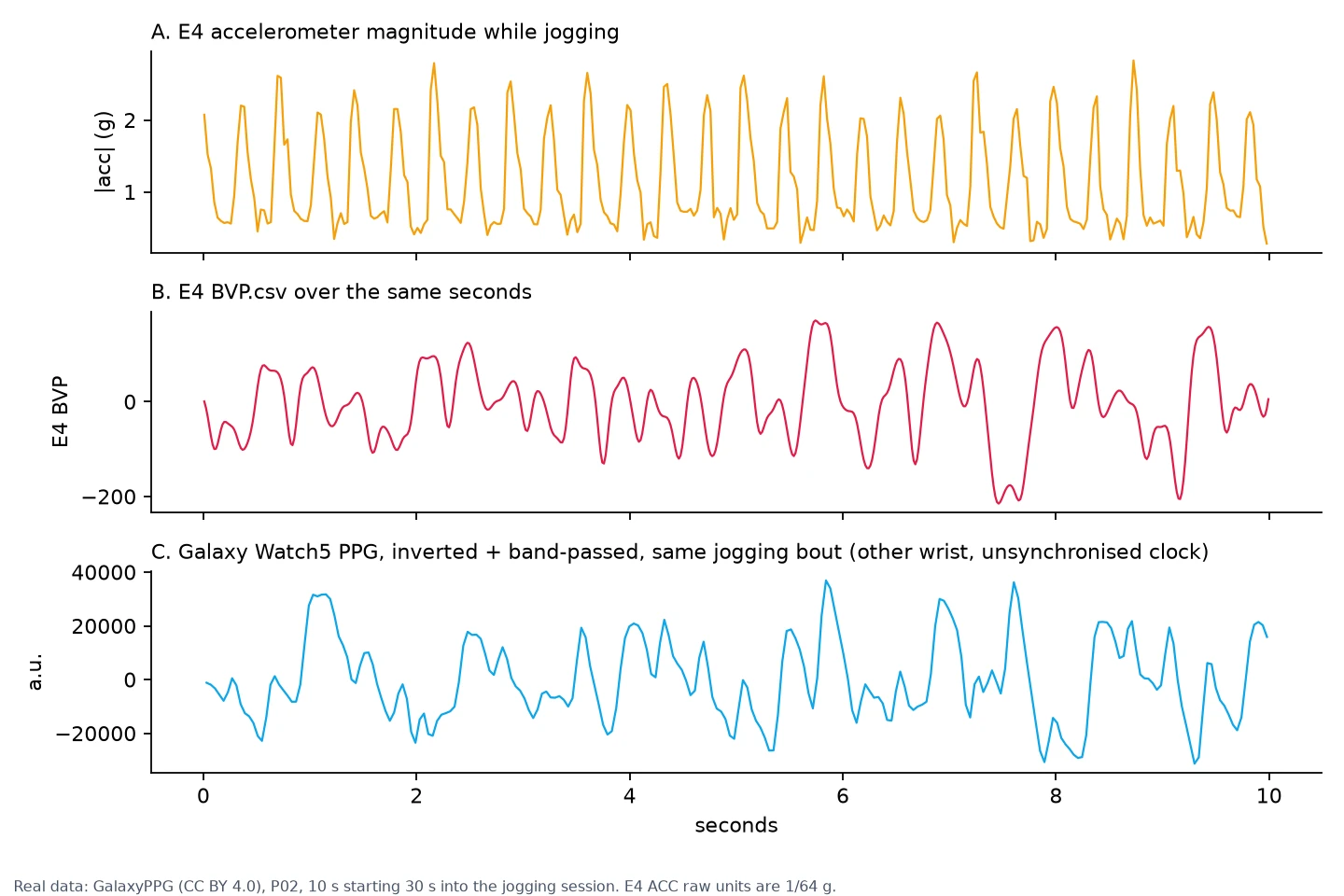
Figure 2. Real data from GalaxyPPG (Park et al. 2025; Zenodo, CC BY 4.0), participant P02, 10 s starting 30 s into the jogging session. Plotting by ChatPPG.
Call it pulse rate variability when that is what you measured. Intervals between wrist pulses are not identical to ECG R-R intervals, because pulse arrival time varies from beat to beat (PRV vs HRV). If your labels came from BVP peaks, name the measure accordingly, or validate against ECG before you write "HRV" in a methods table.
Respect licences. Non-commercial research datasets are fine for offline methods work under their terms. That does not make them reusable as figures on a commercial site, as public leaderboards or as training data for a shipped product. Read each dataset card before you plot or redistribute.
Document BVP assumptions in the model card. List channel count, sampling rate, polarity method, filter, and whether DC-dependent heads were frozen or left out, so reviewers do not have to reverse-engineer your preprocessing from a filename.
Kubios's Empatica guide makes a related point: it recommends importing BVP.csv and running your own beat detection rather than relying on the derived IBI.csv (Kubios guide). The same applies to learning systems. If you cannot go back to the optical record, you cannot tell whether an error came from the model or from an upstream peak detector. For detector options, see the peak detection guide and the dataset benchmarks overview.
Checklist before you train
- Check every training file's polarity and record it in metadata.
- Treat E4 BVP as one combined, processed channel at 64 Hz, not as raw multi-wavelength PPG.
- Align band-pass, resampling and peak definition before any transfer or joint training.
- Keep SpO2 and perfusion heads off any loss that only saw BVP.
- Evaluate by subject and by motion condition, and say pulse rate variability when labels are pulse-based.
- Check the dataset licence before making figures, redistributing or training for commercial use.
Public BVP-labelled datasets are useful starting points for beat timing and pulse-shape priors, but they are not drop-in substitutes for raw multi-wavelength wrist PPG. Write the preprocessing assumptions (sign, rate, filter, channel map, frozen heads) into the model card so the next device does not expose them for you.
References
- Em PP. EmbracePlus onboard systolic peaks and MSPTDfast in real-world driving: data and analysis code (data for Em and Teoh, submitted to Behavior Research Methods). Zenodo, 2026. CC BY 4.0. https://doi.org/10.5281/zenodo.23718697
- Empatica. Decoding wearable sensor signals: what to expect from your E4 data. https://www.empatica.com/blog/decoding-wearable-sensor-signals-what-to-expect-from-your-e4-data/
- Empatica. E4 technical specifications (2014). https://box.empatica.com/documentation/20141119_E4_TechSpecs.pdf
- Kubios. How to analyze Empatica E4 measurements. https://www.kubios.com/downloads/How-to-analyze-Empatica-E4-measurements.pdf
- MindWare Technologies. KB0053: Import data from the Empatica E4 sensor. https://support.mindwaretech.com/knowledge-base/kb0053/
- Park S, Zheng D, Lee U. A PPG signal dataset collected in semi-naturalistic settings using Galaxy Watch. Sci Data. 2025. https://doi.org/10.1038/s41597-025-05152-z ; data https://doi.org/10.5281/zenodo.14635823 (CC BY 4.0)
- Reisner A, Shaltis PA, McCombie D, Asada HH. Utility of the photoplethysmogram in circulatory monitoring. Anesthesiology. 2008;108(5):950-958. https://doi.org/10.1097/ALN.0b013e31816c89e1
- Reiss A, Indlekofer I, Schmidt P, Van Laerhoven K. Deep PPG: large-scale heart rate estimation with convolutional neural networks. Sensors. 2019;19(14):3079. https://doi.org/10.3390/s19143079 ; data https://archive.ics.uci.edu/dataset/495/ppg+dalia
- Sabour RM, Benezeth Y, De Oliveira P et al. UBFC-Phys: a multimodal database for psychophysiological studies of social stress. IEEE Trans Affect Comput. 2023. https://doi.org/10.1109/TAFFC.2021.3056960
- Schmidt P, Reiss A, Duerichen R, Marberger C, Van Laerhoven K. Introducing WESAD, a multimodal dataset for wearable stress and affect detection. ICMI 2018. https://doi.org/10.1145/3242969.3242985 ; data https://archive.ics.uci.edu/dataset/465/wesad
- Thought Technology. Heart rate variability applied to psychophysiology (MAR953-00). https://thoughttechnology.com/content/docs/manual/MAR953-00%20Heart%20Rate%20Variability%20applied%20to%20psychophysiology.pdf
Frequently Asked Questions
- What is a BVP channel in wrist wearable datasets?
- In Empatica E4 exports and the datasets built on them, BVP (blood volume pulse) is a single 64 Hz processed PPG waveform. Empatica describes it as the output of a proprietary algorithm that combines green and red light, so you do not get separate per-wavelength streams or a raw photodiode recording with a DC level.
- Why does BVP polarity matter when training wrist PPG models?
- Peak detectors and morphology features assume a known sign. On an inverted file the detected systolic peaks land on troughs and every beat time shifts. In GalaxyPPG, the Empatica E4 BVP.csv is systole-up while the raw Galaxy Watch5 PPG must be inverted before analysis. In Em and Teoh's EmbracePlus driving dataset (firmware 4.19.2), the exported BVP was inverted relative to the device's own systolic-peak timestamps in all 18 of 18 sessions. Check the sign of every file before training.
- Can models trained on BVP datasets learn SpO2 or perfusion features?
- Not from the E4-style BVP channel alone. That export is a single zero-centred pulse stream with no usable DC level and no separate red and infrared channels, so AC/DC ratios and ratio-of-ratios SpO2 methods have nothing to learn from.
- Which public datasets label wrist PPG as BVP?
- WESAD and PPG-DaLiA store Empatica E4 wrist BVP at 64 Hz. GalaxyPPG places E4 BVP next to raw Galaxy Watch5 PPG. UBFC-Phys and other Empatica-based stress and exercise datasets use the same naming. Licences differ, and some are limited to non-commercial research.
- Is this article medical advice?
- No. It is educational material for research and engineering teams working with wrist optical signals. It does not diagnose conditions or set clinical thresholds.
Related articles
BVP Meaning: Blood Volume Pulse vs PPG, and Why It Flips
BVP meaning: blood volume pulse is a PPG waveform under another name. How Empatica makes it, why some exports are upside down, and how to fix polarity.
Does Fitbit measure blood pressure? Which models get BP trends
No Fitbit shows mmHg. Blood pressure trends runs only on Fitbit Edge, Air and Pixel Watch 3–5, not Charge 6, Versa 4 or Inspire 3. What a High trend means.
Wrist Blood Pressure Monitor Accuracy
How accurate are wrist blood pressure monitors? We compare oscillometric cuffs and PPG-based cuffless devices, covering validation data, positioning tips, and clinical standards.
Most Accurate Wrist Blood Pressure Monitor: Evidence-Based Guide for 2026
Which wrist blood pressure monitor is most accurate? We compare clinically validated oscillometric cuffs and PPG-based cuffless devices with real accuracy data.
Explainable AI for PPG Models: Saliency, SHAP, and Clinical Interpretability
Explainable AI (XAI) methods reveal which parts of a PPG waveform drive a deep learning model's prediction. Clinicians, regulators, and patients are r...
Devices in this article
Research records with the datasets, papers and published validation results for each device.