rPPG vs Contact PPG Accuracy
Remote photoplethysmography and contact PPG measure the same physiological phenomenon through very different means. Both detect blood volume changes i...
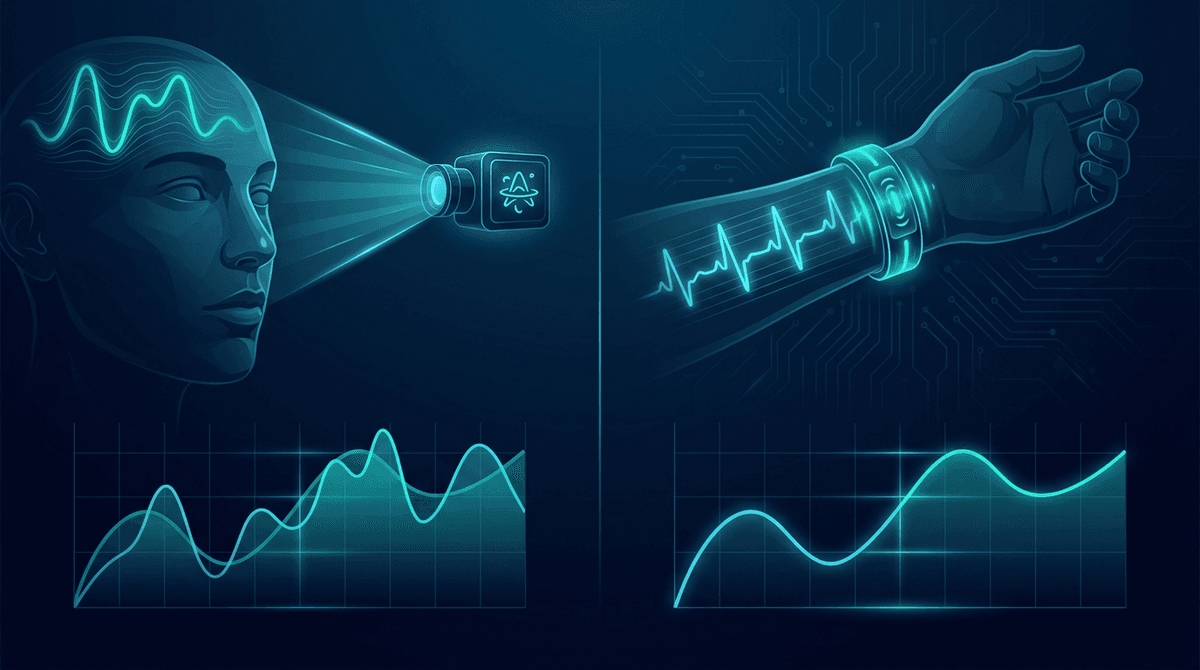
Remote photoplethysmography and contact PPG measure the same physiological phenomenon through very different means. Both detect blood volume changes in peripheral vasculature. But contact PPG does it from millimeters away with a controlled LED and photodetector, while rPPG does it from half a meter or more using ambient or uncontrolled light reflected off skin into a standard camera.
The accuracy gap between the two methods is real and consequential. But it's also narrowing faster than most clinicians expect.
How Contact PPG Works (Brief Baseline)
A contact PPG sensor, like those in smartwatches or clinical oximeters, places a green or red LED in direct contact with (or very close to) the skin. The photodetector sits adjacent, shielded from ambient light. The light path is short, controlled, and stable. Signal-to-noise ratios in good contact PPG systems are in the range of 20-40 dB.
Because the geometry is fixed and the light source is dedicated, contact PPG systems achieve heart rate accuracy of roughly 1-2 bpm RMSE in controlled conditions (Bent et al., 2020, DOI: 10.1038/s41746-020-0226-6).
rPPG Under Controlled Conditions
In good lighting, with a cooperative stationary subject and a quality camera, rPPG systems have achieved heart rate RMSE values below 3 bpm (Poh et al., 2010, DOI: 10.1364/OE.18.010762). More recent deep learning-based methods reach 1-2 bpm RMSE under ideal conditions, approaching contact PPG performance.
The VIPL-HR database validation by Niu et al. (2020, DOI: 10.1109/TPAMI.2020.2986942) showed that the best-performing rPPG algorithms achieved mean absolute errors under 2 bpm on carefully curated test sets with adequate lighting and minimal motion.
That's clinically meaningful accuracy. For resting heart rate trending, wellness monitoring, or population-level screening, this is sufficient.
Where the Gap Widens: Motion and Lighting Variability
The performance gap between rPPG and contact PPG becomes dramatic under real-world conditions.
Motion Artifacts
Contact PPG is affected by motion too — wrist-worn sensors during running can see errors of 5-15 bpm without motion artifact removal. But contact PPG systems benefit from accelerometer data fusion, tighter geometry, and higher SNR that make motion artifact separation more tractable.
rPPG during head motion, speaking, or even small fidgets sees dramatic signal quality drops. The face moves in 3D, different ROIs become shadowed or over-exposed, and the skin-motion signal (movement-induced pixel shifts) can be 10-100x larger than the cardiac signal. Several studies have documented rPPG heart rate errors exceeding 20 bpm during natural head motion (Mcduff et al., 2015, DOI: 10.1109/TBME.2014.2364301).
This is the primary barrier to rPPG deployment in telehealth, where subjects talk, look around, and aren't strapped to a fixed position.
Skin Tone Effects
Contact PPG is largely skin-tone agnostic when well-designed — the proximity means enough light reaches the detector regardless of melanin levels. rPPG is more problematic. Darker skin tones reflect less light overall, reducing the rPPG signal amplitude. Several published systems have shown significantly higher error rates for darker Fitzpatrick scale types (Fitzpatrick IV-VI) compared to lighter types (I-III).
A 2022 paper by Nowara et al. (DOI: 10.1109/CVPRW56347.2022.00199) specifically quantified this bias: MAE for dark skin tones was 2.3x higher than for light skin tones in several benchmark algorithms. Addressing skin-tone bias in rPPG is now an active research area.
Distance and Angle
Contact PPG has no distance variable. rPPG accuracy degrades with distance in a roughly quadratic relationship to illuminance loss. At 2 meters, a typical webcam captures much less light per pixel from the face than at 0.5 meters, substantially reducing SNR. Face angle also matters — a 45-degree head turn can cut usable ROI area by half and change the specular reflection geometry.
Heart Rate vs HRV: A Critical Distinction
Even where rPPG heart rate accuracy is adequate, heart rate variability accuracy tells a different story. HRV requires accurate inter-beat interval (IBI) measurements to millisecond-level precision. Contact PPG can achieve IBI errors below 10-20 ms with good signal quality. rPPG IBI errors are typically much larger — often 20-50 ms in good conditions, and much worse in motion or poor lighting.
The clinical implications are significant. Many HRV biomarkers (SDNN, RMSSD, LF/HF ratio) change meaningfully with IBI errors of just 20-30 ms. Deploying rPPG for clinical HRV measurement without rigorous validation is problematic.
A meta-analysis by Preum et al. (2022, DOI: 10.1145/3477601) found that median rPPG HRV RMSE across published studies was approximately 15 ms (RMSSD), compared to 5-8 ms for contact PPG in similar conditions. Acceptable for some wellness applications; not sufficient for clinical cardiovascular risk assessment.
SpO2 and Blood Pressure: Even Wider Gaps
For oxygen saturation, rPPG cameras need at least two wavelength channels with appropriate spectral response. Modified Beer-Lambert law calculations require known extinction coefficients. Most standard RGB cameras don't have the spectral characteristics needed for accurate SpO2 — the red and green channels aren't centered at 660 nm and 940 nm as clinical pulse oximetry requires.
Some researchers have achieved SpO2 estimation via rPPG with errors of 2-3% in controlled conditions, but this doesn't meet clinical standards. Contact pulse oximetry typically achieves ±1.5% accuracy or better per ISO 80601-2-61.
Blood pressure estimation via rPPG is even less mature. While pulse transit time-based approaches show promise, no contactless BP measurement system has achieved clinical-grade accuracy (±5 mmHg, 8 mmHg SD) in free-living conditions.
Where rPPG Wins
Despite these limitations, rPPG holds real advantages for specific use cases:
Zero compliance friction: Contact PPG requires wearing a device. For elderly patients, hospital patients with compromised skin, or anyone who refuses wearables, rPPG offers continuous monitoring without physical contact.
Simultaneous monitoring of multiple subjects: A single camera can monitor several people in a neonatal ICU, a waiting room, or a driver's seat without per-person sensor deployment.
Infection control: In clinical settings where PPE and contact precautions are required, rPPG eliminates one touch-point entirely.
Longitudinal population screening: For rough wellness trends in large populations — school health screening, corporate wellness programs — rPPG accuracy may be entirely adequate if the use case is detecting gross abnormalities rather than precise monitoring.
The Practical Verdict
For resting heart rate in good lighting with a cooperative, still subject: rPPG achieves accuracy comparable to consumer wearables (2-4 bpm RMSE). That's meaningful.
For HRV, SpO2, or blood pressure: rPPG is not yet clinically equivalent to contact methods. Useful for research and wellness tracking, not for clinical decision-making without specific FDA clearance.
For real-world telehealth with head motion and variable lighting: the gap remains significant, and accurate clinical application requires rigorous user instruction, signal quality gating, and appropriate measurement windows.
The trajectory is clearly toward closing these gaps. But honest characterization of current performance is essential to prevent premature clinical deployment.
- rPPG Comprehensive Guide 2026 — full overview of rPPG technology
- rPPG HRV Measurement Accuracy — deep dive into IBI accuracy
- PPG Skin Tone Bias Accuracy — fairness and equity in PPG
- Camera Heart Rate Clinical Validation — validation study overview
- Wearable Pulse Oximeter Guide — contact SpO2 context
Frequently Asked Questions
Is rPPG as accurate as a pulse oximeter? Not currently for SpO2 measurement. Standard cameras lack the precise spectral bands (660 nm red, 940 nm NIR) needed for accurate SpO2 estimation. For heart rate only, rPPG can approach pulse oximeter accuracy in controlled conditions.
Can rPPG replace a medical-grade heart rate monitor? For resting heart rate trending and wellness monitoring, rPPG achieves sufficient accuracy in good conditions. For clinical decisions — arrhythmia detection, drug titration, intensive care monitoring — contact methods remain the standard.
Why is rPPG less accurate during movement? Movement causes large pixel intensity changes from skin displacement that overwhelm the tiny cardiac signal. Contact PPG sensors move with the skin, so motion artifact is less severe. Camera-based methods must separate movement from cardiac signal, which is computationally hard and imprecise at high motion levels.
How does skin tone affect the accuracy gap between rPPG and contact PPG? Darker skin tones reduce rPPG accuracy more than contact PPG accuracy, widening the gap. Contact PPG with good optics is largely skin-tone independent. rPPG accuracy for Fitzpatrick type V-VI skin can be 2-3x worse than for type I-III skin in the same conditions.
What distance is rPPG accurate at? Most validated systems operate at 0.3 to 1.5 meters. Beyond 2 meters, signal quality typically degrades significantly unless special illumination is used.
Is rPPG heart rate variability reliable? For clinical HRV metrics (SDNN, RMSSD), rPPG IBI errors of 15-50 ms introduce meaningful bias into most indices. Current rPPG HRV is suitable for general wellness trending, not clinical cardiovascular assessment.
Frequently Asked Questions
- Is rPPG as accurate as a pulse oximeter?
- Not currently for SpO2 measurement. Standard cameras lack the precise spectral bands needed for accurate SpO2 estimation. For heart rate only, rPPG can approach pulse oximeter accuracy in controlled conditions.
- Can rPPG replace a medical-grade heart rate monitor?
- For resting heart rate trending and wellness monitoring, rPPG achieves sufficient accuracy in good conditions. For clinical decisions — arrhythmia detection, drug titration, intensive care monitoring — contact methods remain the standard.
- Why is rPPG less accurate during movement?
- Movement causes large pixel intensity changes from skin displacement that overwhelm the tiny cardiac signal. Contact PPG sensors move with the skin, so motion artifact is less severe. Camera-based methods must separate movement from cardiac signal, which is computationally hard.
- Is rPPG heart rate variability reliable?
- For clinical HRV metrics (SDNN, RMSSD), rPPG IBI errors of 15-50 ms introduce meaningful bias into most indices. Current rPPG HRV is suitable for general wellness trending, not clinical cardiovascular assessment.