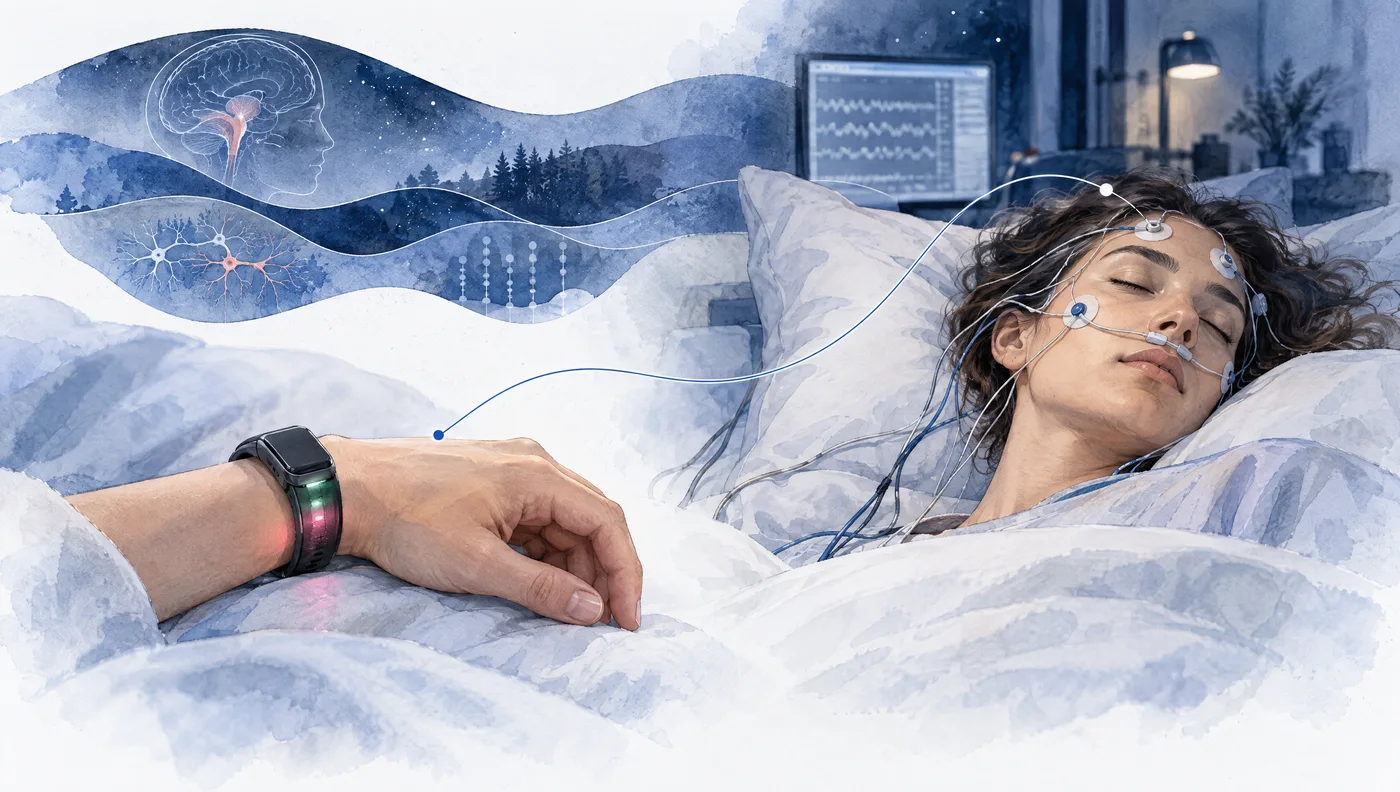
PPG Sleep Tracking SOTA: Staging Kappa, AHI/REI Cutoffs, and What Wearables Actually Measure
State of the art for PPG and wearable sleep tracking in 2026: four-class staging Cohen's kappa (SleepPPG-Net2, wav2sleep), AHI/REI screening cutoffs (≥5 / ≥15 / ≥30), ODI and hypoxic burden, plus public datasets and leaderboards.
Short answer:
- Staging: Four-class PPG sleep staging (wake / light / deep / REM) is judged mainly with Cohen's kappa against PSG. SleepPPG-Net2 reports median κp 0.75 on MESA-test and up to ~19% higher external kappa than SleepPPG-Net; wav2sleep reports κ = 0.742 on MESA with PPG-only at test time (hub result
wav2sleep__mesa__kappa__ppg-test). - Apnea load: Track AHI/REI at ≥5 / ≥15 / ≥30, plus continuous error when published. Wearable PPG/SpO2 is screening, not a PSG substitute. Apple's K240929 SANF: 66.3% sensitivity / 98.5% specificity for AHI ≥15 vs type-3 HSAT (n = 1,499).
- Desaturation metrics: Report ODI (3% vs 4%) and, when available, hypoxic burden—do not treat ODI as AHI.
- Hub boards: Live rows → sleep staging leaderboard and sleep apnea AHI leaderboard. Datasets → wearable sleep staging datasets.
This page is ChatPPG's measure / validate map for PPG and wearable sleep tracking: how stages and apnea load are scored in papers, which public numbers are citable today, and where the hub keeps them. It is not a home-sleep-test buyer guide or treatment pathway (that stays on the Sensor Bio application lane).
Related deep dives: PPG sleep staging algorithms, PPG sleep apnea detection, sleep fragmentation biomarkers, PPG foundation models.
Comparison table: staging SOTA (verified citations only)
Four-class = wake, light (N1+N2), deep (N3), REM unless noted. Values are as reported in the cited paper or ChatPPG hub key-result—protocols differ; do not rank across rows as a single leaderboard.
Scroll horizontally if needed
| Method | Inputs (test) | Dataset / split | Metric | Value | Source |
|---|---|---|---|---|---|
| SleepPPG-Net2 | Raw PPG | MESA-test (source) | Median κp (4-class) | 0.75 | Attia et al., arXiv:2404.06869 Table II |
| SleepPPG-Net2 | Raw PPG | CFS (external) | Median κp | 0.74 | same, Table II |
| SleepPPG-Net2 | Raw PPG | ABC / HomePAP / CAP / SLEEPAI | Median κp | 0.69 / 0.69 / 0.57 / 0.66 | same, Table II |
| SleepPPG-Net | Raw PPG | MESA-test | Median κp | 0.74 | same Table II; Kotzen et al. 2023 |
| BM-DTS (IPR / beat-interval) | Derived IPR from PPG peaks | MESA-test | Median κp | 0.65 | Attia et al. Table II (Sridhar-style DTS) |
| wav2sleep | PPG only | MESA held-out | Cohen's κ (4-class) | 0.742 | Hub wav2sleep__mesa__kappa__ppg-test; arXiv:2411.04644 |
| wav2sleep | PPG + thoracic effort | MESA | Cohen's κ | 0.78 | Hub wav2sleep__mesa__kappa__ppg-thx |
| wav2sleep | ECG only | SHHS | Cohen's κ | 0.74 | Hub wav2sleep__shhs__kappa__ecg |
| SleepPPG-Net (Kotzen 2023) | Raw PPG | Held-out + external (after TL) | Median κ | 0.75 / 0.74 | JBHI 2023 |
| Radha et al. 2021 | Wrist PPG (ECG→PPG transfer) | 60 PPG subjects | Acc / κ (4-class) | 76.36% / 0.65 | npj Digit Med |
| Fonseca et al. 2017 | PPG HRV + ACC | 51 adults | Acc / κ (4-class) | 59.3% / 0.42 | Sleep 2017 |
SleepPPG-Net2 generalization note: Multi-source training improved target-domain κp by 1–19% vs SleepPPG-Net across CFS, ABC, HomePAP, CAP, and SLEEPAI (Attia et al.). Downstream sleep-measure MAE on grouped external sets (SleepPPG-Net2): TST 24.2 min, sleep efficiency 4.56%, FRREM 3.72%, FRLight 9.47%, FRDeep 8.53% (Table III)—usable for TST/SE/REM fraction; light/deep fractions remain weaker.
Related (not PPG-only): SleepFM (Thapa et al., arXiv:2405.17766) is a multi-modal PSG foundation model (brain activity, ECG, respiration). Logistic regression on leave-one-out embeddings: sleep-stage macro AUROC 0.88 vs 0.72 end-to-end CNN; sleep-disordered breathing AUROC 0.85 vs 0.69 (abstract). Cite it as multimodal context, not a wrist-PPG baseline. SleepFM-2 extends scale and wearable transfer—see the model card for the published claims.
What “good” staging looks like (metrics)
Scroll horizontally if needed
| Metric | What it answers | Notes for PPG papers |
|---|---|---|
| Cohen's κ (overall / per-patient) | Agreement beyond chance with PSG stages | Prefer reporting both κc and median κp; state 2/3/4/5-class mapping |
| Accuracy / balanced accuracy / macro-F1 | Epoch correctness | Accuracy alone hides class imbalance (N2 dominates) |
| Confusion by stage | Where errors concentrate | Light↔deep and REM↔wake are common failure modes; OSA severity and age hurt κ (SleepPPG-Net2 error analysis) |
| Sleep measures MAE | TST, SE, stage fractions | Needed if the product claim is “hours of deep sleep,” not epoch labels |
Human ceiling context: Rosenberg & Van Hout (2013) AASM inter-scorer program—overall agreement with majority score ~82.6%, lower for N1/N3 (JCSM).
Live rows: sleep-staging leaderboard.
AHI / REI / ODI: what to track on this pillar
Wearable apnea evaluation is a different task from staging. Keep both on this page so “sleep tracking SOTA” includes the apnea load people actually ask about.
Reference ladder (measure, not buy)
Scroll horizontally if needed
| Tier | What it is | Typical output | Role |
|---|---|---|---|
| Type-1 PSG (lab) | Full EEG/EOG/EMG + airflow + effort + SpO2 | AHI (events / hour of sleep) | Gold-standard diagnosis |
| Type-3 HSAT | Limited channels at home | REI (events / hour of monitoring) | Accepted diagnostic pathway for many adults |
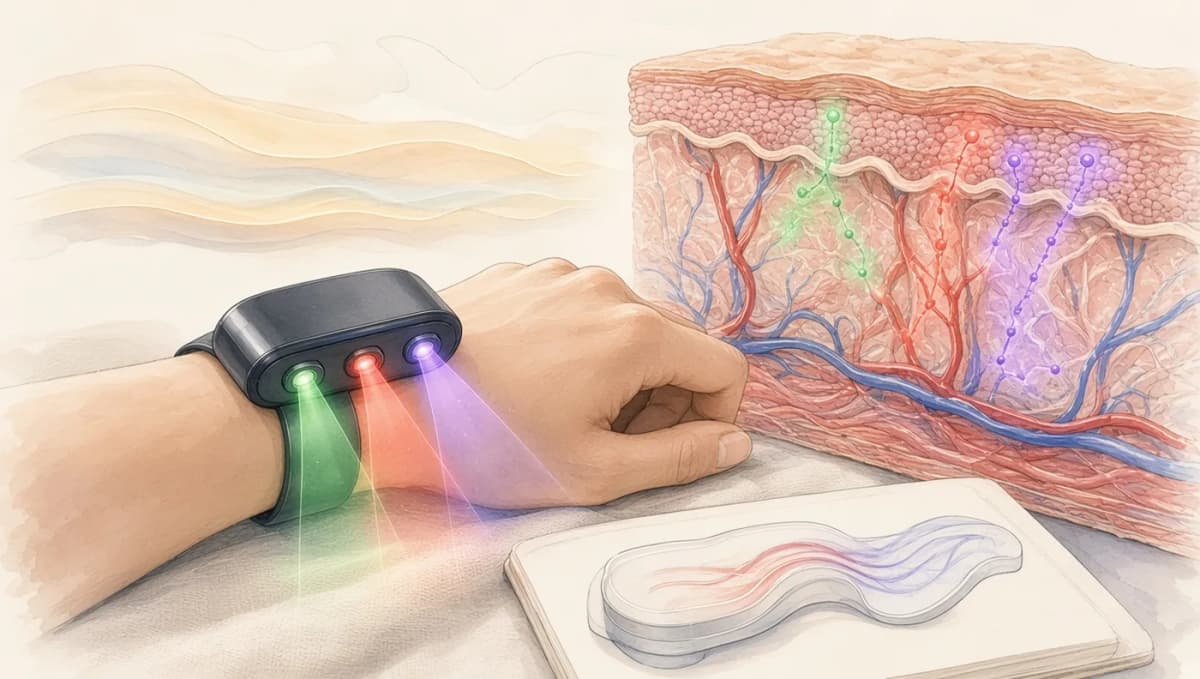
| PPG / SpO2 wearable | Watch/ring oximetry + pulse dynamics | ODI, PRV patterns, proprietary scores | Screening / longitudinal only unless cleared and labeled otherwise |
Cutoffs to report (when the paper uses AHI or REI)
Scroll horizontally if needed
| Cutoff | Usual clinical band | Why track it |
|---|---|---|
| ≥5 | Mild or greater | Inclusive screening operating point |
| ≥15 | Moderate-to-severe | Common device/FDA analysis point (e.g. Apple K240929) |
| ≥30 | Severe | High-pretest / triage operating point |
Also report continuous error when published (e.g. MAE in events/hour). Example hub row: PaPaGei linear probe on MESA AHI3 — MAE 12.97 events/h (papagei__mesa__ahi3-mae). Board: sleep-apnea-ahi.
Consumer / cleared screening example (public facts only)
Scroll horizontally if needed
| System | Reference | Endpoint | Result | Source |
|---|---|---|---|---|
| Apple Sleep Apnea Notification Feature | Type-3 HSAT | AHI ≥15 | Sens 66.3%, Spec 98.5% (n = 1,499) | FDA 510(k) K240929 |
Interpretation for engineers: high specificity → few false alarms; sensitivity gap → roughly one-third of AHI ≥15 cases not flagged. That is screening math, not a lab AHI substitute. Broader PPG/SpO2 apnea methods and ODI caveats: PPG sleep apnea detection.
ODI and hypoxic burden
- ODI: count of SpO2 drops (define 3% vs 4%) per hour. Correlates with AHI but misses hypopneas that arouse without much desaturation (REM-related OSA, high baseline reserve). Rashid et al. (2021) systematic review: ODI sensitivity/specificity vs AHI varied widely across studies (doi:10.1002/lary.28663).
- Hypoxic burden: cumulative desaturation (area under the desaturation curve), increasingly used because AHI ignores event depth and duration. Prefer papers that report burden alongside event rate when available.
- OxiNet (Levy et al. 2023): deep learning AHI estimate from single-channel oximetry on 12,923 PSGs—missed 0.2% of moderate-to-severe OSA vs 21% for the best benchmark in that paper (Nat Commun). Oximetry ≠ wrist PPG, but it bounds what desaturation-centric models can do.
Public datasets and hub links
Scroll horizontally if needed
| Resource | Why it matters | Link |
|---|---|---|
| Wearable sleep staging datasets (DREAMT, sleep-accel, NSRR) | Access + reference labels | /research/topics/wearable-sleep-staging-datasets |
| Sleep staging leaderboard | Task × dataset × metric rows | /research/leaderboards/sleep-staging |
| Sleep apnea AHI leaderboard | AHI / severity probes | /research/leaderboards/sleep-apnea-ahi |
| wav2sleep model card | Variable-sensor staging | /research/models/wav2sleep |
| SleepFM / SleepFM-2 | Multimodal PSG FMs | /research/models/sleepfm-v1, /research/models/sleepfm-2 |
| MESA / SHHS (NSRR) | Scale PSG + PPG (gated) | Via NSRR; see dataset cards in hub |
Pitfalls (measure / validate)
- Cross-paper kappa leaderboards without protocol — 3-class vs 4-class, R&K vs AASM, fingertip Nonin vs wrist BVP, within-dataset vs leave-one-dataset-out are not comparable.
- Calling ODI “AHI” — different event definitions; state the reference (PSG AHI vs HSAT REI vs ODI3/ODI4).
- Single operating point — publish ≥5 / ≥15 / ≥30 (or the paper’s cutoffs), not only AUROC.
- Ignoring OSA severity and age — SleepPPG-Net2 found higher AHI and older age independently lower κp.
- Product “sleep score” ≠ published staging — consumer stages are often proprietary fusions of PPG + ACC + heuristics; cite the validation study, not the marketing label.
- Clinical pathway creep — HSAT ordering, CPAP titration, and dysautonomia care paths are Sensor Bio application content. Soft link only; do not duplicate buyer guides here.
FAQ
What is the state of the art for PPG sleep staging in 2026?
For four-class staging from raw PPG, SleepPPG-Net2 (Attia et al., arXiv:2404.06869) reports median per-patient Cohen's kappa up to 0.75 on MESA-test and improves external-set kappa by up to 19% versus SleepPPG-Net via multi-source training. wav2sleep reports κ = 0.742 on MESA with PPG-only at test time. Compare only on matched label sets, datasets, and splits—see the table above and the sleep-staging leaderboard.
What is Cohen's kappa for sleep staging, and what is a good score?
Cohen's kappa measures agreement with expert PSG beyond chance. Strong recent PPG four-class results sit around the mid-0.6 to mid-0.7 band; SleepPPG-Net2's MESA-test median κp is 0.75. Human inter-scorer agreement (~82.6% with majority score in Rosenberg & Van Hout 2013) is a useful ceiling, not a kappa number you can paste next to a model without conversion.
Can a smartwatch measure AHI like a sleep lab?
No. PSG defines AHI; HSAT defines REI; wearables mostly see ODI-like desaturation and pulse dynamics. Apple's K240929 feature is a clear public screening example: 66.3% sensitivity and 98.5% specificity for AHI ≥15 versus type-3 HSAT—not a lab AHI device.
What cutoffs should I track for wearable sleep apnea evaluation?
Track the paper's AHI or REI cutoffs—typically ≥5, ≥15, and ≥30—plus continuous error (MAE/bias) when given. Always name whether the reference was PSG AHI or HSAT REI, and keep ODI / hypoxic burden in separate columns.
What is the difference between AHI, REI, ODI, and hypoxic burden?
AHI = PSG events per hour of sleep. REI = HSAT events per hour of monitoring. ODI = SpO2 dips per hour (state 3% vs 4%). Hypoxic burden = cumulative desaturation over time. PPG wearables observe the last two most directly.
Which public datasets are best for PPG sleep research?
Wrist + PSG stages: DREAMT. Scale NSRR oximeter PPG: MESA and related cohorts (DUA). Small open watch HR: sleep-accel. Full pick list: wearable sleep staging datasets.
Is this a clinical sleep-apnea diagnosis guide?
No. This is ChatPPG measure/validate. For application-science framing of physiology and product context, see Sensor Bio; for care decisions, follow clinicians and AASM pathways.
Sources
- Attia, S., et al. (2024). SleepPPG-Net2: Deep learning generalization for sleep staging from photoplethysmography. arXiv:2404.06869. https://arxiv.org/abs/2404.06869
- Kotzen, K., et al. (2023). SleepPPG-Net. IEEE JBHI. https://doi.org/10.1109/JBHI.2022.3225363
- Carter, J. F., & Tarassenko, L. (2024). wav2sleep. arXiv:2411.04644. https://arxiv.org/abs/2411.04644
- Thapa, R., et al. (2024). SleepFM. arXiv:2405.17766. https://arxiv.org/abs/2405.17766
- Radha, M., et al. (2021). Wearable sleep stage classification with PPG. npj Digital Medicine. https://doi.org/10.1038/s41746-021-00510-8
- Fonseca, P., et al. (2017). PPG-based sleep staging vs PSG. Sleep. https://doi.org/10.1093/sleep/zsx097
- Rosenberg, R. S., & Van Hout, S. (2013). AASM inter-scorer reliability. JCSM. https://doi.org/10.5664/jcsm.2350
- Levy, J., et al. (2023). Deep learning OSA from single-channel oximetry. Nature Communications. https://doi.org/10.1038/s41467-023-40604-3
- Rashid, N. H., et al. (2021). ODI for OSA screening systematic review. Laryngoscope. https://doi.org/10.1002/lary.28663
- U.S. FDA. 510(k) K240929 — Apple Sleep Apnea Notification Feature. https://www.accessdata.fda.gov/scripts/cdrh/cfdocs/cfPMN/pmn.cfm?ID=K240929
Frequently Asked Questions
- What is the state of the art for PPG sleep staging in 2026?
- For four-class staging from raw PPG (wake, light, deep, REM), SleepPPG-Net2 (Attia et al., arXiv:2404.06869) reports median per-patient Cohen's kappa up to 0.75 on MESA-test and improves external-set kappa by up to 19% versus SleepPPG-Net via multi-source training. wav2sleep (Carter & Tarassenko, arXiv:2411.04644) reports κ = 0.742 on MESA with PPG-only at test time after joint multi-dataset training. Always compare models on the same label set, dataset, and split.
- What is Cohen's kappa for sleep staging, and what is a good score?
- Cohen's kappa measures agreement with expert-scored polysomnography beyond chance. PPG four-class papers often land roughly in the mid-0.6 to mid-0.7 range on local tests; SleepPPG-Net2 reaches median κp 0.75 on MESA-test. Human AASM inter-scorer agreement is a useful ceiling: Rosenberg & Van Hout (2013) reported about 82.6% agreement with the majority score overall, with lower agreement for N1 and N3.
- Can a smartwatch measure AHI like a sleep lab?
- No. Lab PSG remains the gold standard for apnea-hypopnea index (AHI). Type-3 home sleep apnea tests (HSAT) report a respiratory event index (REI) that is accepted for many diagnostic pathways. PPG/SpO2 wearables are screening tools: they estimate oxygen desaturation index (ODI), pulse-rate patterns, or proprietary scores. Apple's Sleep Apnea Notification Feature (FDA 510(k) K240929) reported 66.3% sensitivity and 98.5% specificity for AHI ≥15 versus a type-3 HSAT reference in 1,499 participants—high specificity, but about one-third of moderate-to-severe cases missed.
- What cutoffs should I track for wearable sleep apnea evaluation?
- Report performance at the clinical severity cutoffs used in the source study: typically AHI or REI ≥5 (mild+), ≥15 (moderate-to-severe), and ≥30 (severe), plus continuous error (MAE or bias in events/hour) when available. Also report ODI definitions (3% vs 4%) and, when the paper provides it, hypoxic burden. Do not mix AHI, REI, and ODI as if they were interchangeable.
- What is the difference between AHI, REI, ODI, and hypoxic burden?
- AHI counts apneas and hypopneas per hour of sleep from PSG. REI is the analogous count from limited-channel HSAT (often per hour of monitoring). ODI counts SpO2 drops of a defined magnitude (commonly 3% or 4%) per hour. Hypoxic burden captures cumulative desaturation over time, not just event rate. PPG wearables most directly observe ODI-like desaturation and pulse dynamics; mapping those to AHI requires validation against PSG or HSAT.
- Which public datasets are best for PPG sleep research?
- For wrist PPG with technician stages, start with DREAMT (Empatica E4 BVP during PSG). For scale and oximeter PPG under NSRR DUAs, use MESA and related cohorts. sleep-accel (Walch) is small and open but provides PPG-derived heart rate, not raw PPG. Dataset picks and access notes live at /research/topics/wearable-sleep-staging-datasets.
- Is this a clinical sleep-apnea diagnosis guide?
- No. ChatPPG covers measure and validate: algorithms, metrics, datasets, and published cutoffs. Clinical pathways, HSAT ordering, and treatment decisions are application science—see Sensor Bio for product-framed physiology context, and follow AASM/clinician guidance for care.
Core guide: What Is Actigraphy?
Related articles
Home Sleep Apnea Test vs Polysomnography: Where Wearables Fit and What They Cannot Replace
HSAT and polysomnography answer different clinical questions. This guide explains when each test is appropriate, what wearables and PPG can support, and what they still cannot replace in sleep apnea care.
SpO2 Monitoring in Heart Failure Patients: What Home Oxygen Tracking Can and Cannot Tell You
Home SpO2 tracking in heart failure can be useful in selected situations, especially when nocturnal desaturation or sleep-disordered breathing is a concern. This guide explains what oxygen monitoring can support, what it cannot diagnose, and where it fits in heart failure care.
Stress Tracker Accuracy Guide: What Wearables Actually Measure
Independent review of wearable stress tracker accuracy covering HRV methods, sensor limitations, and how to interpret stress scores from Garmin, Fitbit, and Apple Watch.
Smartwatch AF detection vs Holter: what a 150-person wrist-worn study found
A 150-person npj Digital Medicine study compared wrist PPG + single-lead ECG to 24-h Holter for AF detection and burden, then tracked 28 days of wear.
PPG Sleep Apnea Detection
Sleep apnea affects an estimated 1 billion people worldwide, with the majority undiagnosed. PPG-based wearables can screen for it by tracking nocturna...
Devices in this article
Research records with the datasets, papers and published validation results for each device.