Paperdoi:10.1088/1361-6579/aec110
MorphSSF: a fast slope-sum adaptive-period dilation algorithm for photoplethysmography beat detection
Physiological Measurement, 2026 (accepted manuscript online 2026-11-11)
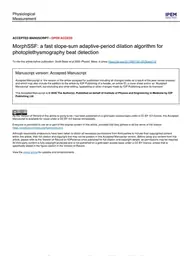 (opens in a new tab)
Scott Desai et al., "MorphSSF: a fast slope-sum adaptive-period dilation algorithm for photoplethysmography beat detection", doi:10.1088/1361-6579/aec110, CC BY 4.0
TL;DR
Scalogram-free PPG beat detector (slope-sum + autocorrelation period + period-matched running-max dilation). Best mean F1 rank (1.29) against 8 benchmark detectors on 7 public datasets (544 recordings), 3.23× faster than MSPTDfast v2, and a fixed-point C version reproduced the integer model exactly on an emulated Cortex-M4. No code released.
- Form factor: finger + wrist (benchmark spans clinical finger PPG and wrist Empatica E4)
Abstract
Objective: Detecting heartbeats in photoplethysmography (PPG) underlies heart-rate, heart-rate-variability and arrhythmia analysis on wearable and clinical devices, and must be both efficient and accurate. Several accurate benchmark detectors, especially the multi-scale peak-and-trough family (MSPTD/MSPTDfast), rely on costly local-maxima scalograms; we seek a detector that improves the benchmark-wide speed–accuracy trade-off rather than merely accelerating one baseline. Approach: MorphSSF converts each PPG window to a slope-sum function (SSF), estimates the dominant pulse period from a band-limited autocorrelation, and selects candidates as fixed points of a period-matched running-maximum dilation on the SSF. This combines systolic-upstroke enhancement with adaptive period spacing using one-dimensional operations and no scalogram. We evaluate under identical conditions on seven datasets (544 recordings) with benchmark-wide rank tests, detector-specific exclusions and one-to-one matching. Separate fixed-point C and causal MATLAB variants are evaluated. Main results: MorphSSF has the best mean dataset F1 rank. Against MSPTDfast (v2), sensitivity tests favour MorphSSF on five datasets (including a zero median effect on CapnoBase); F1 is higher on MIMIC-test, MIMIC-train and PPG-DaLiA, while positive predictive value (PPV) is lower on WESAD. Both pooled and equal-dataset analyses favour MorphSSF in F1 against all eight baselines. MorphSSF is 3.05–218.18× faster than the eight baselines, including 3.23× faster than MSPTDfast (v2), based on median runtime ratios across recordings. All detectors receive the same prefiltered PPG input, with this shared filtering step excluded from runtime measurements. Significance: Period-adaptive detection on the slope-sum provides an efficient, scalogram-free approach to PPG beat detection.
Verbatim from the publisher's DOI record (opens in a new tab) · Publisher licence: https://creativecommons.org/licenses/by/4.0/
Results on ChatPPG leaderboards
All leaderboardsNo results from this paper on ChatPPG leaderboards yet. Browse the leaderboards.
Tasks & signals
Signals
Devices
Keywords
Datasets used
 BIDMC PPG and Respiration (Pimentel 2016 / PhysioNet)Evaluation53 subjects · PPG · ECG · SpO₂
 CapnoBase IEEE TBME RR benchmark (Karlen 2013)EvaluationPPG · ECG · Resp
 MIMIC PERformCharlton PPG/ECG/RESP ICU beat-detection benchmarks (+ AF subset)Evaluation35 subjects · PPG · ECG · BP
 PPG-DaLiAPPG dataset for motion compensation / HREvaluation15 subjects · PPG · ECG · IMU
 WESADWearable Stress and Affect DetectionEvaluation15 subjects · PPG · ECG · IMU
How it works
Cite this paper
Desai, S., & Shi, W. (2026). MorphSSF: a fast slope-sum adaptive-period dilation algorithm for photoplethysmography beat detection. Physiological Measurement, 2026. https://doi.org/10.1088/1361-6579/aec110
Desai, Scott and Wei Shi. 2026. "MorphSSF: a fast slope-sum adaptive-period dilation algorithm for photoplethysmography beat detection." Physiological Measurement, 2026. https://doi.org/10.1088/1361-6579/aec110.
Desai, S. and Shi, W. (2026) 'MorphSSF: a fast slope-sum adaptive-period dilation algorithm for photoplethysmography beat detection', Physiological Measurement, 2026. doi: 10.1088/1361-6579/aec110.
Desai, Scott, and Wei Shi "MorphSSF: a fast slope-sum adaptive-period dilation algorithm for photoplethysmography beat detection." Physiological Measurement, 2026, 2026. https://doi.org/10.1088/1361-6579/aec110.
S. Desai and W. Shi, "MorphSSF: a fast slope-sum adaptive-period dilation algorithm for photoplethysmography beat detection," Physiological Measurement, 2026, 2026, doi: 10.1088/1361-6579/aec110.
@article{desai2026morphssf,
  title         = {{MorphSSF: a fast slope-sum adaptive-period dilation algorithm for photoplethysmography beat detection}},
  author        = {Desai, Scott and Shi, Wei},
  year          = {2026},
  journal       = {Physiological Measurement, 2026},
  doi           = {10.1088/1361-6579/aec110}
}Added to the ChatPPG research hub