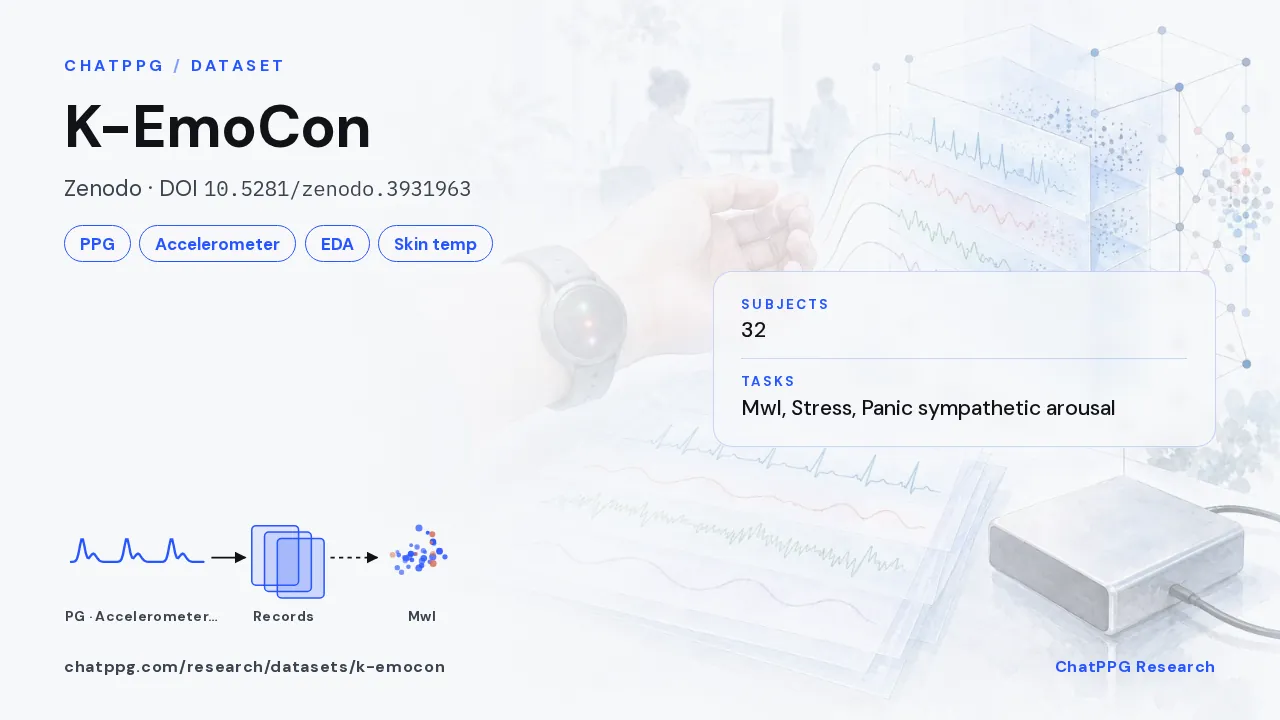
K-EmoCon is a multimodal sensor dataset for continuous emotion recognition during naturalistic conversations. It was introduced by Cheul Young Park, Narae Cha, Soowon Kang, Auk Kim, Ahsan Habib Khandoker, Leontios Hadjileontiadis, Alice Oh, Yong Jeong and Uichin Lee in "K-EmoCon, a multimodal sensor dataset for continuous emotion recognition in naturalistic conversations", Scientific Data 7:293 (2020).
The authors point out that most emotion datasets were collected in constrained settings and cannot capture the idiosyncratic emotions that come up in real social interaction. K-EmoCon records 16 sessions of paired debates on a social issue, each about 10 minutes long. The study recruited 32 participants between January and March 2019.
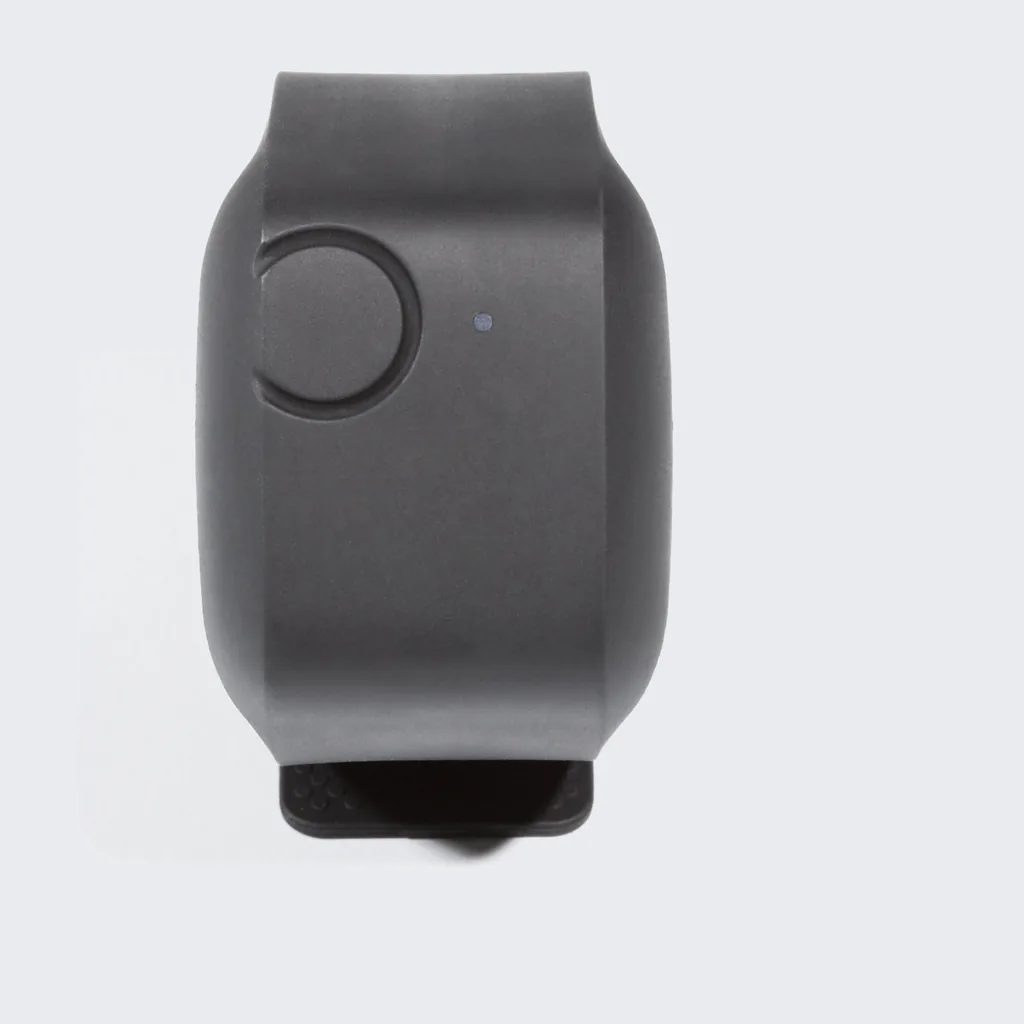
Participants wore three off-the-shelf devices. An Empatica E4 wristband captured PPG, three-axis acceleration, body temperature and electrodermal activity, with heart rate and inter-beat interval derived from the blood volume pulse. A Polar H7 chest strap recorded heart rate with an ECG sensor, partly to complement the E4 PPG, which is sensitive to motion. A NeuroSky MindWave headset collected EEG from two dry electrodes. Audio and video of the debates were recorded too.
The emotion labels are the main contribution. Emotions were annotated from three perspectives: the participants themselves, their debate partners and external observers. Raters marked emotional displays every 5 seconds while watching the debate footage, using arousal and valence plus 18 additional categorical emotions. The authors describe K-EmoCon as the first public emotion dataset with this kind of multiperspective assessment during social interaction.
For PPG work, K-EmoCon offers wrist PPG with a chest heart rate reference in a conversational setting, which is rare. It is a good test for emotion and arousal models that need to work outside the lab, and for heart rate methods during talking and gesturing.
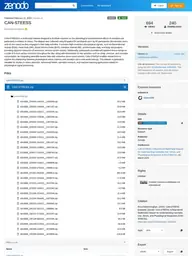
The Zenodo record (version 1.0.0, July 2020) is restricted, so you must request access there. The files cover E4 data, NeuroSky and Polar data, debate audio and video, emotion annotations, metadata and data quality tables.
Labels
arousal, valence and 18 additional categorical emotions
Access
restricted Zenodo record 10.5281/zenodo.3931963
Paper
Park et al., Scientific Data 7:293 (2020), doi 10.1038/s41597-020-00630-y
Sessions
16 paired debates of about 10 minutes; 32 participants recruited
Annotations every 5 seconds from self, partner and external raters
Recognizing emotions during social interactions has many potential applications with the popularization of low-cost mobile sensors, but a challenge remains with the lack of naturalistic affective interaction data. Most existing emotion datasets do not support studying idiosyncratic emotions arising in the wild as they were collected in constrained environments. Therefore, studying emotions in the context of social interactions requires a novel dataset, and K-EmoCon is such a multimodal dataset with comprehensive annotations of continuous emotions during naturalistic conversations. The dataset contains multimodal measurements, including audiovisual recordings, EEG, and peripheral physiological signals, acquired with off-the-shelf devices from 16 sessions of approximately 10-minute long paired debates on a social issue. Distinct from previous datasets, it includes emotion annotations from all three available perspectives: self, debate partner, and external observers. Raters annotated emotional displays at intervals of every 5 seconds while viewing the debate footage, in terms of arousal-valence and 18 additional categorical emotions. The resulting K-EmoCon is the first publicly available emotion dataset accommodating the multiperspective assessment of emotions during social interactions.
* Version 1.0.0 (Jul 7, 2020): - Updated emotion_annotations.tar.gz: - Updated aggregated external annotations to support the reproduction of technical validation results.
* Version 0.2.0 (May 11, 2020): - Added data_quality_tables.tar.gz - Updated emotion_annotations.tar.gz - Newly added aggregated external annotations. - Updated metadata.tar.gz: - Added a new column to data_availability.csv to show the availability of aggregated external annotations.
K-EmoCon (Park et al., Scientific Data 2020) is a multimodal dataset for continuous emotion recognition in naturalistic conversations. It contains audiovisual recordings, EEG and peripheral physiological signals from 16 sessions of approximately 10-minute paired debates on a social issue. Emotions were annotated every 5 seconds in terms of arousal, valence and 18 additional categories, from three perspectives: the participant, the debate partner and external observers.
Full photo credits and licences are on each device page. An icon means we have no openly licensed or manufacturer-cleared photo of that exact device yet.
A dataset of 16 roughly 10-minute paired debates with wearable physiological signals, EEG, audio-video and emotion ratings every 5 seconds.
How do I get K-EmoCon?
Request access on its Zenodo record. The files are restricted and released on approval.
What wearables were used?
An Empatica E4 wristband, a NeuroSky EEG headset and a Polar H7 heart-rate sensor.
Who annotated the emotions?
The participants themselves, their debate partners, and external observers.
How do I download K-EmoCon?
Request access on the Zenodo record (DOI 10.5281/zenodo.3931963). Access is restricted; follow the record’s instructions and cite the dataset paper.
K-EmoCon vs WESAD?
WESAD is a lab study of stress and amusement with chest and wrist sensors. K-EmoCon records naturalistic debates with continuous emotion labels from self, partner and observers.
What are K-EmoCon benchmark results?
The Scientific Data paper presents technical validation of the data and annotations, so model results come from later studies.
Cite this dataset
This citation is the paper recorded with this dataset. Check it against the publisher before submitting.
Park, C. Y., Cha, N., Kang, S., Kim, A., Khandoker, A. H., Hadjileontiadis, L., Oh, A., Jeong, Y., & Lee, U. (2020). K-EmoCon, a multimodal sensor dataset for continuous emotion recognition in naturalistic conversations. Scientific Data, 7(1). https://doi.org/10.1038/s41597-020-00630-y
Park, Cheul Young, Narae Cha, Soowon Kang, Auk Kim, Ahsan Habib Khandoker, Leontios Hadjileontiadis, Alice Oh, Yong Jeong, and Uichin Lee. 2020. "K-EmoCon, a multimodal sensor dataset for continuous emotion recognition in naturalistic conversations." Scientific Data 7 (1). https://doi.org/10.1038/s41597-020-00630-y.
Park, C. Y., Cha, N., Kang, S., Kim, A., Khandoker, A. H., Hadjileontiadis, L., Oh, A., Jeong, Y. and Lee, U. (2020) 'K-EmoCon, a multimodal sensor dataset for continuous emotion recognition in naturalistic conversations', Scientific Data, 7(1). doi: 10.1038/s41597-020-00630-y.
Park, Cheul Young, et al. "K-EmoCon, a multimodal sensor dataset for continuous emotion recognition in naturalistic conversations." Scientific Data, vol. 7, no. 1, 2020. https://doi.org/10.1038/s41597-020-00630-y.
C. Y. Park et al., "K-EmoCon, a multimodal sensor dataset for continuous emotion recognition in naturalistic conversations," Scientific Data, vol. 7, no. 1, 2020, doi: 10.1038/s41597-020-00630-y.
@article{park2020kemocon,
  title         = {{K-EmoCon, a multimodal sensor dataset for continuous emotion recognition in naturalistic conversations}},
  author        = {Park, Cheul Young and Cha, Narae and Kang, Soowon and Kim, Auk and Khandoker, Ahsan Habib and Hadjileontiadis, Leontios and Oh, Alice and Jeong, Yong and Lee, Uichin},
  year          = {2020},
  journal       = {Scientific Data},
  volume        = {7},
  number        = {1},
  publisher     = {Springer Science and Business Media LLC},
  doi           = {10.1038/s41597-020-00630-y}
}
Cite the ChatPPG record
Cite the dated snapshot 2026-10 for a fixed, reproducible version. Please also cite the original publications listed above.
APA
ChatPPG. (2026). K-EmoCon: dataset record (Version 2026-10) [Data set]. ChatPPG Research Hub. https://chatppg.com/research/datasets/k-emocon
BibTeX
@misc{chatppg_dataset_k_emocon,
  author       = {{ChatPPG}},
  title        = {{K-EmoCon: dataset record}},
  year         = {2026},
  month        = nov,
  version      = {2026-10},
  howpublished = {\url{https://chatppg.com/research/datasets/k-emocon}},
  note         = {ChatPPG Research Hub, Snapshot 2026-10, https://chatppg.com/research/snapshots/2026-10}
}
CITATION.cff
cff-version: 1.2.0
message: "If you use this resource, please cite it as below."
type: dataset
title: "K-EmoCon: dataset record"
authors:
  - name: "ChatPPG"
url: "https://chatppg.com/research/datasets/k-emocon"
repository-artifact: "https://chatppg.com/research/snapshots/2026-10"
version: "2026-10"
date-released: "2026-11-15"
History
Record updated
Newsletter
Get new PPG datasets, papers and models
Get alerts when new models are benchmarked on K-EmoCon, plus the weekly digest.
New datasets, papers and models
Practical guides from the hub
Unsubscribe anytime
The waveform is an illustration of a PPG pulse, not a recording.