PaperarXiv:2603.11950
SLIP: Learning Transferable Sensor Models via Language-Informed Pretraining

arXiv 2603.11950 (cs.AI; v1 2026-03-12, v2 2026-09-27) — preprint
 (opens in a new tab)
Chen, Yuliang et al., "Learning Transferable Sensor Models via Language-Informed Pretraining", arXiv:2603.11950, CC BY 4.0
TL;DR
Pretraining: ~600K sensor–caption pairs (~1 B time points). Community time-series corpora were captioned with the SensorLM recipe and augmented with ChatTS synthetic pairs. Domains include health, energy, IoT and more.
- Form factor: other
Abstract
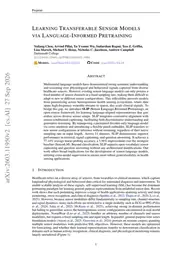
Multimodal language models have demonstrated strong semantic understanding and reasoning over physiological and behavioral signals captured from diverse healthcare sensors. However, existing sensor-language models can only process a fixed number of sensor channels at a fixed sampling rate, making them difficult to adapt to new or different sensor configurations. This inflexibility prevents models from generalizing across heterogeneous health sensing ecosystems, where data spans high-frequency wearable streams to sparse, day-scale clinical signals. To bridge this gap, we introduce SLIP (Sensor Language-Informed Pretraining), an open-source framework for learning language-aligned representations that generalize across diverse sensor setups. SLIP integrates contrastive alignment with sensor-conditioned captioning, facilitating both discriminative understanding and generative reasoning. By repurposing a pretrained decoder-only language model via cross-attention and introducing a flexible patch embedder, SLIP transfers to new sensor configurations at inference without retraining, regardless of their native sampling rate or input length. Across 11 datasets, SLIP demonstrates superior performance in retrieval, signal captioning, and question answering. It achieves a 77.14% average linear-probing accuracy, a 3.56% improvement over the strongest baseline (SensorLM). Beyond classification, SLIP supports open-vocabulary sensor captioning and question answering without any architectural modifications. Our work offers broad implications for the development of sensor-language models, utilizing cross-modal supervision to ensure more robust generalizability in health sensing applications.
Verbatim from arXiv (opens in a new tab) · arXiv metadata (abstracts are released under CC0)
Results on ChatPPG leaderboards
All leaderboardsNo results from this paper on ChatPPG leaderboards yet. Browse the leaderboards.
Tasks & signals
Signals
Devices
Keywords
Datasets used
- HAR-CoT85,482 triaxial accel windows + GPT-4o chain-of-thought (OpenTSLM / TimeNet opentslm/har-cot)IMU
 Sleep-EDF Database Expanded (PhysioNet)Resp · Temp · EEG
- StudentLifeDartmouth smartphone sensing corpus with inferred sleep timing48 subjects · IMU · Audio · light
 UCI Human Activity Recognition Using Smartphones (UCI-HAR)30 subjects · IMU
 WESADWearable Stress and Affect DetectionEvaluation15 subjects · PPG · ECG · IMU
 WISDM AR v1.1cellphone accelerometer HAR (n=36)36 subjects · IMU
Models
How it works
Cite this paper
Chen, Y., Pillai, A., Wu, Y. Y., Regmi, S., Griffin, T. Z., Marsch, L., Heinz, M. V., Jacobson, N. C., & Campbell, A. (2026). SLIP: Learning Transferable Sensor Models via Language-Informed Pretraining. arXiv 2603.11950 — preprint. https://arxiv.org/abs/2603.11950
Chen, Yuliang, Arvind Pillai, Yu Yvonne Wu, Sudarshan Regmi, Tess Z. Griffin, Lisa Marsch, Michael V. Heinz, Nicholas C. Jacobson, and Andrew Campbell. 2026. "SLIP: Learning Transferable Sensor Models via Language-Informed Pretraining." arXiv 2603.11950 — preprint. https://arxiv.org/abs/2603.11950.
Chen, Y., Pillai, A., Wu, Y. Y., Regmi, S., Griffin, T. Z., Marsch, L., Heinz, M. V., Jacobson, N. C. and Campbell, A. (2026) 'SLIP: Learning Transferable Sensor Models via Language-Informed Pretraining', arXiv 2603.11950 — preprint. Available at: https://arxiv.org/abs/2603.11950
Chen, Yuliang, et al. "SLIP: Learning Transferable Sensor Models via Language-Informed Pretraining." arXiv 2603.11950 — preprint, 2026. https://arxiv.org/abs/2603.11950.
Y. Chen et al., "SLIP: Learning Transferable Sensor Models via Language-Informed Pretraining," arXiv 2603.11950 — preprint, 2026, [Online]. Available: https://arxiv.org/abs/2603.11950.
@misc{chen2026slip,
  title         = {{SLIP: Learning Transferable Sensor Models via Language-Informed Pretraining}},
  author        = {Chen, Yuliang and Pillai, Arvind and Wu, Yu Yvonne and Regmi, Sudarshan and Griffin, Tess Z. and Marsch, Lisa and Heinz, Michael V. and Jacobson, Nicholas C. and Campbell, Andrew},
  year          = {2026},
  howpublished  = {arXiv 2603.11950 — preprint},
  eprint        = {2603.11950},
  archivePrefix = {arXiv}
}Record updated
Added to the ChatPPG research hub