PaperarXiv:2410.04133
ECGFounder: An ECG Foundation Model Built on 10+ Million Recordings
arXiv preprint
 (opens in a new tab)
Li, Jun et al., "An Electrocardiogram Foundation Model Built on over 10 Million Recordings with External Evaluation across Multiple Domains", arXiv:2410.04133, CC BY 4.0
Key results2 SOTA
All results0.993
AUROC ↑
AFib detection · PTB-XL
ECGFounder
atrial fibrillation, 12-lead · cross-dataset · pretrained classifier, no fine-tuning
Best comparison: CTN 0.953
0.981
AUROC ↑
ECG diagnosis · CODE-test
ECGFounder
average over 6 rhythm/conduction labels, 12-lead · cross-dataset · pretrained classifier, no fine-tuning
Best comparison: CTN 0.963
0.957
AUROC ↑
AFib detection · External single-lead devices
AF, single-lead · cross-dataset · pretrained classifier
Results as reported by the authors; not independently reproduced. A SOTA star marks the best value among results reported under the same evaluation protocol; ties go to the earlier publication.
Embed this badge (2 badges for READMEs and project pages)
 Markdown
[](https://chatppg.com/research/models/ecgfounder#key-results)HTML<a href="https://chatppg.com/research/models/ecgfounder#key-results"><img src="https://chatppg.com/research/badges/ecgfounder--afib-ptb-xl-auroc.svg" alt="SOTA on ChatPPG: AFib detection · PTB-XL" height="20"></a> Markdown
[](https://chatppg.com/research/models/ecgfounder#key-results)HTML<a href="https://chatppg.com/research/models/ecgfounder#key-results"><img src="https://chatppg.com/research/badges/ecgfounder--ecg-diagnosis-code-test-auroc.svg" alt="SOTA on ChatPPG: ECG diagnosis · CODE-test" height="20"></a>
TL;DR
ECGFounder is a general-purpose ECG foundation model trained on more than 10 million recordings with real-world annotations from cardiology experts. On held-out validation it reached expert-level performance, with AUROC above 0.95 for 80 diagnoses.
- Training data: 10M+ ECG recordings with expert annotations
- Result: AUROC > 0.95 for 80 diagnoses (internal validation)
Abstract
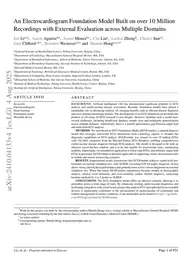
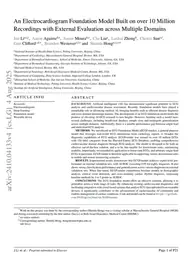
Artificial intelligence (AI) has demonstrated significant potential in ECG analysis and cardiovascular disease assessment. Recently, foundation models have played a remarkable role in advancing medical AI. The development of an ECG foundation model holds the promise of elevating AI-ECG research to new heights. However, building such a model faces several challenges, including insufficient database sample sizes and inadequate generalization across multiple domains. Additionally, there is a notable performance gap between single-lead and multi-lead ECG analyses. We introduced an ECG Foundation Model (ECGFounder), a general-purpose model that leverages real-world ECG annotations from cardiology experts to broaden the diagnostic capabilities of ECG analysis. ECGFounder was trained on over 10 million ECGs with 150 label categories from the Harvard-Emory ECG Database, enabling comprehensive cardiovascular disease diagnosis through ECG analysis. The model is designed to be both an effective out-of-the-box solution, and a to be fine-tunable for downstream tasks, maximizing usability. Importantly, we extended its application to lower rank ECGs, and arbitrary single-lead ECGs in particular. ECGFounder is applicable to supporting various downstream tasks in mobile monitoring scenarios. Experimental results demonstrate that ECGFounder achieves expert-level performance on internal validation sets, with AUROC exceeding 0.95 for eighty diagnoses. It also shows strong classification performance and generalization across various diagnoses on external validation sets. When fine-tuned, ECGFounder outperforms baseline models in demographic analysis, clinical event detection, and cross-modality cardiac rhythm diagnosis. The trained model and data will be publicly released upon publication through the bdsp.io. Our code is available at https://github.com/PKUDigitalHealth/ECGFounder
Verbatim from arXiv (opens in a new tab) · arXiv metadata (abstracts are released under CC0)
Results on ChatPPG leaderboards · 1
All leaderboards| Leaderboard | Method | Result | Rank |
|---|---|---|---|
| external-single-lead AUROCAtrial fibrillation detection | ECGFoundervia model ECGFounder | 0.957AUROC, higher is better | #1 of 1 |
No row is credited to the paper itself; 1 more belong to models it introduces or evaluates. Ranks apply within each leaderboard only, as reported by the source.
Tasks & signals
Tasks
Signals
Keywords
Datasets used
Models
How it works
Cite this paper
Li, J., Aguirre, A., Moura, J., Liu, C., Zhong, L., Sun, C., Clifford, G., Westover, B., & Hong, S. (2024). ECGFounder: An ECG Foundation Model Built on 10+ Million Recordings. arXiv preprint. https://arxiv.org/abs/2410.04133
Li, Jun, Aaron Aguirre, Junior Moura, Che Liu, Lanhai Zhong, Chenxi Sun, Gari Clifford, Brandon Westover, and Shenda Hong. 2024. "ECGFounder: An ECG Foundation Model Built on 10+ Million Recordings." arXiv preprint. https://arxiv.org/abs/2410.04133.
Li, J., Aguirre, A., Moura, J., Liu, C., Zhong, L., Sun, C., Clifford, G., Westover, B. and Hong, S. (2024) 'ECGFounder: An ECG Foundation Model Built on 10+ Million Recordings', arXiv preprint. Available at: https://arxiv.org/abs/2410.04133
Li, Jun, et al. "ECGFounder: An ECG Foundation Model Built on 10+ Million Recordings." arXiv preprint, 2024. https://arxiv.org/abs/2410.04133.
J. Li et al., "ECGFounder: An ECG Foundation Model Built on 10+ Million Recordings," arXiv preprint, 2024, [Online]. Available: https://arxiv.org/abs/2410.04133.
@misc{li2024ecgfounder,
  title         = {{ECGFounder: An ECG Foundation Model Built on 10+ Million Recordings}},
  author        = {Li, Jun and Aguirre, Aaron and Moura, Junior and Liu, Che and Zhong, Lanhai and Sun, Chenxi and Clifford, Gari and Westover, Brandon and Hong, Shenda},
  year          = {2024},
  howpublished  = {arXiv preprint},
  eprint        = {2410.04133},
  archivePrefix = {arXiv}
}Record updated