Activity counts measure attention, not model quality. Missing counts are unknown. Publication status follows the linked source; a listed venue alone does not confirm peer review.
GPT-PPG adapts the GPT architecture to continuous PPG signals. It was pretrained on more than 200 million 30-second PPG samples and then fine-tuned for specific tasks. It matched or beat earlier methods on several tasks, notably atrial fibrillation detection, and can denoise signals without extra fine-tuning.
Published
Physiological Measurement, 2025
Signals
PPG
Pretraining
200M+ 30 s PPG samples
Tasks
atrial fibrillation detection and others; denoising
License
CC BY 4.0
Year
2025
Architecture
GPT-style generative transformer
Emory follow-on
PPG-Distill (NeurIPS TS4H 2025) compresses GPT-PPG teachers for edge
Results as reported by the authors; not independently reproduced. A SOTA star marks the best value among results reported under the same evaluation protocol; ties go to the earlier publication.
Embed this badge (1 badge for READMEs and project pages)
Markdown
[](https://chatppg.com/research/models/gpt-ppg#key-results)
HTML
<a href="https://chatppg.com/research/models/gpt-ppg#key-results"><img src="https://chatppg.com/research/badges/gpt-ppg--afib-stanford-ppg-f1.svg" alt="SOTA on ChatPPG: AFib detection · Stanford AF (DeepBeat)" height="20"></a>
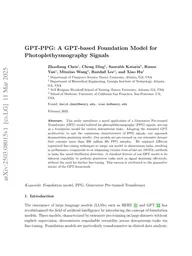
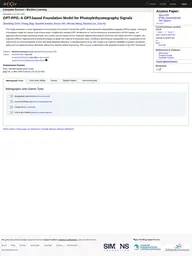
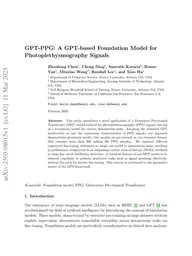
This study introduces a novel application of a Generative Pre-trained Transformer (GPT) model tailored for photoplethysmography (PPG) signals, serving as a foundation model for various downstream tasks. Adapting the standard GPT architecture to suit the continuous characteristics of PPG signals, our approach demonstrates promising results. Our models are pre-trained on our extensive dataset that contains more than 200 million 30s PPG samples. We explored different supervised fine-tuning techniques to adapt our model to downstream tasks, resulting in performance comparable to or surpassing current state-of-the-art (SOTA) methods in tasks like atrial fibrillation detection. A standout feature of our GPT model is its inherent capability to perform generative tasks such as signal denoising effectively, without the need for further fine-tuning. This success is attributed to the generative nature of the GPT framework.
Verbatim fromarXiv· arXiv metadata (abstracts are released under CC0)
How it works
Datasets linked in the hub; pretraining vs evaluation roles follow the paper.
Architecture
Decoder-only GPT (RMSNorm + RoPE), 1-s patches, logit-Laplace next-patch head
Inputs
PPG
Approach
PPG · foundation model · generative · decoder only · emory · ppg atlas
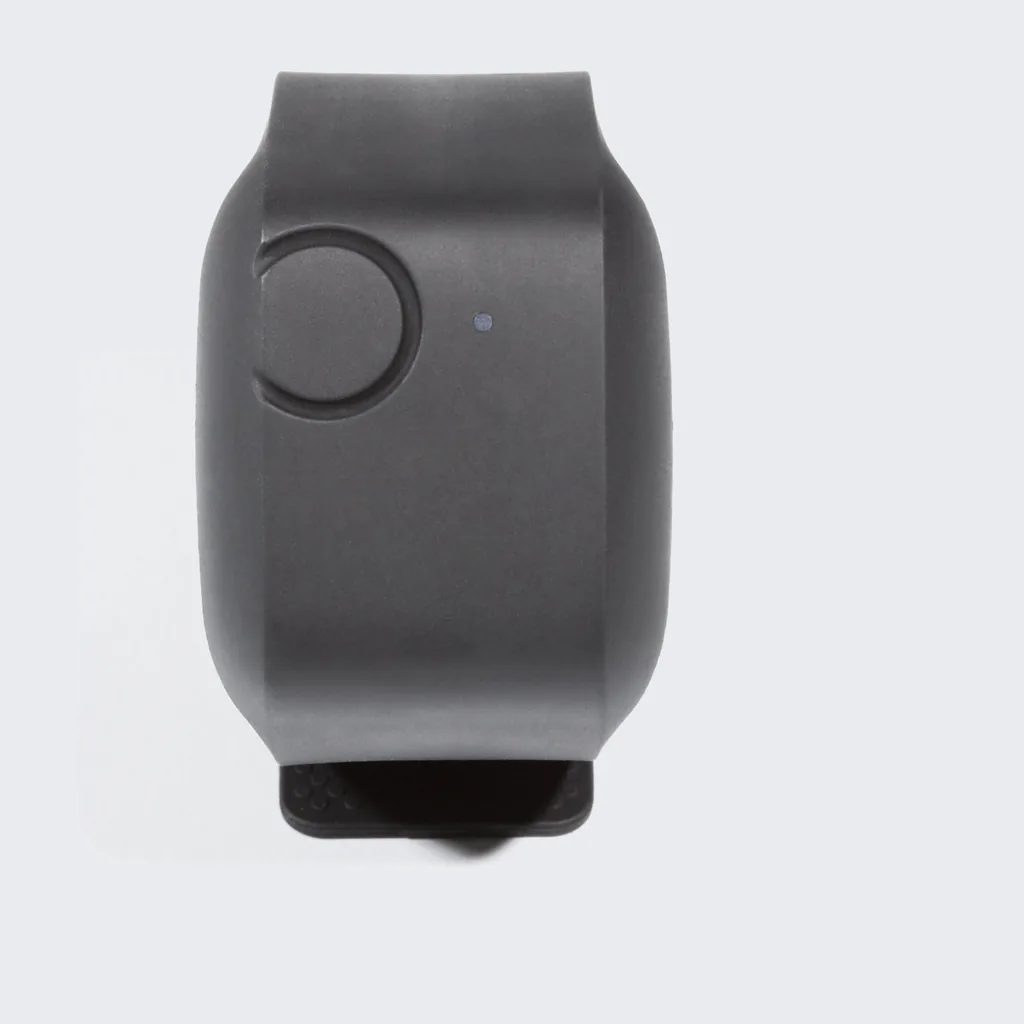
Full photo credits and licences are on each device page. An icon means we have no openly licensed or manufacturer-cleared photo of that exact device yet.
Cite the publication recorded for this model. Check it against the publisher before submitting.
Chen, Z., Ding, C., Kataria, S., Yan, R., Wang, M., Lee, R., & Hu, X. (2025). GPT-PPG: a GPT-based foundation model for photoplethysmography signals. Physiological Measurement. https://doi.org/10.1088/1361-6579/add988
Chen, Zhaoliang, Cheng Ding, Saurabh Kataria, Runze Yan, Minxiao Wang, Randall Lee, and Xiao Hu. 2025. "GPT-PPG: a GPT-based foundation model for photoplethysmography signals." Physiological Measurement. https://doi.org/10.1088/1361-6579/add988.
Chen, Z., Ding, C., Kataria, S., Yan, R., Wang, M., Lee, R. and Hu, X. (2025) 'GPT-PPG: a GPT-based foundation model for photoplethysmography signals', Physiological Measurement. doi: 10.1088/1361-6579/add988.
Chen, Zhaoliang, et al. "GPT-PPG: a GPT-based foundation model for photoplethysmography signals." Physiological Measurement, 2025. https://doi.org/10.1088/1361-6579/add988.
Z. Chen et al., "GPT-PPG: a GPT-based foundation model for photoplethysmography signals," Physiological Measurement, 2025, doi: 10.1088/1361-6579/add988.
@article{chen2025gptppg,
  title         = {{GPT-PPG: a GPT-based foundation model for photoplethysmography signals}},
  author        = {Chen, Zhaoliang and Ding, Cheng and Kataria, Saurabh and Yan, Runze and Wang, Minxiao and Lee, Randall and Hu, Xiao},
  year          = {2025},
  journal       = {Physiological Measurement},
  doi           = {10.1088/1361-6579/add988},
  eprint        = {2503.08015},
  archivePrefix = {arXiv}
}
History
Added to the ChatPPG research hub
Newsletter
Get new PPG datasets, papers and models
Get alerts when GPT-PPG is benchmarked on new datasets, plus the weekly digest.
New datasets, papers and models
Practical guides from the hub
Unsubscribe anytime
The waveform is an illustration of a PPG pulse, not a recording.