Activity counts measure attention, not model quality. Missing counts are unknown. Publication status follows the linked source; a listed venue alone does not confirm peer review.
PaPaGei is an open foundation model for photoplethysmography (PPG) signals, described in the paper "PaPaGei: Open Foundation Models for Optical Physiological Signals" by Arvind Pillai, Dimitris Spathis, Fahim Kawsar and Mohammad Malekzadeh, accepted at ICLR 2025. The authors present it as the first open foundation model for PPG.
The model was pre-trained on more than 57,000 hours of PPG, about 20 million unlabeled segments, taken from three public datasets: VitalDB (finger PPG recorded during surgery), the MIMIC-III waveform database matched subset (fingertip PPG from ICU monitors) and the sleep sub-study of the Multi-Ethnic Study of Atherosclerosis (MESA). Every segment was resampled to 125 Hz, the lowest sampling rate among the three sources.
The paper trains two variants. PaPaGei-P uses patient contrastive learning, so embeddings of signals from the same person are pulled together. PaPaGei-S instead pairs segments with similar pulse morphology, which pushes the encoder to learn waveform shape. Both are small by foundation-model standards, with 5M parameters for PaPaGei-P and 5.7M for PaPaGei-S.
Evaluation covered 20 tasks from 10 datasets in cardiovascular health, sleep disorders, pregnancy monitoring and wellbeing. Compared with general time-series foundation models such as Chronos and MOMENT and with self-supervised baselines, PaPaGei improved classification metrics by 6.3% and regression metrics by 2.9% in at least 14 tasks, and it beat models that are 70x larger. The authors also report performance across skin tones and offer that analysis as a bias benchmark for later models.
The weights are on Zenodo (record 13983110), which holds papagei_p.pt, papagei_s.pt and papagei_s_svri.pt. Code, preprocessing and feature-extraction examples are in the nokia-bell-labs GitHub repository, released under BSD-3-Clause. PaPaGei can be used as a frozen feature extractor for small downstream classifiers or as the PPG encoder inside a multimodal model. Pulse-PPG, a later open PPG foundation model trained on smartwatch field data, uses PaPaGei as its main open baseline and resamples inputs to 125 Hz to match it.
Signals
PPG
Input
PPG resampled to 125 Hz
Paper
PaPaGei: Open Foundation Models for Optical Physiological Signals (Pillai, Spathis, Kawsar, Malekzadeh), accepted at ICLR 2025
Pre-training data
more than 57,000 hours, about 20 million unlabeled PPG segments, from VitalDB, MIMIC-III waveform matched subset and MESA
Variants
PaPaGei-P (patient contrastive, 5M parameters) and PaPaGei-S (morphology-aware, 5.7M parameters)
Evaluation
20 tasks from 10 datasets; classification and regression metrics improved by 6.3% and 2.9% in at least 14 tasks
Outperforms models that are 70x larger
Weights
Zenodo record 13983110 (papagei_p.pt, papagei_s.pt, papagei_s_svri.pt)
Results as reported by the authors; not independently reproduced. A SOTA star marks the best value among results reported under the same evaluation protocol; ties go to the earlier publication.
Embed this badge (4 badges for READMEs and project pages)
Markdown
[](https://chatppg.com/research/models/papagei-s#key-results)
[](https://chatppg.com/research/models/papagei-s#key-results)
HTML
<a href="https://chatppg.com/research/models/papagei-s#key-results"><img src="https://chatppg.com/research/badges/papagei-s--hypertension-ppgbp-guilin-auroc.svg" alt="SOTA on ChatPPG: Hypertension · PPG-BP" height="20"></a>
Markdown
[](https://chatppg.com/research/models/papagei-s#key-results)
HTML
<a href="https://chatppg.com/research/models/papagei-s#key-results"><img src="https://chatppg.com/research/badges/papagei-s--sleep-apnea-sdb-garde-auroc.svg" alt="SOTA on ChatPPG: Sleep-disordered breathing · SDB (Garde et al.)" height="20"></a>
Markdown
[](https://chatppg.com/research/models/papagei-s#key-results)
HTML
<a href="https://chatppg.com/research/models/papagei-s#key-results"><img src="https://chatppg.com/research/badges/papagei-s--sleep-apnea-ahi-mesa-mae-events-per-hour.svg" alt="SOTA on ChatPPG: Apnea-hypopnea index · MESA" height="20"></a>
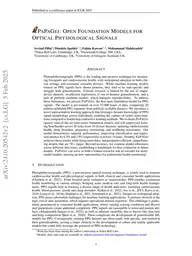
Photoplethysmography (PPG) is the leading non-invasive technique for monitoring biosignals and cardiovascular health, with widespread adoption in both clinical settings and consumer wearable devices. While machine learning models trained on PPG signals have shown promise, they tend to be task-specific and struggle with generalization. Current research is limited by the use of single-device datasets, insufficient exploration of out-of-domain generalization, and a lack of publicly available models, which hampers reproducibility. To address these limitations, we present PaPaGei, the first open foundation model for PPG signals. The model is pre-trained on over 57,000 hours of data, comprising 20 million unlabeled PPG segments from publicly available datasets. We introduce a novel representation learning approach that leverages domain knowledge of PPG signal morphology across individuals, enabling the capture of richer representations compared to traditional contrastive learning methods. We evaluate PaPaGei against state-of-the-art time-series foundation models and self-supervised learning benchmarks across 20 tasks from 10 diverse datasets, spanning cardiovascular health, sleep disorders, pregnancy monitoring, and wellbeing assessment. Our model demonstrates superior performance, improving classification and regression metrics by 6.3% and 2.9% respectively in at least 14 tasks. Notably, PaPaGei achieves these results while being more data- and parameter-efficient, outperforming models that are 70x larger. Beyond accuracy, we examine model robustness across different skin tones, establishing a benchmark for bias evaluation in future models. PaPaGei can serve as both a feature extractor and an encoder for multimodal models, opening up new opportunities for multimodal health monitoring.
Verbatim fromarXiv· arXiv metadata (abstracts are released under CC0)
Full photo credits and licences are on each device page. An icon means we have no openly licensed or manufacturer-cleared photo of that exact device yet.
PaPaGei is an open foundation model for PPG signals from Pillai, Spathis, Kawsar and Malekzadeh, accepted at ICLR 2025. It was pre-trained on more than 57,000 hours of PPG (about 20 million segments) from VitalDB, MIMIC-III and MESA, and it produces embeddings you can use for downstream health tasks.
How do I download PaPaGei?
The weights are on Zenodo record 13983110 (https://zenodo.org/records/13983110). Save papagei_s.pt into a weights/ folder and load it with the code in https://github.com/nokia-bell-labs/papagei-foundation-model.
PaPaGei vs Pulse-PPG: what is the difference?
PaPaGei was pre-trained on clinical and sleep-study PPG from public datasets (VitalDB, MIMIC-III, MESA) at 125 Hz. Pulse-PPG was trained only on raw smartwatch PPG from a 100-day field study with 120 participants, and its authors benchmark it against PaPaGei as the leading open PPG foundation model.
What are PaPaGei's benchmark results?
Across 20 tasks from 10 datasets, PaPaGei improved classification metrics by 6.3% and regression metrics by 2.9% in at least 14 tasks compared with time-series foundation models and self-supervised baselines, while outperforming models 70x larger.
Cite this model
Cite the publication recorded for this model. Check it against the publisher before submitting.
Pillai, A., Spathis, D., Kawsar, F., & Malekzadeh, M. (2024). PaPaGei: Open Foundation Models for Optical Physiological Signals. ICLR 2025. https://doi.org/10.48550/ARXIV.2410.20542
Pillai, Arvind, Dimitris Spathis, Fahim Kawsar, and Mohammad Malekzadeh. 2024. "PaPaGei: Open Foundation Models for Optical Physiological Signals." ICLR 2025. https://doi.org/10.48550/ARXIV.2410.20542.
Pillai, A., Spathis, D., Kawsar, F. and Malekzadeh, M. (2024) 'PaPaGei: Open Foundation Models for Optical Physiological Signals', ICLR 2025. doi: 10.48550/ARXIV.2410.20542.
Pillai, Arvind, et al. "PaPaGei: Open Foundation Models for Optical Physiological Signals." ICLR 2025, 2024. https://doi.org/10.48550/ARXIV.2410.20542.
A. Pillai, D. Spathis, F. Kawsar, and M. Malekzadeh, "PaPaGei: Open Foundation Models for Optical Physiological Signals," ICLR 2025, 2024, doi: 10.48550/ARXIV.2410.20542.
@misc{pillai2024papagei,
  title         = {{PaPaGei: Open Foundation Models for Optical Physiological Signals}},
  author        = {Pillai, Arvind and Spathis, Dimitris and Kawsar, Fahim and Malekzadeh, Mohammad},
  year          = {2024},
  howpublished  = {ICLR 2025},
  publisher     = {arXiv},
  doi           = {10.48550/ARXIV.2410.20542},
  eprint        = {2410.20542},
  archivePrefix = {arXiv}
}
History
Record updated
Added to the ChatPPG research hub
Newsletter
Get new PPG datasets, papers and models
Get alerts when PaPaGei-S is benchmarked on new datasets, plus the weekly digest.
New datasets, papers and models
Practical guides from the hub
Unsubscribe anytime
The waveform is an illustration of a PPG pulse, not a recording.