TEX-MEX
similarity-guided temporal contrastive SSL; 560K-param PPG foundation model
Activity counts measure attention, not model quality. Missing counts are unknown. Publication status follows the linked source; a listed venue alone does not confirm peer review.
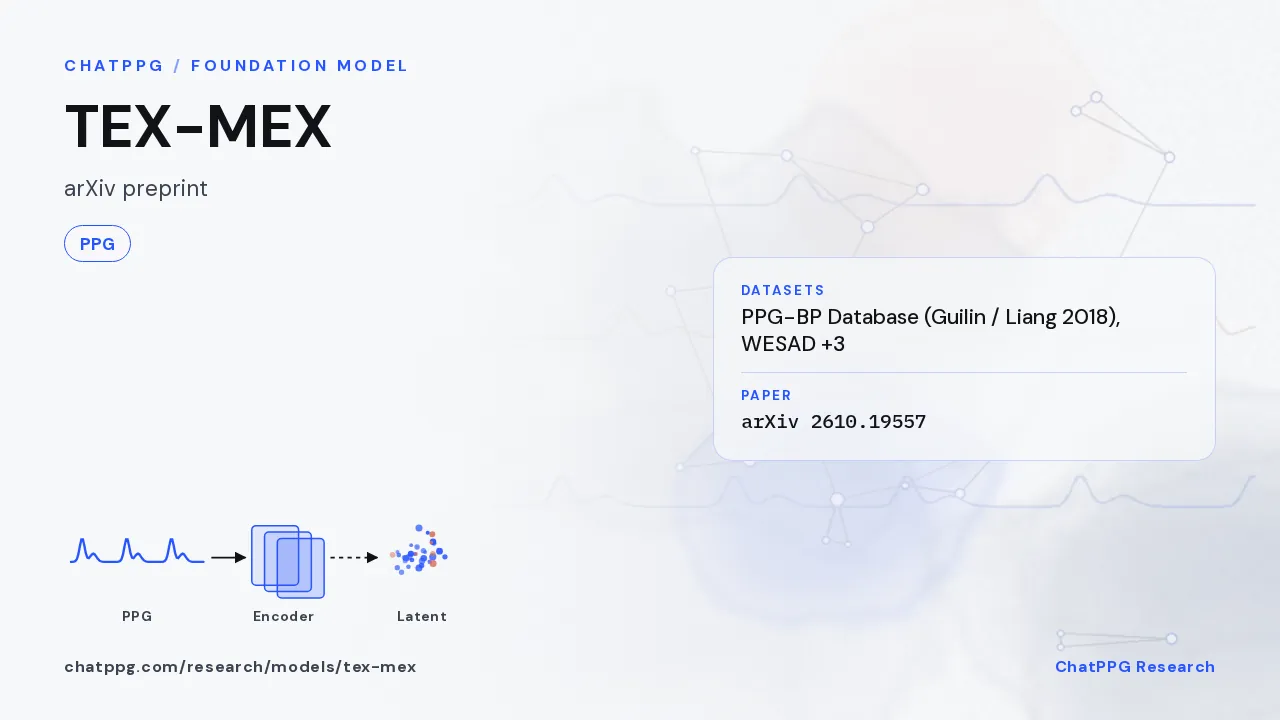
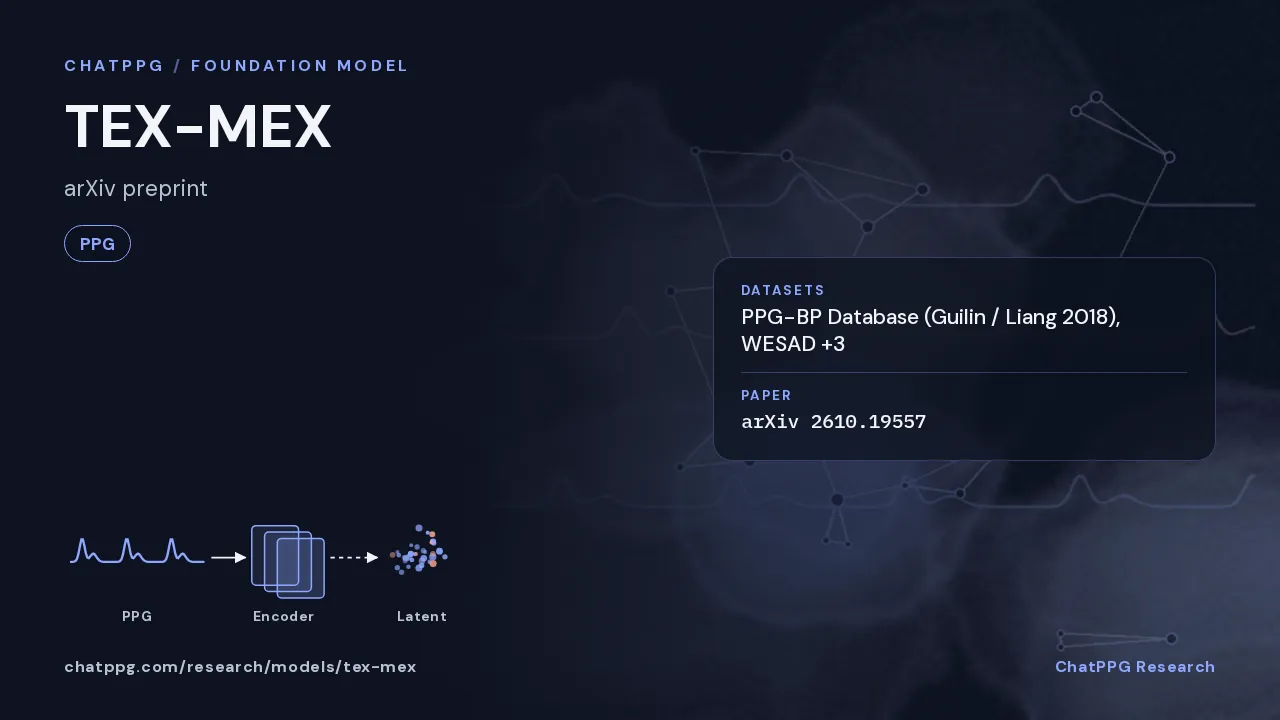
TEX-MEX is a self-supervised contrastive objective for time series that unifies structural similarity (windows with similar morphology) and temporal similarity (windows close together in time) into a single relationship. Within each batch the encoder identifies structurally similar and dissimilar windows, then pulls each window toward the temporally shifted versions of similar windows and pushes it away from those of dissimilar ones. Across PPG, EEG, ECG, accelerometry and continuous glucose monitoring it broadly matches or beats contrastive, reconstructive, JEPA-based and modality-specific baselines, and the authors train a 560K-parameter PPG foundation model that is roughly 50x smaller than the next-best unimodally pretrained PPG foundation model in their evaluation.
- Published: arXiv preprint, 2026
- Pretraining data: MOODS field smartwatch PPG (Pulse-PPG corpus)
- Form factor: wrist
Abstract
Contrastive learning for time series depends on deciding which pairs of inputs should be treated as similar and dissimilar. Because few augmentations reliably preserve meaning in time series, prior methods have relied on two disjoint notions of similarity between windows: structural similarity, which relates windows with similar morphology, and temporal similarity, which relates windows that occur close together in time. We introduce TEX-MEX, to our knowledge the first approach to unify the two into a single relationship. Given a random batch of windows drawn across the dataset, TEX-MEX uses the encoder to identify which windows are structurally similar or dissimilar to each other. It then pulls each window toward the temporally shifted versions of similar windows and pushes it away from those of dissimilar ones, learning what typically accompanies similar windows in time. Across PPG, EEG, ECG, accelerometry, and continuous glucose monitoring, TEX-MEX broadly achieves state-of-the-art performance against contrastive, reconstructive, JEPA-based, and modality-specific approaches, establishing it as a strong general SSL objective. We further train a 560K-parameter PPG foundation model that achieves state-of-the-art performance across a broad range of downstream benchmarks while being roughly 50x smaller than the next-best unimodally pretrained PPG foundation model in our evaluation. We will release this foundation model open-source and open-weight to the community to support future work and practical applications.
Verbatim fromarXiv· arXiv metadata (abstracts are released under CC0)
Key results
How it works
Datasets linked in the hub; pretraining vs evaluation roles follow the paper.
- Pretraining data
- MOODS field smartwatch PPG (Pulse-PPG corpus)
- Inputs
- PPG
- Approach
- PPG FM · SSL · contrastive · temporal contrastive · tiny model · open weights promised
Devices· 2
Illustrations by form factor; product photos are added as licences clear.
Leaderboard rows· 4
All leaderboards| Task | Dataset | Metric | Value | Rank |
|---|---|---|---|---|
| Cuffless blood pressure | PPG-BP Database (Guilin / Liang 2018) | AUROC ↑ | 0.7347 | #1 / 1 |
| Cuffless blood pressure | PPG-BP Database (Guilin / Liang 2018) | MAE (mmHg) ↓ | 14.007 | #3 / 3 |
| Heart rate estimation | PPG-DaLiA | MAE (bpm) ↓ | 9.790 | #10 / 11 |
| Mental workload / stress | WESAD | AUROC ↑ | 0.9630 | #4 / 7 |
Datasets· 5
Cite
@misc{texmex2026,
  title = {{TEX-MEX: Similarity-Guided Temporal Contrastive Learning for Time Series}},
  year = {2026},
  howpublished = {arXiv preprint},
  eprint = {2610.19557},
  url = {https://arxiv.org/abs/2610.19557}
}History
Added to the ChatPPG research hub
More on ChatPPG
- PPG-BP Database (Guilin / Liang 2018)
Research dataset
- WESAD
Wearable Stress and Affect Detection
- PPG-DaLiA
PPG dataset for motion compensation / HR
- Cuffless blood pressure leaderboard
Benchmark results for cuffless blood pressure
- Heart rate estimation leaderboard
Benchmark results for heart rate estimation
- Aether
compute-optimal physiological waveform FM family (20M–2.1B)