Activity counts measure attention, not model quality. Missing counts are unknown. Publication status follows the linked source; a listed venue alone does not confirm peer review.
SOTER is a generative foundation model for wearable physiological time series. It combines a backbone that models links between channels, a mixture-of-experts layer that routes by fixed spectral bands, and a neural controlled differential equation decoder that predicts and imputes at any timestamp. It had the best zero-shot forecasting error on most of six datasets and the lowest imputation error on all six at 75% missing data.
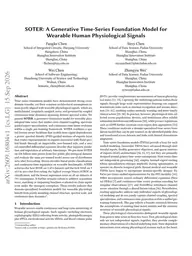
Time-series foundation models have demonstrated strong cross-domain transfer, yet their common architectural assumptions remain poorly aligned with wearable physiological signals, which are multichannel, irregularly sampled, noisy, and governed by coupled continuous-time dynamics spanning distinct spectral scales. We present SOTER, a generative foundation model for wearable physiological time series that unifies cross-channel coupling, spectrum-guided expert specialization, and continuous-time latent evolution within a single pre-training framework. SOTER combines a spatial feature-aware backbone that models inter-signal dependencies, a power spectral density (PSD)-guided mixture-of-experts layer that routes representations to experts associated with fixed spectral bands through an inspectable, non-learned rule, and a neural controlled differential equation decoder that supports prediction and imputation at arbitrary timestamps. We pre-train SOTER on 226 billion time points from five public physiological datasets and evaluate the same pre-trained model across out-of-distribution zero-shot forecasting, frozen-encoder linear-probe classification, and continuous-time imputation on wearable benchmarks. SOTER achieves the best RMSE on 4 of 6 datasets and the best MAE on 5 of 6 in zero-shot forecasting, the highest average Macro-AUROC in classification, and the lowest imputation error on all six datasets at 75% missingness. It further remains robust to additive acquisition noise, matching or surpassing baselines evaluated on clean inputs even under the strongest corruption. These results indicate that domain-specialized foundation models for wearable physiology benefit from jointly modeling channel structure, spectral scale, and continuous-time dynamics.
Verbatim fromarXiv· arXiv metadata (abstracts are released under CC0)
How it works
Datasets linked in the hub; pretraining vs evaluation roles follow the paper.
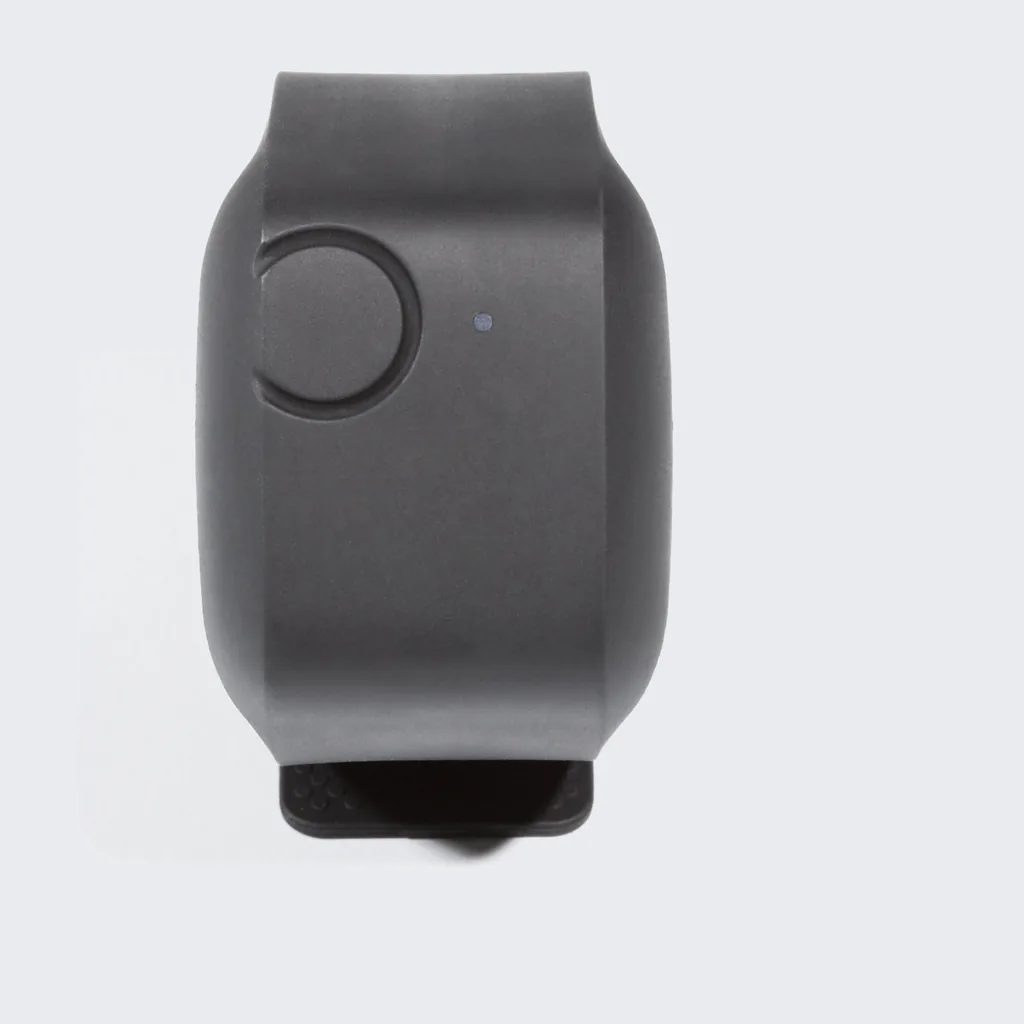
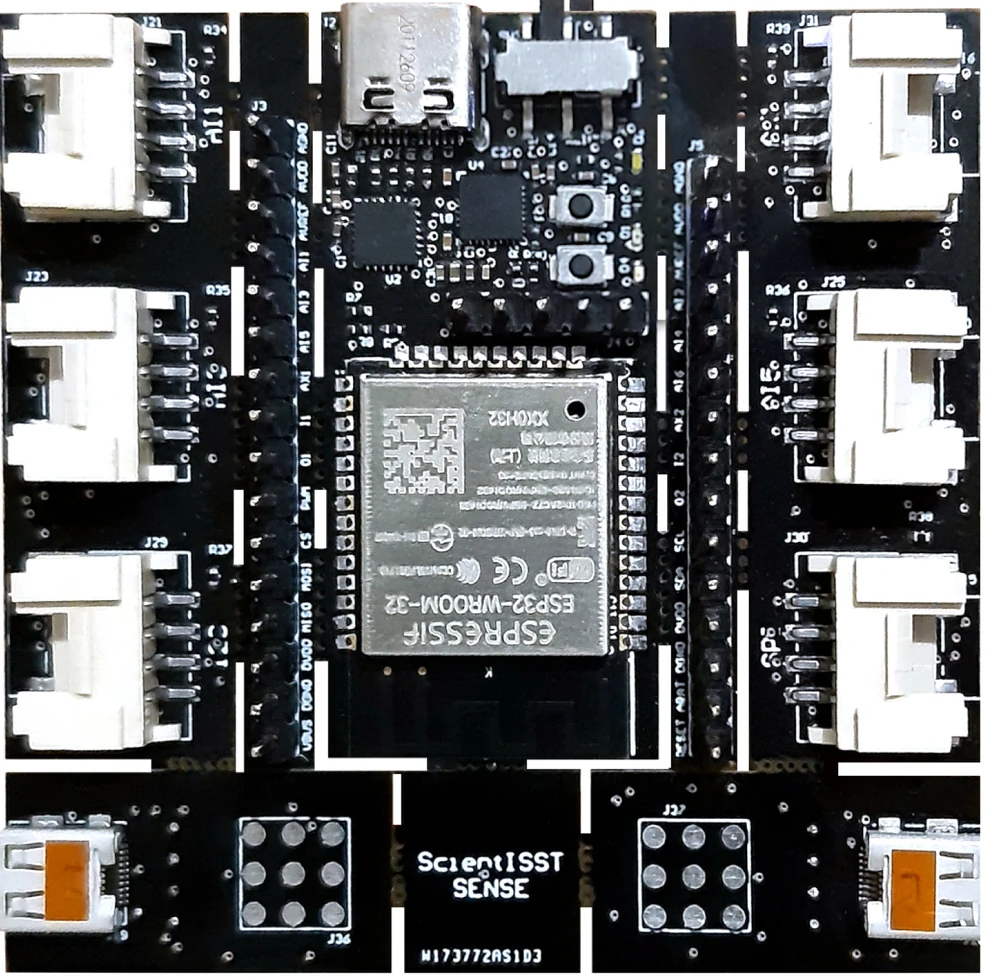
Full photo credits and licences are on each device page. An icon means we have no openly licensed or manufacturer-cleared photo of that exact device yet.
Cite the publication recorded for this model. Check it against the publisher before submitting.
Chen, F., Chen, S., Chen, W., & Wei, Z. (2026). SOTER: A Generative Time-Series Foundation Model for Wearable Human Physiological Signals. arXiv preprint. https://arxiv.org/abs/2609.16804
Chen, Fangke, Sirry Chen, Wei Chen, and Zhongyu Wei. 2026. "SOTER: A Generative Time-Series Foundation Model for Wearable Human Physiological Signals." arXiv preprint. https://arxiv.org/abs/2609.16804.
Chen, F., Chen, S., Chen, W. and Wei, Z. (2026) 'SOTER: A Generative Time-Series Foundation Model for Wearable Human Physiological Signals', arXiv preprint. Available at: https://arxiv.org/abs/2609.16804
Chen, Fangke, et al. "SOTER: A Generative Time-Series Foundation Model for Wearable Human Physiological Signals." arXiv preprint, 2026. https://arxiv.org/abs/2609.16804.
F. Chen, S. Chen, W. Chen, and Z. Wei, "SOTER: A Generative Time-Series Foundation Model for Wearable Human Physiological Signals," arXiv preprint, 2026, [Online]. Available: https://arxiv.org/abs/2609.16804.
@misc{chen2026soter,
  title         = {{SOTER: A Generative Time-Series Foundation Model for Wearable Human Physiological Signals}},
  author        = {Chen, Fangke and Chen, Sirry and Chen, Wei and Wei, Zhongyu},
  year          = {2026},
  howpublished  = {arXiv preprint},
  eprint        = {2609.16804},
  archivePrefix = {arXiv}
}
History
Record updated
Added to the ChatPPG research hub
Newsletter
Get new PPG datasets, papers and models
Get alerts when SOTER is benchmarked on new datasets, plus the weekly digest.
New datasets, papers and models
Practical guides from the hub
Unsubscribe anytime
The waveform is an illustration of a PPG pulse, not a recording.