Most Accurate Wrist Blood Pressure Monitor: Evidence-Based Guide for 2026
Which wrist blood pressure monitor is most accurate? We compare clinically validated oscillometric cuffs and PPG-based cuffless devices with real accuracy data.
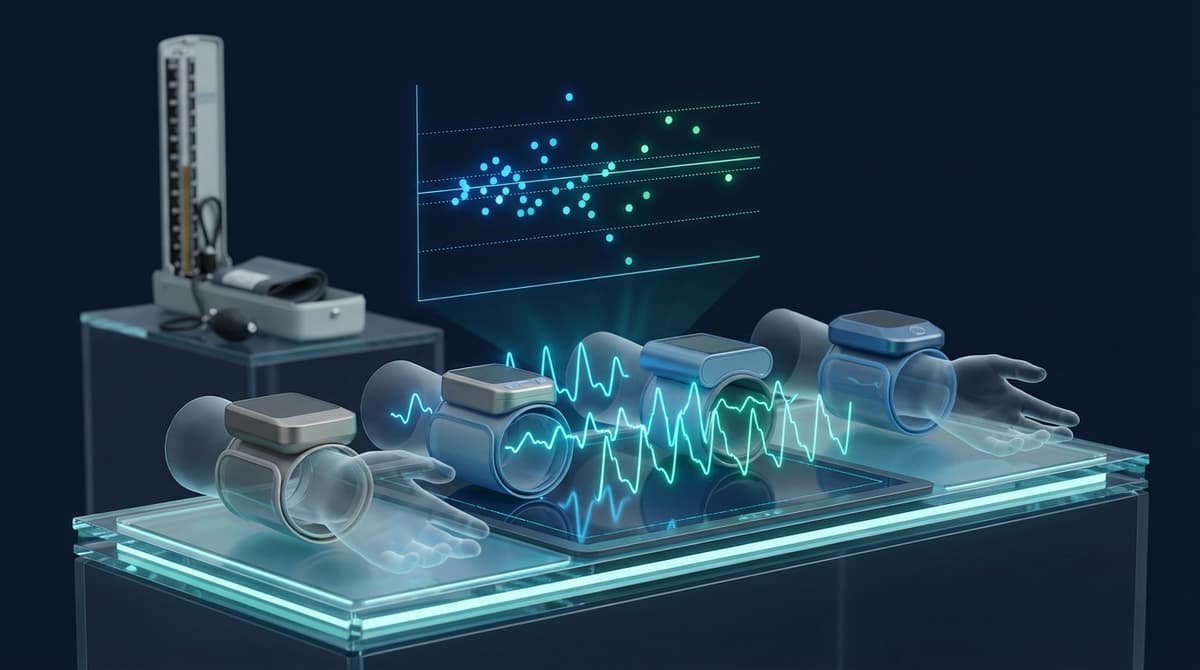
The most accurate wrist blood pressure monitors are oscillometric cuff devices that have passed ISO 81060-2 clinical validation, such as the Omron HEM-6232T and the iHealth BP7s. These validated wrist cuffs achieve mean errors within 5 mmHg with a standard deviation under 8 mmHg, meeting international accuracy standards. However, even the best wrist monitors are inherently less accurate than upper-arm cuffs due to anatomical differences at the radial artery site.
Choosing a wrist blood pressure monitor means navigating trade-offs between convenience and accuracy. This guide covers the devices that have earned clinical validation, explains why wrist measurement is harder to get right, and examines the emerging category of PPG-based cuffless monitors that promise continuous blood pressure tracking from the wrist.
Why Wrist Blood Pressure Monitors Are Less Accurate Than Upper-Arm Cuffs
Upper-arm cuffs measure blood pressure at the brachial artery, which is close to heart level and has a relatively consistent relationship to central aortic pressure. Wrist monitors measure at the radial and ulnar arteries, and this introduces several sources of error.
Hydrostatic pressure effects. The wrist is frequently positioned above or below heart level during measurement. Every centimeter of vertical displacement from the heart adds or subtracts roughly 0.74 mmHg of hydrostatic pressure. A wrist held 10 cm below the heart will read approximately 7 mmHg too high. This is the single largest source of error in wrist blood pressure measurement and the reason every instruction manual insists on positioning the wrist at heart level.
Smaller artery diameter. The radial artery has a smaller diameter and thinner wall compared to the brachial artery. Oscillometric signal amplitude is lower, making the algorithms more sensitive to movement artifacts and individual anatomical variation.
Arterial stiffness gradient. Blood pressure is not constant throughout the arterial tree. Peripheral amplification, caused by wave reflection at branching points, means that systolic pressure at the wrist is typically 5 to 10 mmHg higher than at the brachial artery. The magnitude of this amplification varies with age, arterial stiffness, and vasoactive state. Older adults with stiff arteries show less amplification, while young, healthy individuals may show substantial differences.
Sharman et al. (2009) demonstrated that the relationship between central and peripheral blood pressure varies significantly across populations, with peripheral amplification declining from an average of 14 mmHg in adults under 30 to 6 mmHg in those over 60 (DOI: 10.1016/j.jacc.2009.02.066). This variability complicates any wrist-based measurement that attempts to estimate central or brachial pressure.
For a deeper look at how arterial waveform shape encodes pressure information, see our guide on PPG waveform anatomy and features.
What Makes a Wrist Blood Pressure Monitor "Clinically Validated"?
Clinical validation is the single most important criterion when choosing any blood pressure monitor, but it is especially important for wrist devices where accuracy margins are tighter.
The ISO 81060-2 Standard
The current gold standard for blood pressure monitor validation is ISO 81060-2:2018, which harmonizes requirements from the Association for the Advancement of Medical Instrumentation (AAMI), the European Society of Hypertension (ESH), and the British Hypertension Society (BHS). The standard requires:
- Sample size: At least 85 participants spanning a wide range of blood pressures
- Reference method: Invasive intra-arterial measurement or, more commonly, trained observer auscultation with a mercury or aneroid sphygmomanometer
- Accuracy criteria: Mean error no greater than 5 mmHg, standard deviation no greater than 8 mmHg for both systolic and diastolic measurements
- Population diversity: Adequate representation across age groups, arm circumferences, and blood pressure ranges including hypertensive subjects
Devices that pass ISO 81060-2 appear on the STRIDE BP validated device listing, maintained by an international consortium of hypertension societies. This listing is the most reliable resource for consumers and clinicians evaluating monitor accuracy.
Why Validation Status Matters More Than Marketing
Many wrist blood pressure monitors are sold with vague claims about accuracy. Terms like "clinically tested" or "hospital grade" have no regulatory definition. A device that is "clinically tested" may have been tested and failed. Only independent validation against ISO 81060-2 by a disinterested research team, published in a peer-reviewed journal, provides meaningful evidence of accuracy.
Stergiou et al. (2018) reviewed the validation status of commercially available blood pressure monitors and found that the majority of wrist devices on the market had never been independently validated (DOI: 10.1097/HJH.0000000000001654). Of those that had been tested, several failed to meet accuracy criteria. The authors recommended that consumers and clinicians check validation databases before purchasing any monitor.
Which Wrist Blood Pressure Monitors Have Passed Clinical Validation?
The list of clinically validated wrist blood pressure monitors is much shorter than most consumers expect. As of early 2026, the following oscillometric wrist cuff devices have passed ISO 81060-2 or equivalent ESH validation protocols.
Omron HEM-6232T (RS7 Intelli IT)
The Omron RS7 Intelli IT is one of the few wrist monitors with published independent validation data. It features a positioning sensor that guides the user to hold the wrist at heart level, which helps reduce the hydrostatic error that plagues wrist measurement. In validation testing, it met ESH protocol requirements for both systolic and diastolic blood pressure.
Omron's IntelliWrap cuff design distributes pressure more evenly around the wrist compared to older designs, reducing sensitivity to cuff placement angle. The device stores readings and syncs via Bluetooth to the Omron Connect app.
iHealth BP7s
The iHealth BP7s wrist monitor has been validated against the ESH International Protocol and has published accuracy data in peer-reviewed literature. It uses a standard oscillometric detection algorithm and connects to a smartphone app for tracking.
Omron HEM-6181
An older model that passed validation under the earlier ESH 2010 protocol. While the validation is dated, it remains one of the few wrist devices with published clinical evidence.
Important Context
Even these validated devices carry caveats. Validation studies are conducted under controlled conditions: the subject is seated, rested, and their wrist is positioned at heart level by a trained technician. Real-world accuracy, where users measure hastily with inconsistent positioning, will always be worse than the numbers from validation studies.
For a broader comparison of clinical-grade and consumer devices, including the standards that separate them, see our article on clinical-grade vs. consumer wearables.
PPG-Based Cuffless Wrist Blood Pressure Monitors
Beyond oscillometric wrist cuffs, a newer category of devices uses photoplethysmography (PPG) sensors embedded in smartwatches and fitness bands to estimate blood pressure without any cuff at all. These represent a fundamentally different approach with different accuracy characteristics.
How PPG-Based Blood Pressure Estimation Works
PPG sensors in wrist wearables shine green or infrared light into the skin and measure changes in light absorption caused by pulsatile blood flow. The shape, timing, and features of the resulting PPG waveform encode information about arterial stiffness, vascular resistance, and pulse wave velocity, all of which correlate with blood pressure.
However, correlation is not causation, and these relationships are indirect. PPG waveform features are influenced by many factors beyond blood pressure: skin temperature, hydration, contact pressure between the sensor and skin, body position, and individual anatomical variation. Extracting a reliable blood pressure estimate from this noisy, confounded signal remains a major research challenge.
For a technical overview of PPG-based blood pressure estimation, including pulse transit time and machine learning approaches, see our detailed article on PPG blood pressure estimation methods.
Samsung Galaxy Watch Blood Pressure Monitoring
Samsung's Galaxy Watch series (Galaxy Watch 4 and later) includes a blood pressure monitoring feature using the watch's built-in PPG sensor and the Samsung Health Monitor app. The system has received regulatory clearance in South Korea and select markets.
The Samsung approach requires periodic calibration against a traditional cuff monitor, typically every four weeks. During calibration, the watch learns the user's personal relationship between PPG waveform features and cuff-measured blood pressure. Between calibrations, it estimates blood pressure using changes in the PPG signal relative to the calibration baseline.
This calibration requirement is both the feature's greatest strength and its most significant limitation. Immediately after calibration, accuracy is reasonable because the estimate is anchored to a known reference. But blood pressure, vascular tone, and arterial stiffness change over days and weeks, causing calibration drift. The further you get from your last calibration, the less reliable the estimate becomes.
Samsung's internal validation showed mean errors of approximately 3 to 4 mmHg for systolic and 2 to 3 mmHg for diastolic blood pressure shortly after calibration. Independent validation by third-party researchers across diverse populations over extended periods is still limited.
Other PPG-Based Devices
Several other companies are pursuing PPG-based cuffless blood pressure, including:
- Aktiia: A wrist-worn device using optical sensors with overnight measurement. It received CE marking in Europe and uses a calibration-based approach similar in principle to Samsung's.
- Biobeat: A medical-grade wrist device and patch that estimates blood pressure from PPG, with published validation data in clinical settings.
- Various research prototypes: Academic groups worldwide have published PPG blood pressure estimation algorithms, but the gap between research prototypes and validated consumer products remains wide.
The contact pressure between a PPG sensor and the skin significantly affects waveform quality and, consequently, blood pressure estimation accuracy. Our guide on PPG contact pressure optimization explains why this variable matters and how device designers attempt to control it.
Can PPG Devices Match Cuff Accuracy?
Not yet, at least not consistently. The fundamental challenge is that PPG measures a surrogate signal, not pressure directly. Mukkamala et al. (2015) showed that PPG-based methods typically achieve systolic blood pressure estimation errors of 8 to 12 mmHg standard deviation, which exceeds the AAMI/ISO requirement of 8 mmHg (DOI: 10.1109/TBME.2015.2441951).
The promise of cuffless monitoring is not beat-to-beat clinical accuracy but rather trending. A device that tracks relative changes in blood pressure throughout the day, even if absolute values carry 10 mmHg uncertainty, could still provide useful information about blood pressure patterns, medication timing effects, and lifestyle impacts. For more on this distinction, see our discussion of continuous blood pressure monitoring with PPG.
How to Get the Most Accurate Readings from a Wrist Blood Pressure Monitor
If you are using an oscillometric wrist cuff, proper technique makes a larger difference than the specific device model. The following practices minimize measurement error.
Positioning
Hold your wrist at heart level. For most people seated in a chair, this means resting your elbow on a table and raising your forearm until the cuff is level with the middle of your sternum. Some devices include a positioning sensor that confirms correct alignment. Do not let your wrist hang at your side or rest in your lap.
Preparation
- Sit quietly for 5 minutes before measuring. Physical activity, conversation, and even full bladder status can elevate readings by 5 to 15 mmHg.
- Avoid caffeine and nicotine for 30 minutes prior.
- Roll up your sleeve so the cuff contacts skin directly.
Cuff Fit
The cuff should be snug but not tight, positioned approximately 1 cm proximal to the wrist crease. A loose cuff will overestimate blood pressure. An overly tight cuff may underestimate it.
Multiple Readings
Take three readings separated by 1 to 2 minutes and average the last two. The first reading is often elevated due to an alerting response. Clinical guidelines from the American Heart Association recommend this averaging approach for home blood pressure monitoring.
Cross-Validate with an Upper-Arm Monitor
When you first start using a wrist monitor, compare its readings to a validated upper-arm cuff on the same arm within a few minutes. If the wrist monitor consistently deviates by more than 5 mmHg from the upper-arm device, it may not be reliable for your particular anatomy.
Should You Buy a Wrist Monitor or an Upper-Arm Monitor?
For most people, a validated upper-arm blood pressure monitor remains the better choice for accuracy. The American Heart Association, the European Society of Hypertension, and most national hypertension guidelines recommend upper-arm cuffs as the standard for home blood pressure monitoring.
Wrist monitors make sense in specific situations:
- Large arm circumference. Individuals with very large upper arms (over 42 cm) may not fit standard or large adult cuffs. A validated wrist monitor can be a practical alternative.
- Pain or injury. Conditions like lymphedema, dialysis fistula, or upper-arm injury may make cuff inflation painful or contraindicated.
- Portability. Wrist monitors are smaller and easier to carry for travel.
- Dexterity limitations. Some people with arthritis or limited hand strength find it easier to position a wrist cuff than an upper-arm cuff.
If you do choose a wrist monitor, buy one with published ISO 81060-2 validation data. The convenience savings are not worth it if the readings are unreliable.
Frequently Asked Questions
Are wrist blood pressure monitors as accurate as upper-arm monitors?
No. Even validated wrist monitors are generally less accurate than validated upper-arm cuffs in real-world use. The main reasons are sensitivity to wrist positioning relative to heart level, smaller artery diameter, and peripheral pressure amplification. Under ideal conditions with correct positioning, validated wrist devices can meet clinical accuracy standards. In everyday use, errors tend to be larger.
What is the most accurate wrist blood pressure monitor you can buy?
As of 2026, the Omron HEM-6232T (RS7 Intelli IT) is among the most accurate wrist blood pressure monitors available, with published ESH validation data and a built-in positioning sensor to reduce the most common source of wrist measurement error. The iHealth BP7s is another validated option.
Can a smartwatch accurately measure blood pressure?
Current smartwatch blood pressure features, like Samsung Galaxy Watch BP monitoring, provide estimates rather than clinical measurements. They require calibration against a cuff and accuracy degrades over time as calibration drifts. They are best used for tracking blood pressure trends rather than obtaining absolute readings for clinical decision-making.
Why does my wrist blood pressure monitor give different readings than my doctor's cuff?
Several factors explain this difference: wrist positioning (even a few centimeters off heart level changes the reading), peripheral pressure amplification (wrist systolic pressure is naturally higher than brachial), timing differences (blood pressure varies throughout the day), and differences in measurement technique. White-coat hypertension, where blood pressure rises in clinical settings, is another common explanation.
How should I position my wrist for the most accurate reading?
Sit in a chair with your feet flat on the floor. Place your elbow on a table and raise your forearm so the wrist cuff is at the same height as the middle of your chest. Keep your palm facing upward and your wrist straight, not bent. Remain still and avoid talking during the measurement.
Do cuffless PPG blood pressure monitors need FDA clearance?
In the United States, any device that claims to measure blood pressure for health purposes would generally require FDA clearance as a Class II medical device. Samsung's blood pressure feature has regulatory clearance in South Korea but has not received FDA clearance for use in the US as of early 2026. The FDA has been cautious about cuffless blood pressure devices, requiring evidence of accuracy across diverse populations.
How often should I calibrate a cuffless blood pressure device?
Manufacturers typically recommend calibration every 2 to 4 weeks, but accuracy begins declining within days of calibration. For the most reliable results, calibrate more frequently, particularly after changes in medication, significant weight change, or any event that might alter your baseline vascular state. Always calibrate using a validated upper-arm cuff, not another wrist device.