Dataset

Stress-Predict Dataset (E4, MIT)

Pilot stress-monitoring dataset from Sensors 2022 (10.3390/s22218135). Open GitHub release by Iqbal et al. Three stress-inducing tasks + rest blocks.

At a glance
Type
Dataset
Licence
Not reported
Access
Not reported
Subjects
35
PPG sites
Wrist
Setting
Lab
Wrist
Yes
Raw waveforms
Yes
Updated
Nov 25, 2026

Original description

With the recent advancements in the field of wearable technologies, the opportunity to monitor stress continuously using different physiological variables has gained significant interest. The early detection of stress can help improve healthcare and minimizes the negative impact of long-term stress. This paper reports outcomes of a pilot study and associated stress-monitoring dataset, named the “Stress-Predict Dataset”, created by collecting physiological signals from healthy subjects using wrist-worn watches with a photoplethysmogram (PPG) sensor. While wearing these watches, 35 healthy volunteers underwent a series of tasks (i.e., Stroop color test, Trier Social Stress Test and Hyperventilation Provocation Test), along with a rest period in-between each task. They also answered questionnaires designed to induce stress levels compatible with daily life. The changes in the blood volume pulse (BVP) and heart rate were recorded by the watch and were labelled as occurring during stress-inducing tasks or a rest period (no stress). Additionally, respiratory rate was estimated using the BVP signal. Statistical models and personalised adaptive reference ranges were used to determine the utility of the proposed stressors and the extracted variables (heart rate and respiratory rate). The analysis showed that the interview session was the most significant stress stimulus, causing a significant variation in heart rate of 27 (77%) participants and respiratory rate of 28 (80%) participants out of 35. The outcomes of this study contribute to the understanding the role of stressors and their association with physiological response and provide a dataset to help develop new wearable solutions for more reliable, valid, and sensitive physio-logical stress monitoring.

Verbatim fromthe publisher's DOI record· Publisher licence: https://creativecommons.org/licenses/by/4.0/

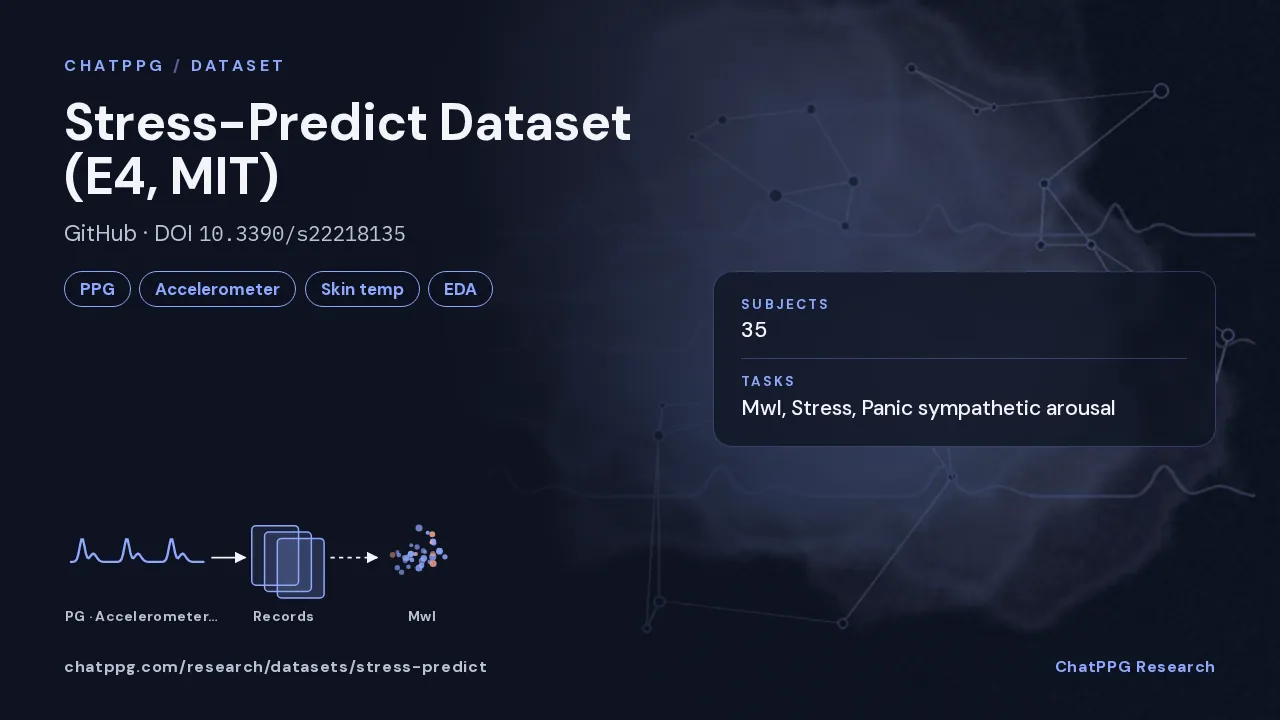
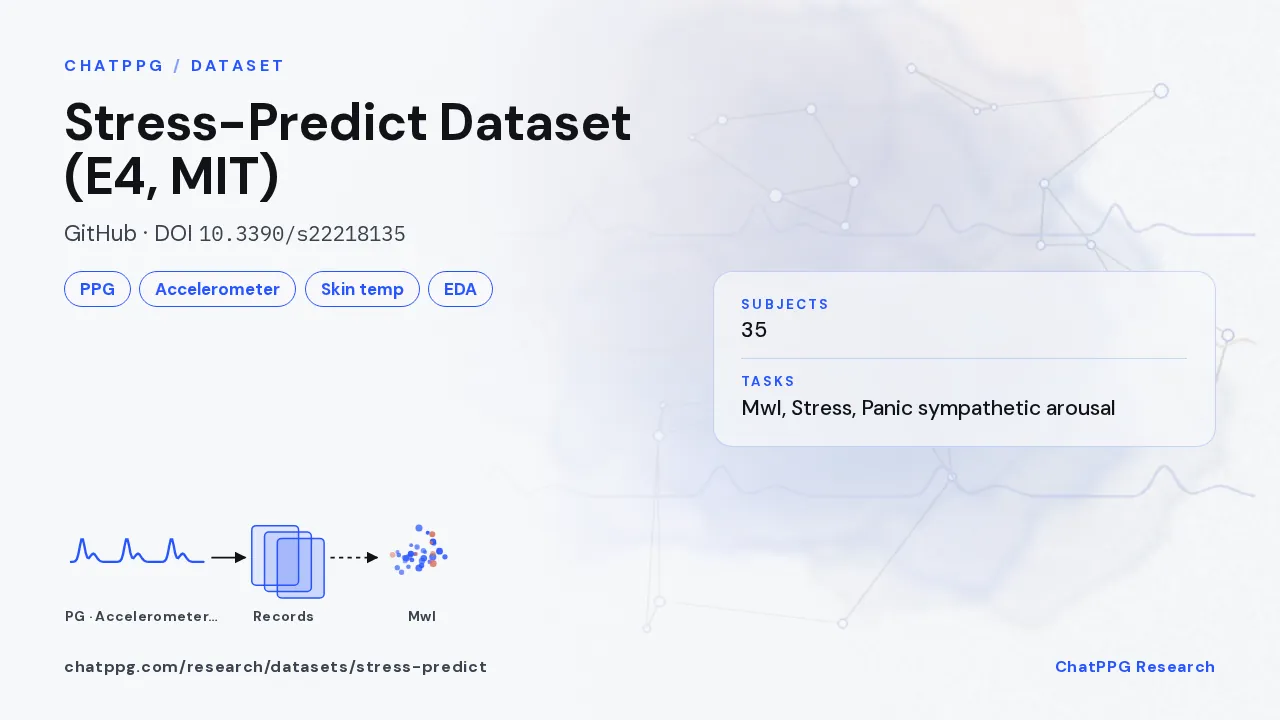
Stress-Predict Dataset (E4, MIT): ChatPPG research summary card

Key numbers

35
Subjects
2
Reference labels
STRESS, MWL
1Hz
Released sampling rate
E4 standard: BVP 64Hz; ACC 32Hz; EDA/TEMP 4Hz; HR 1Hz (derived)

How it works

How Stress-Predict Dataset (E4, MIT) works: Devices & body sites → Signals recorded → TasksDevices & body sites: Empatica E4 (Empatica · Wrist). PPG sites: Wrist. Signals recorded: Stress-Predict Dataset (E4, MIT), 35 subjects · 1Hz, signals PPG, IMU, EDA, Temperature. Tasks: Mental workload; Stress; Panic sympathetic arousal.Devices & body sitesEmpatica E4: Empatica · WristEmpatica E4Empatica · WristPPG sites: WristPPG sitesWristSignals recordedStress-Predict Dataset (E4…35 subjects · 1HzPPGxyzIMUEDATemperatureTasksMental workloadMental workloadStressStressPanic sympathetic arousalPanic sympathetic arousal

No model in the hub reports results on this dataset yet.

Sampling
E4 standard: BVP 64Hz; ACC 32Hz; EDA/TEMP 4Hz; HR 1Hz (derived)
Reference labels
stress, mwl
Device roles
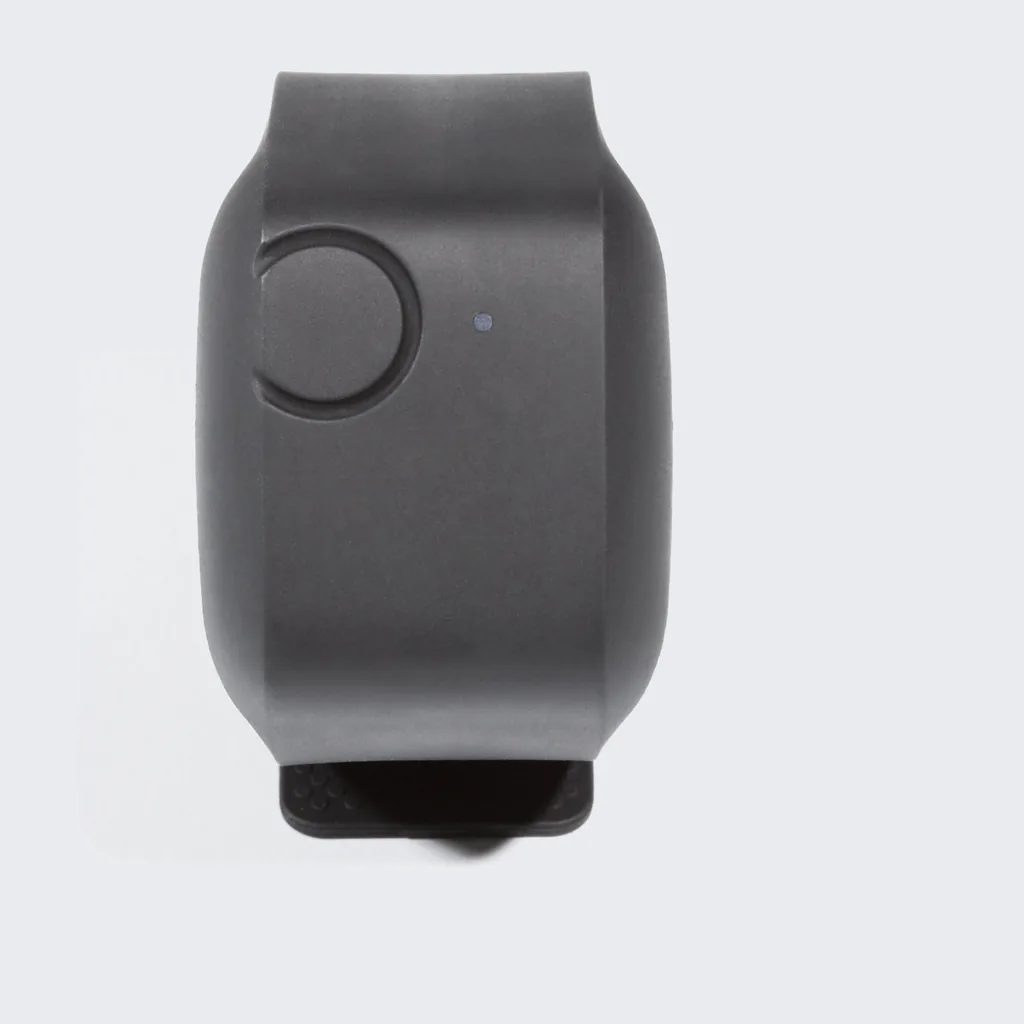
Study wearable (IMU)

Devices· 1

Full photo credits, sources and licences are on each device page.

FAQ

How many subjects are in Stress-Predict Dataset?

Stress-Predict Dataset has data from 35 subjects, as listed in its research record.

What signals does Stress-Predict Dataset include?

Stress-Predict Dataset includes PPG, accelerometer, skin temperature and EDA data. Sampling rate as recorded: E4 standard: BVP 64Hz; ACC 32Hz; EDA/TEMP 4Hz; HR 1Hz (derived). Raw waveforms are included.

What can Stress-Predict Dataset be used for?

Research tasks it supports: mental workload assessment and stress detection. Reference labels: stress and mental workload.

How do I get Stress-Predict Dataset, and what is its licence?

It is hosted on GitHub at https://github.com/italha-d/Stress-Predict-Dataset. No licence is recorded for it here, so check the terms on the source page before you use it.

Was Stress-Predict Dataset recorded with a wrist-worn device?

Yes. Its record lists wrist-worn recording.

Cite this dataset

Cite this dataset with the fields recorded here. Check it against the publisher before submitting.

Stress-Predict Dataset (E4, MIT) [Data set]. (n.d.). github. https://doi.org/10.3390/s22218135
@misc{stresspredictstresspredict,
  title         = {{Stress-Predict Dataset (E4, MIT)}},
  howpublished  = {github},
  doi           = {10.3390/s22218135}
}

Cite the ChatPPG record

Cite the dated snapshot 2026-10 for a fixed, reproducible version. Please also cite the original publications listed above.

APA

ChatPPG. (2026). Stress-Predict Dataset (E4, MIT): dataset record (Version 2026-10) [Data set]. ChatPPG Research Hub. https://chatppg.com/research/datasets/stress-predict

BibTeX
@misc{chatppg_dataset_stress_predict,
  author       = {{ChatPPG}},
  title        = {{Stress-Predict Dataset (E4, MIT): dataset record}},
  year         = {2026},
  month        = nov,
  version      = {2026-10},
  howpublished = {\url{https://chatppg.com/research/datasets/stress-predict}},
  note         = {ChatPPG Research Hub, Snapshot 2026-10, https://chatppg.com/research/snapshots/2026-10}
}
CITATION.cff
cff-version: 1.2.0
message: "If you use this resource, please cite it as below."
type: dataset
title: "Stress-Predict Dataset (E4, MIT): dataset record"
authors:
  - name: "ChatPPG"
url: "https://chatppg.com/research/datasets/stress-predict"
repository-artifact: "https://chatppg.com/research/snapshots/2026-10"
version: "2026-10"
date-released: "2026-11-25"

History

  1. Record updated