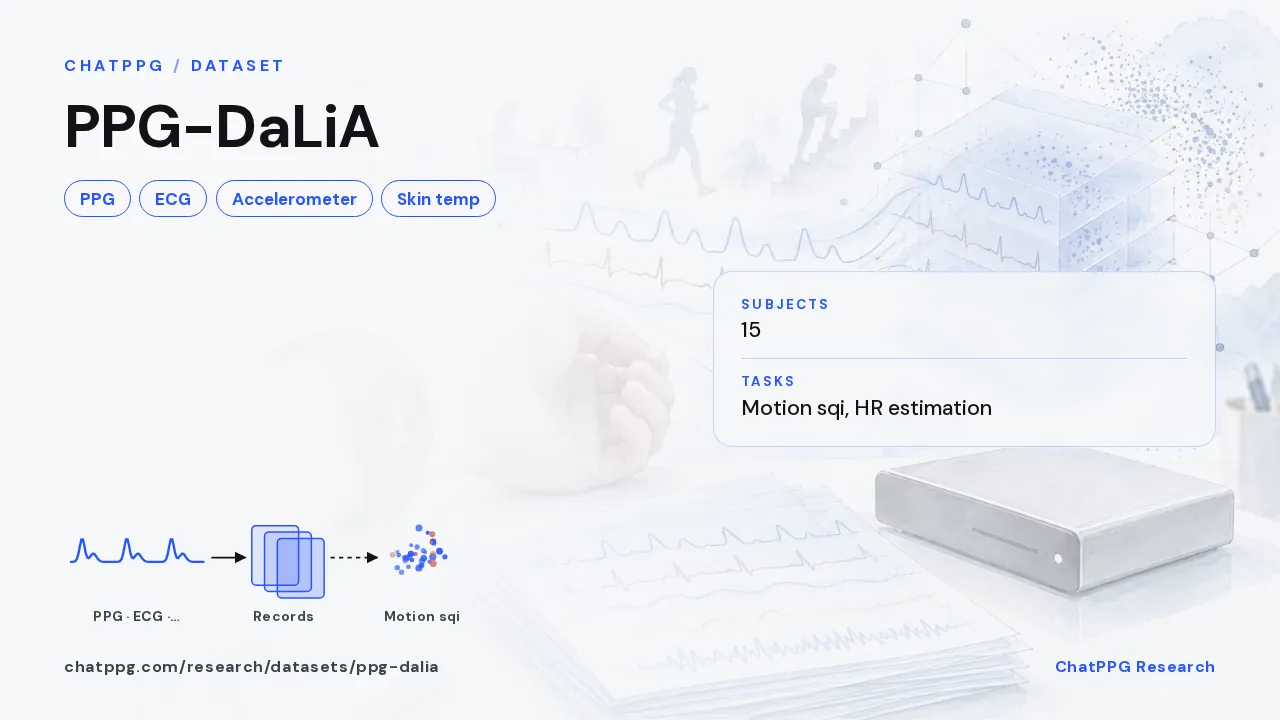
PPG-DaLiA is a public dataset for PPG-based heart rate estimation during daily life activities. It was introduced by Attila Reiss, Ina Indlekofer, Philip Schmidt and Kristof Van Laerhoven in "Deep PPG: Large-Scale Heart Rate Estimation with Convolutional Neural Networks", published in Sensors 19(14):3079 in 2019.
The motivation is motion artefacts. Wrist PPG is easy to collect, but movement corrupts the signal, and earlier heart rate methods were heavily tuned to small public datasets recorded in narrow scenarios. PPG-DaLiA was built to test how well methods generalize: 15 subjects wore physiological and motion sensors while performing a wide range of activities under close to real-life conditions.
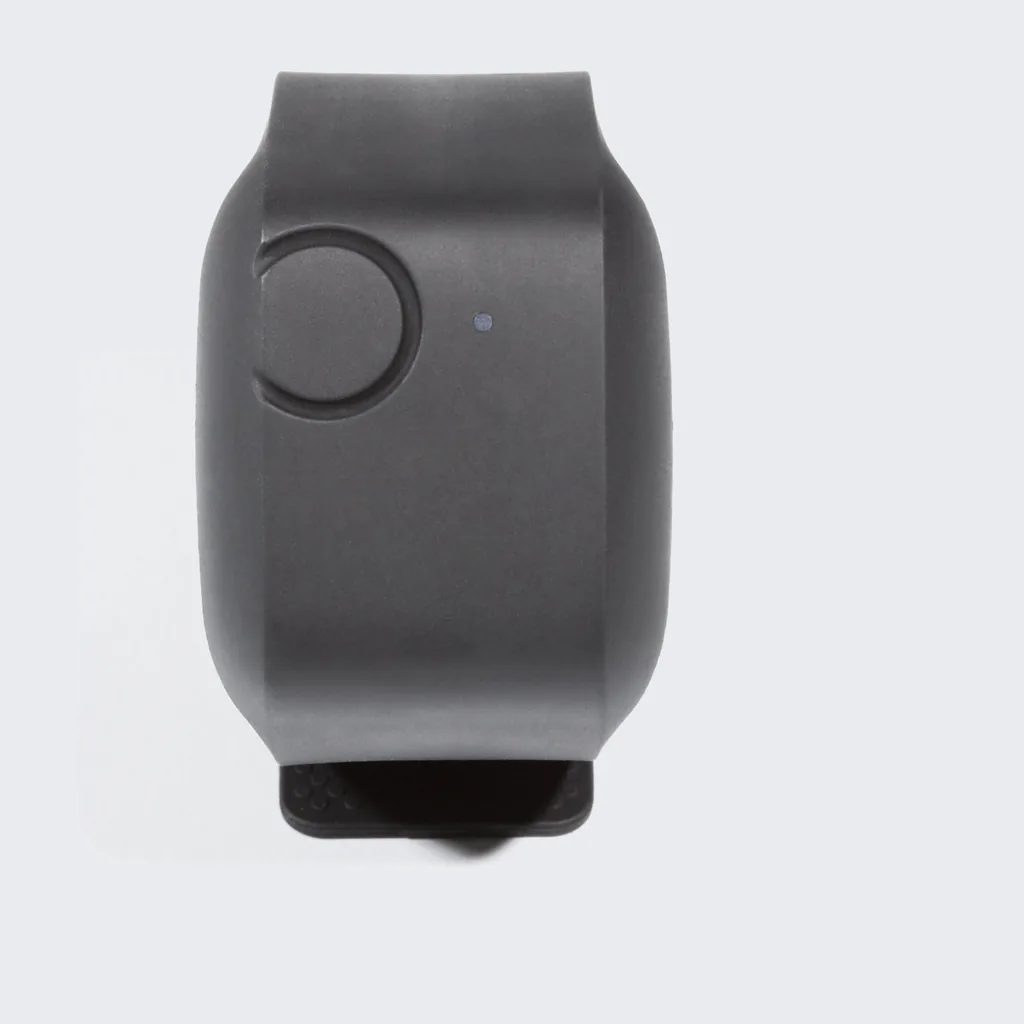
Two devices recorded at the same time. A chest-worn RespiBAN captured ECG, respiration and three-axis acceleration, all sampled at 700 Hz. A wrist-worn Empatica E4 captured blood volume pulse (the PPG signal) at 64 Hz, electrodermal activity at 4 Hz, body temperature at 4 Hz and three-axis acceleration at 32 Hz. The ECG provides the heart rate ground truth, and the wrist PPG plus accelerometer are the inputs for estimating heart rate while compensating for motion. A readme file documents the data format, the study protocol and how the ground truth was generated.
In the original paper, the authors extended a state-of-the-art spectral algorithm and also trained convolutional neural networks on time-frequency spectra of synchronized PPG and accelerometer signals. Evaluated on four public datasets, the deep learning model clearly beat the other methods on the large ones, cutting mean absolute error by 31% on PPG-DaLiA and by 21% on WESAD. Since then PPG-DaLiA has become a standard benchmark for heart rate estimation under motion, and the hub lists it as a downstream dataset for PPG foundation models such as PaPaGei and Pulse-PPG.
The data (2.7 GB) is released by the authors on the University of Siegen project page. Their terms allow use for scientific, non-commercial purposes, with credit to the owners in any published work. A copy is also mirrored on the UCI Machine Learning Repository, but the Siegen terms are the ones that come from the creators.
Size
2.7 GB
Paper
Deep PPG: Large-Scale Heart Rate Estimation with Convolutional Neural Networks (Reiss, Indlekofer, Schmidt, Van Laerhoven), Sensors 19(14):3079, 2019
PPG-DaLiA is the standard dataset for PPG heart rate estimation under motion. Fifteen subjects wore an Empatica E4 on the wrist and a RespiBAN on the chest while sitting, climbing stairs, playing table soccer, cycling, driving, eating, walking and working, giving more than 36 hours of data. Ground-truth heart rate is the mean instantaneous ECG heart rate in 8-second windows with a 2-second shift (Reiss et al., Sensors 2019).
What's inside
Subjects
15
Duration
More than 36 hours in total
Activities
Sitting, stairs, table soccer, cycling, driving, lunch break, walking, working (8 types) plus transitions
Full photo credits and licences are on each device page. An icon means we have no openly licensed or manufacturer-cleared photo of that exact device yet.
A public dataset for PPG-based heart rate estimation in daily life: 15 subjects with wrist PPG and accelerometer (Empatica E4) and chest ECG (RespiBAN), more than 36 hours in total, introduced in Deep PPG (Sensors 2019).
How is ground-truth heart rate defined in PPG-DaLiA?
As the mean instantaneous heart rate from corrected ECG R-peaks within each 8-second window, with a 2-second window shift.
What is the sampling rate of PPG-DaLiA?
Wrist BVP 64 Hz, wrist accelerometer 32 Hz, EDA and temperature 4 Hz; chest signals 700 Hz.
How big is PPG-DaLiA?
The UCI download data.zip is 2.7 GB.
What MAE is state of the art on PPG-DaLiA?
See the leaderboard on this page for reported mean absolute errors and each paper's protocol. The Deep PPG paper reported a 31% MAE reduction with a CNN over classical methods.
How do I download PPG-DaLiA?
Download the 2.7 GB archive from the authors' University of Siegen project page (https://ubi29.informatik.uni-siegen.de/usi/data_ppgdalia.html). Use is limited to scientific, non-commercial purposes with credit to the owners.
PPG-DaLiA vs WESAD?
Both come from the same group and use the same Empatica E4 and RespiBAN devices with 15 subjects. PPG-DaLiA targets heart rate estimation during daily activities; WESAD is a lab study of stress and affect with neutral, stress and amusement states.
What are PPG-DaLiA benchmark results?
In the original paper, a CNN on time-frequency spectra of PPG and accelerometer signals reduced mean absolute error by 31% on PPG-DaLiA compared with classical methods.
Cite this dataset
This citation is the paper recorded with this dataset. Check it against the publisher before submitting.
Reiss, A., Indlekofer, I., Schmidt, P., & Van Laerhoven, K. (2019). Deep PPG: Large-Scale Heart Rate Estimation with Convolutional Neural Networks. Sensors, 19(14), 3079. https://doi.org/10.3390/s19143079
Reiss, Attila, Ina Indlekofer, Philip Schmidt, and Kristof Van Laerhoven. 2019. "Deep PPG: Large-Scale Heart Rate Estimation with Convolutional Neural Networks." Sensors 19 (14): 3079. https://doi.org/10.3390/s19143079.
Reiss, A., Indlekofer, I., Schmidt, P. and Van Laerhoven, K. (2019) 'Deep PPG: Large-Scale Heart Rate Estimation with Convolutional Neural Networks', Sensors, 19(14), p. 3079. doi: 10.3390/s19143079.
Reiss, Attila, et al. "Deep PPG: Large-Scale Heart Rate Estimation with Convolutional Neural Networks." Sensors, vol. 19, no. 14, 2019, p. 3079. https://doi.org/10.3390/s19143079.
A. Reiss, I. Indlekofer, P. Schmidt, and K. Van Laerhoven, "Deep PPG: Large-Scale Heart Rate Estimation with Convolutional Neural Networks," Sensors, vol. 19, no. 14, p. 3079, 2019, doi: 10.3390/s19143079.
@article{reiss2019deep,
  title         = {{Deep PPG: Large-Scale Heart Rate Estimation with Convolutional Neural Networks}},
  author        = {Reiss, Attila and Indlekofer, Ina and Schmidt, Philip and Van Laerhoven, Kristof},
  year          = {2019},
  journal       = {Sensors},
  volume        = {19},
  number        = {14},
  pages         = {3079},
  publisher     = {MDPI AG},
  doi           = {10.3390/s19143079}
}
Cite the ChatPPG record
Cite the dated snapshot 2026-10 for a fixed, reproducible version. Please also cite the original publications listed above.
APA
ChatPPG. (2026). PPG-DaLiA: dataset record (Version 2026-10) [Data set]. ChatPPG Research Hub. https://chatppg.com/research/datasets/ppg-dalia
BibTeX
@misc{chatppg_dataset_ppg_dalia,
  author       = {{ChatPPG}},
  title        = {{PPG-DaLiA: dataset record}},
  year         = {2026},
  month        = nov,
  version      = {2026-10},
  howpublished = {\url{https://chatppg.com/research/datasets/ppg-dalia}},
  note         = {ChatPPG Research Hub, Snapshot 2026-10, https://chatppg.com/research/snapshots/2026-10}
}
CITATION.cff
cff-version: 1.2.0
message: "If you use this resource, please cite it as below."
type: dataset
title: "PPG-DaLiA: dataset record"
authors:
  - name: "ChatPPG"
url: "https://chatppg.com/research/datasets/ppg-dalia"
repository-artifact: "https://chatppg.com/research/snapshots/2026-10"
version: "2026-10"
date-released: "2026-11-24"
History
Record updated
Newsletter
Get new PPG datasets, papers and models
Get alerts when new models are benchmarked on PPG-DaLiA, plus the weekly digest.
New datasets, papers and models
Practical guides from the hub
Unsubscribe anytime
The waveform is an illustration of a PPG pulse, not a recording.