Device comparisons
Apple Watch Ultra 2 vs Garmin Fenix 8: Specs Guide
Choose the Garmin Fenix 8 if battery life, built-in mapping, and training tools come first. Choose the Apple Watch Ultra 2 if you use an iPhone and value tighter Apple integration, cellular connectivity, and a brighter specified display. Both offer optical heart-rate sensing, multi-band positioning, ECG support in eligible regions, and a 40 m recreational dive rating. This comparison uses the 49 mm Ultra 2 and 47 mm Fenix 8 AMOLED as the clearest like-for-like models.
Devices
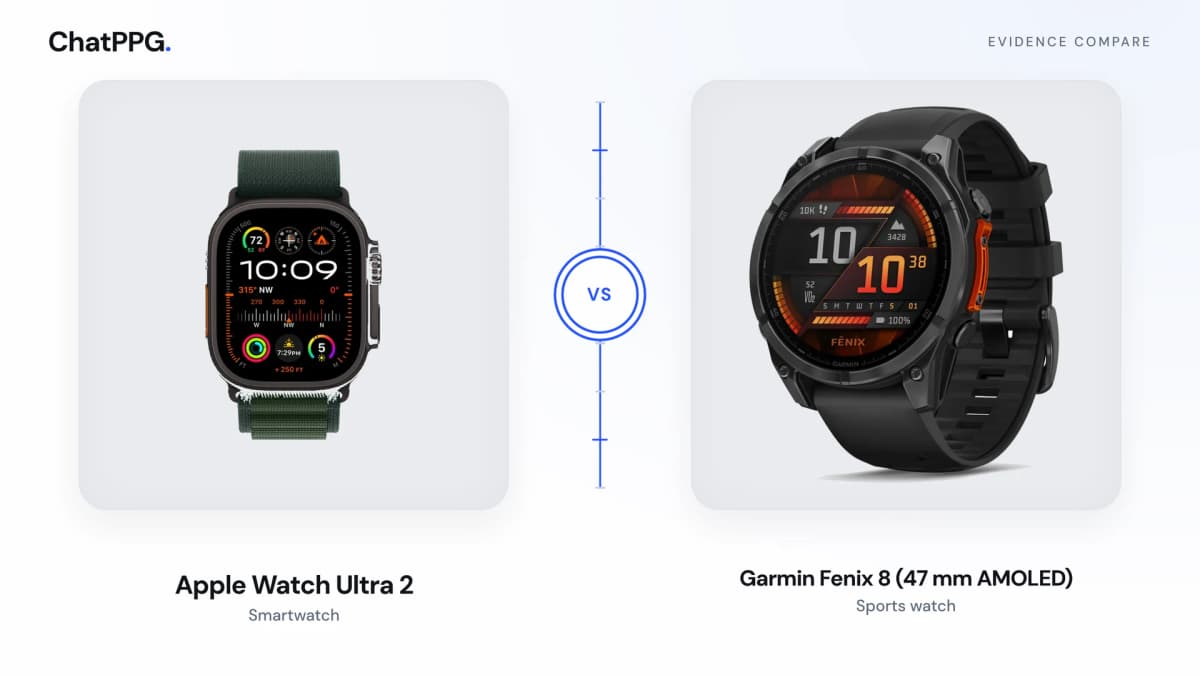
Apple Watch Ultra 2, black titanium with an olive Alpine Loop: product photograph from Apple Newsroom, September 2024. Garmin fēnix 8 47 mm AMOLED, slate gray case with a black silicone band (part 010-02904-00): product photograph from Garmin.
At a glance
This page does not list head-to-head accuracy numbers, so the scoreboard shows hardware differences only.
| Specification | Apple Watch Ultra 2 | Garmin Fenix 8 (47 mm AMOLED) |
|---|---|---|
| Compared modelDiffers | 49 mm titanium case | 47 mm AMOLED case |
| Optical sensingDiffers | Third-generation optical heart sensor; blood oxygen sensor | Wrist-based heart rate, Pulse Ox, and HRV Status |
| Battery claimDiffers | Up to 36 hours normal use; up to 72 hours in Low Power Mode | Up to 16 days with gesture; up to 7 days with always-on display |
| PositioningDiffers | L1+L5 precision dual-frequency GPS | Multi-band GPS with SatIQ |
| Maps and navigationDiffers | Offline maps, U.S. topographic park maps, waypoints, and Backtrack | TopoActive maps, courses, turn-by-turn directions, and dynamic round-trip routing |
| Water and divingDiffers | 100 m water resistance; recreational diving to 40 m | 10 ATM water rating; recreational diving to 40 m |
Primary rows only. The study tables further down list more results from the accuracy database.
Hardware specs
| Specification | Apple Watch Ultra 2 | Garmin Fenix 8 (47 mm AMOLED) |
|---|---|---|
| Compared modelDiffers | 49 mm titanium case | 47 mm AMOLED case |
| Optical sensingDiffers | Third-generation optical heart sensor; blood oxygen sensor | Wrist-based heart rate, Pulse Ox, and HRV Status |
| Battery claimDiffers | Up to 36 hours normal use; up to 72 hours in Low Power Mode | Up to 16 days with gesture; up to 7 days with always-on display |
| PositioningDiffers | L1+L5 precision dual-frequency GPS | Multi-band GPS with SatIQ |
| Maps and navigationDiffers | Offline maps, U.S. topographic park maps, waypoints, and Backtrack | TopoActive maps, courses, turn-by-turn directions, and dynamic round-trip routing |
| Water and divingDiffers | 100 m water resistance; recreational diving to 40 m | 10 ATM water rating; recreational diving to 40 m |
| ECG | ECG app; availability and eligibility restrictions apply | ECG app; availability and eligibility restrictions apply |
| DisplayDiffers | Always-On Retina LTPO2 OLED; up to 3000 nits | AMOLED |
Hardware only. Study results are not repeated in this table. Differs marks values that are not the same. An em dash means this page did not publish that figure.
Specs verified on August 17, 2026: Apple Watch Ultra 2 technical specifications, Garmin Fenix 8 product and feature overview, Garmin Fenix 8 battery information, Garmin Fenix 8 specifications.
Pros and cons
Apple Watch Ultra 2
Pros
- Up to 3000-nit always-on display
- Built-in cellular connectivity and dual-frequency GPS
- ECG app, irregular rhythm notifications, and optical heart-rate sensing
- iPhone and Apple Health integration
Cons
- Up to 36 hours of normal use is much shorter than the Fenix 8 claim
- Requires a compatible iPhone
- Only one 49 mm case size
Garmin Fenix 8 (47 mm AMOLED)
Pros
- Up to 16 days in smartwatch mode with gesture display
- TopoActive mapping and extensive training features
- AMOLED and solar options across multiple case sizes
- Multi-band GPS with SatIQ
Cons
- ECG app availability depends on region and software
- Preloaded multi-continent TopoActive maps are limited to Sapphire versions
- Base Fenix 8 models do not include the LTE and satellite features of Fenix 8 Pro
What published studies show
One table per metric. These rows come from the accuracy database and are not repeated as a second card list. From the wearable accuracy database (v1.0.0).
Heart rate at rest3 studies
| Device tested | Result | Reference | Sample | Study |
|---|---|---|---|---|
| Apple Watch Series 9 / Ultra 2 | 5.91% (MAE 3.73 bpm)Mean absolute percentage error | Polar H10 + Kubios HRV | n = 39, Serial morning measurements over 14 days, 316 readings | O'Grady et al. (2024)Independent |
| Apple Watch Series 6R-R intervals and BPM at rest | 1.15%Mean absolute percentage error | ECG | n = 78, Lab: rest, talking, movie, before/ | Bonneval et al. (2025)Independent |
| Garmin Vivoactive 4 | ρc = 0.9998Lin's concordance correlation | ECG | n = 263, 30-min standardised recording | Theurl et al. (2023)Independent |
Heart rate during exercise9 studies
| Device tested | Result | Reference | Sample | Study |
|---|---|---|---|---|
| Apple Watch Series 6 | High agreement in squat, deadlift, cable row (rho > 0.832)Study finding (no single number) | ECG chest strap (Polar H7/ | n = 29, Resistance exercise (5 exercises) | Støve et al. (2022)Funding not reported |
| Apple Watch SE | Significantly lower MAE than Polar Pacer Pro and Galaxy Watch 6Study finding (no single number) | ECG chest strap (Polar H7/ | n = 37, Low/ | Jeong et al. (2026)Independent |
| Apple Watch Series 8 | Skin pigmentation did not predict error (P = 0.62); 50% of missing data from dark-skin participantsStudy finding (no single number) | ECG chest strap (Polar H7/ | n = 28, Rest, cycling, recovery | Mulholland et al. (2026)Independent |
| Apple Watch Series 9 | Less accurate for darker skin pigmentationStudy finding (no single number) | ECG chest strap (Polar H7/ | n = 30, 10-min treadmill | Chase et al. (2024)Independent |
More results (2)
| Device tested | Result | Reference | Sample | Study |
|---|---|---|---|---|
| Apple Watch Series 4 | 0.9%–4.3% (range by intensity)Coefficient of variation | ECG chest strap (Polar H7/ | n = 25, Sitting, walking, running, sprints | Düking et al. (2020)Independent |
| Apple Watch Series 6 | < 5% in all 5 activitiesCoefficient of variation | ECG chest strap (Polar H7/ | n = 60, Sitting, walking, running, resistance, cycling | Hajj-Boutros et al. (2023)Funding not reported |
6 more results in the database. Heart rate accuracy across devices →
Overnight heart rate1 study
| Device tested | Result | Reference | Sample | Study |
|---|---|---|---|---|
| Apple Watch Series 6 | ICC 0.96Intraclass correlation | ECG | n = 53, Overnight, sleep laboratory | Miller et al. (2022)Other maker funded |
| Apple Watch Series 6 | 1.5 bpm (absolute bias)Mean absolute error | ECG | n = 53, Overnight, sleep laboratory | Miller et al. (2022)Other maker funded |
| Garmin Forerunner 245 Music | ICC 0.41Intraclass correlation | ECG | n = 53, Overnight, sleep laboratory | Miller et al. (2022)Other maker funded |
| Garmin Forerunner 245 Music | 5.4 bpm (absolute bias)Mean absolute error | ECG | n = 53, Overnight, sleep laboratory | Miller et al. (2022)Other maker funded |
HRV (RMSSD)4 studies
| Device tested | Result | Reference | Sample | Study |
|---|---|---|---|---|
| Apple Watch Series 9 / Ultra 2 | 28.88% (MAE 20.46 ms)Mean absolute percentage error | Polar H10 + Kubios HRV | n = 39, Serial morning measurements over 14 days, 316 readings | O'Grady et al. (2024)Independent |
| Apple Watch Series 6 | ICC 0.67Intraclass correlation | ECG | n = 53, Overnight, sleep laboratory | Miller et al. (2022)Other maker funded |
| Apple Watch Series 6 | 22.5 ms (absolute bias)Mean absolute error (absolute bias) | ECG | n = 53, Overnight, sleep laboratory | Miller et al. (2022)Other maker funded |
| Garmin Fenix 6 | 10.52%Mean absolute percentage error | ECG | n = 13, Home, during sleep, 536 nights | Dial et al. (2025)Independent |
More results (2)
| Device tested | Result | Reference | Sample | Study |
|---|---|---|---|---|
| Garmin Fenix 6 | 0.87Lin's concordance correlation | ECG | n = 13, Home, during sleep, 536 nights | Dial et al. (2025)Independent |
| Garmin Forerunner 245 Music | ICC 0.24Intraclass correlation | ECG | n = 53, Overnight, sleep laboratory | Miller et al. (2022)Other maker funded |
2 more results in the database. HRV accuracy across devices →
Sleep stages (4-stage)4 studies
| Device tested | Result | Reference | Sample | Study |
|---|---|---|---|---|
| Apple Watch Series 8 | κ = 0.53Cohen's kappa | Polysomnography (PSG) | n = 62, Sleep laboratory, 1 night | Schyvens et al. (2025)Funding not reported |
| Apple Watch Series 8 | 50.5–86.1% (range across stages)Sensitivity | Polysomnography (PSG) | n = 35, Inpatient, 1 night | Robbins et al. (2024)Other maker funded |
| Apple Watch Series 8deep sleep duration | Deep sleep −43 minMean bias (signed) | Polysomnography (PSG) | n = 35, Inpatient, 1 night | Robbins et al. (2024)Other maker funded |
| Apple Watch Series 6 | 53%Epoch-by-epoch agreement | Polysomnography (PSG) | n = 53, Sleep laboratory, 1 night, 9 h in bed, all devices worn together | Miller et al. (2022)Other maker funded |
More results (2)
| Device tested | Result | Reference | Sample | Study |
|---|---|---|---|---|
| Apple Watch Series 6 | κ = 0.20Cohen's kappa | Polysomnography (PSG) | n = 53, Sleep laboratory, 1 night, 9 h in bed, all devices worn together | Miller et al. (2022)Other maker funded |
| Apple Watch Series 8 | κ = 0.3Cohen's kappa | Polysomnography (PSG) | n = 26, Two Korean sleep centres, in-lab PSG | Lee et al. (2023)Independent |
4 more results in the database. Sleep accuracy across devices →
Sleep vs wake (2-stage)4 studies
| Device tested | Result | Reference | Sample | Study |
|---|---|---|---|---|
| Apple Watch Series 8 | > 90% (all devices)Sensitivity | Polysomnography (PSG) | n = 62, Sleep laboratory, 1 night | Schyvens et al. (2025)Funding not reported |
| Apple Watch Series 8 | ≥ 95%Sensitivity | Polysomnography (PSG) | n = 35, Inpatient, 1 night | Robbins et al. (2024)Other maker funded |
| Apple Watch Series 6 | 88%Epoch-by-epoch agreement | Polysomnography (PSG) | n = 53, Sleep laboratory, 1 night, 9 h in bed, all devices worn together | Miller et al. (2022)Other maker funded |
| Apple Watch Series 6 | κ = 0.30Cohen's kappa | Polysomnography (PSG) | n = 53, Sleep laboratory, 1 night, 9 h in bed, all devices worn together | Miller et al. (2022)Other maker funded |
More results (2)
| Device tested | Result | Reference | Sample | Study |
|---|---|---|---|---|
| Garmin Vivosmart 4 | > 90% (all devices)Sensitivity | Polysomnography (PSG) | n = 62, Sleep laboratory, 1 night | Schyvens et al. (2025)Funding not reported |
| Garmin Fenix 5S | Worse than actigraphyStudy finding (no single number) | Polysomnography (PSG) | n = 34, Sleep laboratory, 3 nights incl. disrupted night | Chinoy et al. (2021)Funding not reported |
3 more results in the database. Sleep accuracy across devices →
Total sleep time1 study
| Device tested | Result | Reference | Sample | Study |
|---|---|---|---|---|
| Garmin Forerunner 945 | MAE 84.63 min (overestimate)Mean absolute error | Polysomnography (PSG) | n = 49, 1 night PSG + MSLT | Budig et al. (2022)Independent |
Blood oxygen (SpO2)11 studies
| Device tested | Result | Reference | Sample | Study |
|---|---|---|---|---|
| Apple Watch Series 7 | 3.5% (rest)Root-mean-square error | Medical-grade pulse oximeter | n = 36, Rest, COPD outpatients | Støve et al. (2023)Funding not reported |
| Apple Watch Series 6 | r = 0.89Pearson correlation | Medical-grade pulse oximeter | n = 265, Spot readings | Spaccarotella et al. (2022)Independent |
| Apple Watch Series 6 | −0.23 (LoA −3.49 to 3.04)Mean bias (signed) | Medical-grade pulse oximeter | n = 265, Spot readings | Spaccarotella et al. (2022)Independent |
| Apple Watch Series 7 | 2.2% (RMSE 2.9%)Mean absolute error | Medical-grade pulse oximeter | n = 49, Spot readings, with and without chronic pulmonary disease | Jiang et al. (2023)Independent |
More results (2)
| Device tested | Result | Reference | Sample | Study |
|---|---|---|---|---|
| Apple Watch Series 7 | 2.9%Root-mean-square error | Medical-grade pulse oximeter | n = 49, Spot readings, with and without chronic pulmonary disease | Jiang et al. (2023)Independent |
| Apple Watch Series 8 | Met ISO RMS ≤ 4% at normoxia and SpO2 < 90%; lowest bias and RMSD of the threeStudy finding (no single number) | Medical-grade pulse oximeter | n = 18, Induced hypoxemia (FiO2 14%, 12%, 10%), ISO 80601-2-61 | Walzel et al. (2023)Independent |
10 more results in the database. SpO2 accuracy across devices →
Atrial fibrillation detection4 studies
| Device tested | Result | Reference | Sample | Study |
|---|---|---|---|---|
| Apple Watch Series 6smartwatch ECG app, inconclusive tracings counted | 85% (spec 75%)Sensitivity | 12-lead ECG | n = 201, Tertiary cardiology service, single-lead ECG algorithms | Mannhart et al. (2023)Funding not reported |
| Apple Watch Series 6smartwatch ECG app, inconclusive tracings counted | 75%Specificity | 12-lead ECG | n = 201, Tertiary cardiology service, single-lead ECG algorithms | Mannhart et al. (2023)Funding not reported |
| Apple Watch + KardiaBand (SmartRhythm 2.0)AF episodes ≥ 1 h | 97.5% episode sensitivity (PPV 39.9%)Sensitivity | Insertable cardiac monitor | n = 24, Ambulatory, 31,348.9 h of recordings | Wasserlauf et al. (2019)Funding not reported |
| Apple Watch (irregular rhythm notification)PPG irregular pulse notification | PPV 0.84 (95% CI 0.76–0.92)Positive predictive value | ECG patch | n = 419297, Siteless pragmatic study; ECG patch after notification | Perez et al. (2019)Maker funded |
More results (1)
| Device tested | Result | Reference | Sample | Study |
|---|---|---|---|---|
| Kardia Band on Apple Watch (single-lead ECG)automated ECG read; 57 of 169 recordings non-interpretable | Sens 93% / spec 84% (interpretable recordings)Sensitivity | 12-lead ECG | n = 100, Before and after cardioversion | Bumgarner et al. (2018)Funding not reported |
VO2max estimate6 studies
| Device tested | Result | Reference | Sample | Study |
|---|---|---|---|---|
| Apple Watch Series 10 | 13.2% (MAE 6.79 mL/kg/min)Mean absolute percentage error | Indirect calorimetry | n = 40, Maximal treadmill test (modified Åstrand) | Lambe et al. (2026)Independent |
| Apple Watch | 13.31% (MAE 6.92 mL/kg/min)Mean absolute percentage error | Indirect calorimetry | n = 30, Maximal treadmill test (modified Åstrand) | Lambe et al. (2025)Independent |
| Apple Watch Series 7 | 15.79% (ICC 0.47)Mean absolute percentage error | Indirect calorimetry | n = 19, Graded cycle ergometer test | Caserman et al. (2024)Independent |
| Garmin Forerunner 245 | 7.9% / 7.2% (two runs)Mean absolute percentage error | Indirect calorimetry | n = 35, Treadmill ramp test | Engel et al. (2026)Funding not reported |
More results (2)
| Device tested | Result | Reference | Sample | Study |
|---|---|---|---|---|
| Garmin Fenix 6 | 7.05% (CCC 0.73)Mean absolute percentage error | Indirect calorimetry | n = 19, Graded exercise test and outdoor run | Carrier et al. (2025)Independent |
| Garmin Forerunner 920XT | 7.3%Mean absolute percentage error | Indirect calorimetry | n = 24, Lab | Passler et al. (2019)Independent |
Energy expenditure (calories)6 studies
| Device tested | Result | Reference | Sample | Study |
|---|---|---|---|---|
| Apple Watch Series 9 | Inconsistent across all groupsStudy finding (no single number) | Indirect calorimetry | n = 30, 10-min treadmill | Chase et al. (2024)Independent |
| Apple Watch Series 4 | 13.5%–27.1% (range by intensity)Coefficient of variation | Indirect calorimetry | n = 25, Sitting, walking, running, sprints | Düking et al. (2020)Independent |
| Apple Watch Series 6 | 14.68–24.85% (poor in all activities)Coefficient of variation | Indirect calorimetry | n = 60, Sitting, walking, running, resistance, cycling | Hajj-Boutros et al. (2023)Funding not reported |
| Apple Watch Series 8physical activity energy expenditure, 10 min | +21.6 kcalMean bias (signed) | Indirect calorimetry | n = 52, 10-min recumbent cycling intervals | Kostrna et al. (2026)Independent |
More results (2)
| Device tested | Result | Reference | Sample | Study |
|---|---|---|---|---|
| Apple Watch Series 6walking | 19.8% walk / 24.4% runMean absolute percentage error | Indirect calorimetry | n = 20, Outdoor 2-km walk (6 km/ | Le et al. (2022)Independent |
| Apple Watch | Lowest EE error of 7 devices, but no device below 20%Study finding (no single number) | Indirect calorimetry | n = 60, Sitting, walking, running, cycling | Shcherbina et al. (2017)Independent |
3 more results in the database. Calories accuracy across devices →
Verdict
The Fenix 8 is the stronger expedition and endurance choice because its stated smartwatch battery life is measured in days rather than hours, and Garmin makes mapping and training analysis central to the watch. The Ultra 2 is the better fit for an iPhone owner who wants cellular access and Apple's watch, phone, and health features in one system. Official specifications do not establish which watch has more accurate exercise heart rate, so this page does not declare a sensor-accuracy winner.
Frequently asked questions
Has anyone tested Apple Watch Ultra 2 vs Garmin Fenix 8 accuracy head to head?
We found no peer-reviewed head-to-head validation of Ultra 2 versus Fenix 8. Published studies tested earlier models: for example, Apple Watch reached 0.92 concordance with ECG versus 0.81 for a Garmin Forerunner 235 in Gillinov et al. (2017). Treat that as brand-level evidence, not a verdict on these two watches.
Which has better battery life: Apple Watch Ultra 2 or Garmin Fenix 8?
Garmin states up to 16 days for the 47 mm Fenix 8 AMOLED with gesture display, or up to 7 days with the always-on display. Apple states up to 36 hours of normal use or 72 hours in Low Power Mode for Ultra 2. Actual battery life varies with settings and use.
Do Apple Watch Ultra 2 and Garmin Fenix 8 both have ECG?
Yes. Both support an ECG app, but availability, minimum age, compatible software, and regional restrictions apply. Check Apple and Garmin availability pages before buying for this feature.
Which watch has more accurate heart rate tracking?
The manufacturers' specification pages do not provide a controlled head-to-head accuracy result. Accuracy can also change with fit, activity, skin contact, and software. A defensible winner requires independent testing of the exact models under the activity you care about.
Does this page compare Ultra 2 or Ultra 4?
This page compares Apple Watch Ultra 2 and Garmin Fenix 8 using specifications verified on the date shown above in the 'Specs verified' field. It does not cover newer Apple Watch Ultra models that may have been released after that date. Check Apple's current product lineup to see which Ultra model is currently available.
Device research records
Datasets, papers and validation results for the models named on this page.