Activity counts measure attention, not model quality. Missing counts are unknown. Publication status follows the linked source; a listed venue alone does not confirm peer review.
DINO-style SSL adapted to inertial data via semantics-preserving motion transformations (simulated motion-pattern and sensor-setup variation). One plain transformer with frequency-aware positional encoding supports variable window length and sampling rate. Public release (2026-11-06) ships inference code (imudino.py, modelfactory.py, exampleforward.py) and the IMUDINO-85M checkpoint; training scripts are not in the release repo.
Not fully enumerated in the public release notes; multi-source IMU covering HAR, health, motion-capture and robot odometry (paper). Checkpoint is IMUDINO-85M.
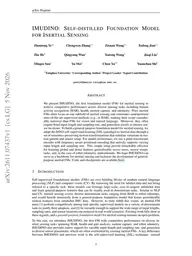
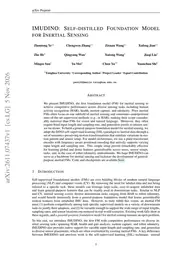
We present IMUDINO, the first foundation model (FM) for inertial sensing to achieve competitive performance across diverse sensing tasks including human activity recognition (HAR), health, motion capture, and odometry. Prior inertial FMs often focus on one subfield of inertial sensing and sometimes underperform state-of-the-art supervised methods (e.g., in HAR), making their scope considerably narrower than FMs for vision and natural language. Moreover, they often require fixed input length and sampling rate, and generalize poorly to unseen sensor locations. To build a general-purpose foundation model for inertial sensing, we adapt the DINO self-supervised learning (SSL) paradigm to inertial data through a set of semantics-preserving motion transformations that simulate variations in motion pattern and sensor setup. For model architecture, we use a plain transformer encoder with frequency-aware positional encoding that natively supports varying input length and sampling rate. This simple setup proved remarkably effective for learning global and dense features generalizable across users, sensor setups, tasks, and, in the case of robot odometry, embodiments. We hope IMUDINO can serve as a backbone for inertial sensing and kickstart the development of general-purpose inertial FMs.
Verbatim fromarXiv· arXiv metadata (abstracts are released under CC0)
How it works
Datasets linked in the hub; pretraining vs evaluation roles follow the paper.
Pretraining data
Not fully enumerated in the public release notes; multi-source IMU covering HAR, health, motion-capture and robot odometry (paper). Checkpoint is IMUDINO-85M.
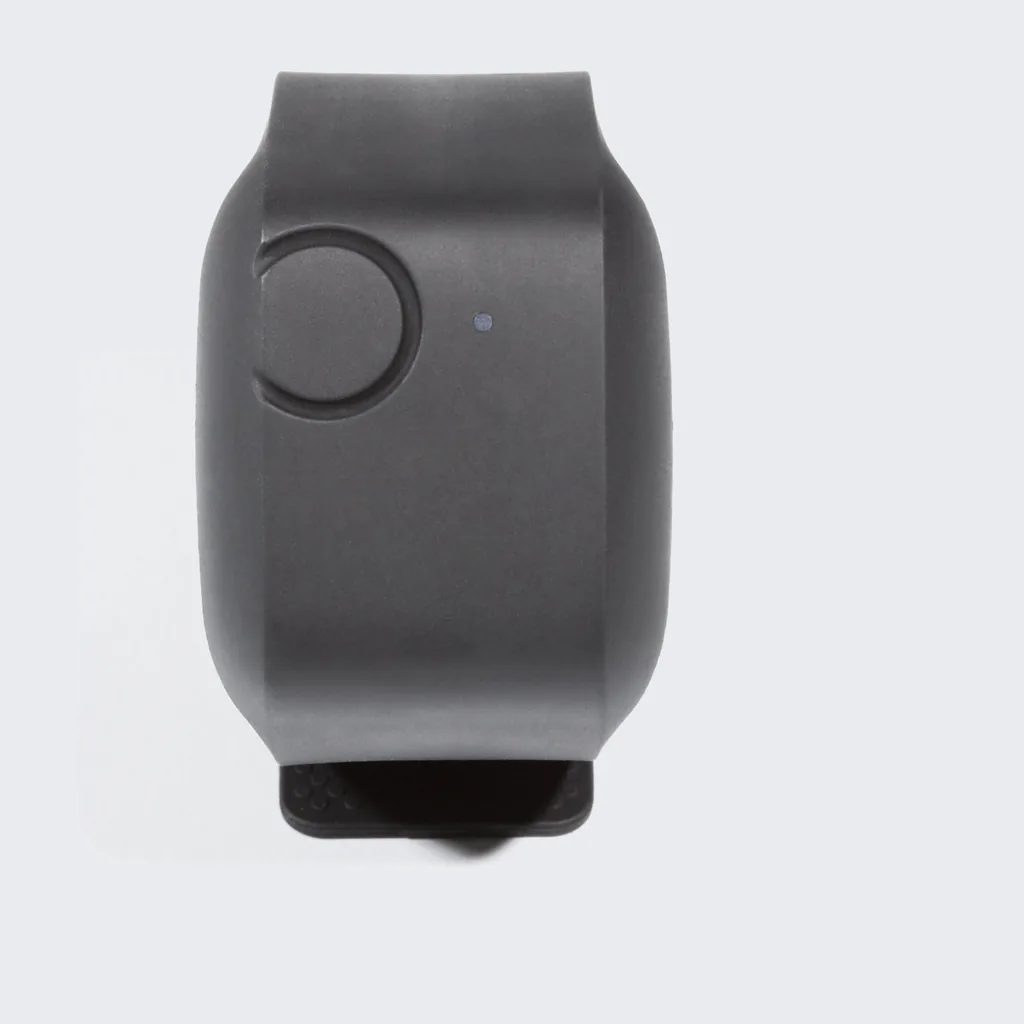
Full photo credits and licences are on each device page. An icon means we have no openly licensed or manufacturer-cleared photo of that exact device yet.
Cite the publication recorded for this model. Check it against the publisher before submitting.
Ye, Z., Zhang, C., Wang, Z., Jian, X., He, Z., Wan, Q., Wang, X., Liu, J., Sun, M., Mei, Y., Yu, C., & Shi, Y. (2026). IMUDINO: Self-distilled Foundation Model for Inertial Sensing. ICLR 2027 submission. https://arxiv.org/abs/2611.07437
Ye, Zhoutong, Chengwen Zhang, Zixuan Wang, Xufeng Jian, Zhe He, Qingyang Wan, and Xutong Wang, et al. 2026. "IMUDINO: Self-distilled Foundation Model for Inertial Sensing." ICLR 2027 submission. https://arxiv.org/abs/2611.07437.
Ye, Z., Zhang, C., Wang, Z., Jian, X., He, Z., Wan, Q. and Wang, X. et al. (2026) 'IMUDINO: Self-distilled Foundation Model for Inertial Sensing', ICLR 2027 submission. Available at: https://arxiv.org/abs/2611.07437
Ye, Zhoutong, et al. "IMUDINO: Self-distilled Foundation Model for Inertial Sensing." ICLR 2027 submission, 2026. https://arxiv.org/abs/2611.07437.
Z. Ye et al., "IMUDINO: Self-distilled Foundation Model for Inertial Sensing," ICLR 2027 submission, 2026, [Online]. Available: https://arxiv.org/abs/2611.07437.
@misc{ye2026imudino,
  title         = {{IMUDINO: Self-distilled Foundation Model for Inertial Sensing}},
  author        = {Ye, Zhoutong and Zhang, Chengwen and Wang, Zixuan and Jian, Xufeng and He, Zhe and Wan, Qingyang and Wang, Xutong and Liu, Jiaqi and Sun, Mingze and Mei, Yu and Yu, Chun and Shi, Yuanchun},
  year          = {2026},
  howpublished  = {ICLR 2027 submission},
  eprint        = {2611.07437},
  archivePrefix = {arXiv}
}
History
Record updated
Added to the ChatPPG research hub
Newsletter
Get new PPG datasets, papers and models
Get alerts when IMUDINO is benchmarked on new datasets, plus the weekly digest.
New datasets, papers and models
Practical guides from the hub
Unsubscribe anytime
The waveform is an illustration of a PPG pulse, not a recording.