Activity counts measure attention, not model quality. Missing counts are unknown. Publication status follows the linked source; a listed venue alone does not confirm peer review.
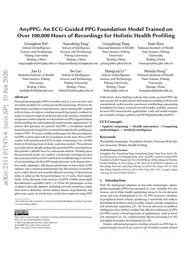
AnyPPG is an ECG-guided PPG foundation model from Guangkun Nie, Xiaocheng Fang, Gongzheng Tang, Yujie Xiao, Jun Li, Bo Liu, Hongyan Li and Shenda Hong. The paper, "AnyPPG: An ECG-Guided PPG Foundation Model Trained on Over 100,000 Hours of Recordings for Holistic Health Profiling", appears in the Proceedings of the 32nd ACM SIGKDD Conference on Knowledge Discovery and Data Mining (2026), with a preprint on arXiv (2511.01747).
The question behind it is how much PPG can say about health beyond the usual cardiovascular tasks. To get representations that are grounded in cardiac physiology, AnyPPG is pre-trained with ECG guidance, aligning synchronized PPG and ECG pairs in a shared latent space, on what the authors call the most diverse PPG corpus with synchronized ECG to date: over 100,000 hours of recordings from 58,796 subjects across six large-scale data sources. The data scripts in the repository cover CFS, HSP, MC-MED, MESA and PulseDB.
The paper then runs what it describes as the first PPG-based phenome-wide disease detection study, covering 1,468 disease phenotypes in more than 15,000 subjects. AnyPPG reached an AUC of at least 0.70 for 307 phenotypes across 16 phecode chapters, and 230 of those were non-circulatory conditions such as dementia and chronic kidney disease. On standard benchmarks, across eight clinical and wearable datasets covering 15 downstream tasks, it achieved the best performance in 13 tasks.
The code and model weights are on GitHub (PKUDigitalHealth/AnyPPG). The pretrained checkpoint ships as load_anyppg/anyppg_ckpt.pth with a small loading module, and the README notes that MC-MED disease checkpoints and phecode mappings will be added later. The GitHub API reports no license file for the repository, so check with the authors before reuse.
AnyPPG is a useful comparison with PaPaGei and Pulse-PPG. Those models learn from PPG alone, while AnyPPG uses synchronized ECG as a teacher signal during pre-training and targets a much wider set of clinical outcomes.
Signals
PPG, ECG
Benchmarks
best in 13 of 15 tasks across eight datasets
Weights
load_anyppg/anyppg_ckpt.pth in the GitHub repository
Year
2025
Paper
AnyPPG (Nie, Fang, Tang et al.), Proceedings of the 32nd ACM SIGKDD Conference (KDD 2026), pages 11717-11727; arXiv 2511.01747
Pre-training
over 100,000 hours of PPG with synchronized ECG from six data sources
ECG-guided pre-training
Phenome-wide study
1,468 phenotypes, more than 15,000 subjects; AUC at least 0.70 for 307 phenotypes across 16 phecode chapters, 230 non-circulatory
Results as reported by the authors; not independently reproduced. A SOTA star marks the best value among results reported under the same evaluation protocol; ties go to the earlier publication.
Embed this badge (6 badges for READMEs and project pages)
Markdown
[](https://chatppg.com/research/models/anyppg#key-results)
[](https://chatppg.com/research/models/anyppg#key-results)
HTML
<a href="https://chatppg.com/research/models/anyppg#key-results"><img src="https://chatppg.com/research/badges/anyppg--hr-estimation-butppg-mae-bpm.svg" alt="SOTA on ChatPPG: Heart rate · BUT PPG" height="20"></a>
Markdown
[](https://chatppg.com/research/models/anyppg#key-results)
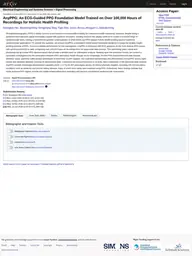
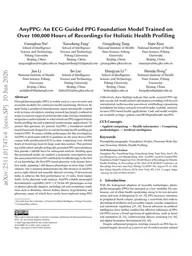
Photoplethysmography (PPG) is widely used as a non-invasive and accessible modality for continuous health monitoring. However, despite being a peripheral hemodynamic signal intrinsically coupled with systemic circulation, existing research has largely confined its scope to a narrow range of cardiovascular tasks, leaving a fundamental question underexplored: to what extent can PPG support holistic health profiling beyond traditional cardiovascular applications? To answer this question, we present AnyPPG, a foundation model-based framework designed to reveal the broader health-profiling potential of PPG. To ensure reliable performance for this investigation, AnyPPG is pretrained with ECG guidance on the most diverse PPG corpus with synchronized ECG to date, comprising over 100,000 hours of recordings from six large-scale data sources. This pretraining yields robust and physiologically grounded PPG representations that provide a reliable basis for subsequent analysis. Building upon this pretrained model, we conduct a systematic investigation into the association between PPG and holistic health through, to our knowledge, the first PPG-based phenome-wide disease detection study, spanning 1,468 disease phenotypes in more than 15,000 subjects. Our evaluation demonstrates the effectiveness of AnyPPG: across eight clinical and wearable datasets covering 15 downstream tasks, it achieves the best performance in 13 tasks. More importantly, in the phenome-wide analysis, AnyPPG exhibits meaningful discriminative capability (AUC ≥ 0.70) for 307 phenotypes across 16 distinct phecode chapters, including 230 non-circulatory conditions such as dementia and chronic kidney disease, many of which have rarely been explored using PPG. Collectively, these findings indicate that easily acquired PPG signals encode rich health-related information extending well beyond conventional cardiovascular assessment.
Verbatim fromarXiv· arXiv metadata (abstracts are released under CC0)
Full photo credits and licences are on each device page. An icon means we have no openly licensed or manufacturer-cleared photo of that exact device yet.
AnyPPG is an ECG-guided PPG foundation model trained on over 100,000 hours of PPG with synchronized ECG from six data sources, published at KDD 2026.
How do I download AnyPPG?
The code and checkpoint (load_anyppg/anyppg_ckpt.pth) are in https://github.com/PKUDigitalHealth/AnyPPG. No license file is set on the repository.
AnyPPG vs PaPaGei?
PaPaGei learns from PPG alone using morphology-aware contrastive learning on more than 57,000 hours of public data. AnyPPG uses synchronized ECG to guide PPG pre-training on over 100,000 hours and adds a phenome-wide disease detection study.
What are AnyPPG's benchmark results?
AnyPPG was best in 13 of 15 downstream tasks across eight clinical and wearable datasets, and it reached AUC of at least 0.70 for 307 of 1,468 disease phenotypes.
Cite this model
Cite the publication recorded for this model. Check it against the publisher before submitting.
Nie, G., Fang, X., Tang, G., Xiao, Y., Li, J., Liu, B., Li, H., & Hong, S. (2026). AnyPPG: An ECG-Guided PPG Foundation Model Trained on Over 100,000 Hours of Recordings for Holistic Health Profiling. Proceedings of the 32nd ACM SIGKDD Conference on Knowledge Discovery and Data Mining V.2, 11717–11727. https://doi.org/10.1145/3770855.3818911
Nie, Guangkun, Xiaocheng Fang, Gongzheng Tang, Yujie Xiao, Jun Li, Bo Liu, Hongyan Li, and Shenda Hong. 2026. "AnyPPG: An ECG-Guided PPG Foundation Model Trained on Over 100,000 Hours of Recordings for Holistic Health Profiling." Proceedings of the 32nd ACM SIGKDD Conference on Knowledge Discovery and Data Mining V.2, 11717–11727. https://doi.org/10.1145/3770855.3818911.
Nie, G., Fang, X., Tang, G., Xiao, Y., Li, J., Liu, B., Li, H. and Hong, S. (2026) 'AnyPPG: An ECG-Guided PPG Foundation Model Trained on Over 100,000 Hours of Recordings for Holistic Health Profiling', Proceedings of the 32nd ACM SIGKDD Conference on Knowledge Discovery and Data Mining V.2, pp. 11717–11727. doi: 10.1145/3770855.3818911.
Nie, Guangkun, et al. "AnyPPG: An ECG-Guided PPG Foundation Model Trained on Over 100,000 Hours of Recordings for Holistic Health Profiling." Proceedings of the 32nd ACM SIGKDD Conference on Knowledge Discovery and Data Mining V.2, 2026, pp. 11717–11727. https://doi.org/10.1145/3770855.3818911.
G. Nie et al., "AnyPPG: An ECG-Guided PPG Foundation Model Trained on Over 100,000 Hours of Recordings for Holistic Health Profiling," Proceedings of the 32nd ACM SIGKDD Conference on Knowledge Discovery and Data Mining V.2, pp. 11717–11727, 2026, doi: 10.1145/3770855.3818911.
@inproceedings{nie2026anyppg,
  title         = {{AnyPPG: An ECG-Guided PPG Foundation Model Trained on Over 100,000 Hours of Recordings for Holistic Health Profiling}},
  author        = {Nie, Guangkun and Fang, Xiaocheng and Tang, Gongzheng and Xiao, Yujie and Li, Jun and Liu, Bo and Li, Hongyan and Hong, Shenda},
  year          = {2026},
  booktitle     = {Proceedings of the 32nd ACM SIGKDD Conference on Knowledge Discovery and Data Mining V.2},
  pages         = {11717--11727},
  publisher     = {ACM},
  doi           = {10.1145/3770855.3818911},
  eprint        = {2511.01747},
  archivePrefix = {arXiv}
}
History
Record updated
Added to the ChatPPG research hub
Newsletter
Get new PPG datasets, papers and models
Get alerts when AnyPPG is benchmarked on new datasets, plus the weekly digest.
New datasets, papers and models
Practical guides from the hub
Unsubscribe anytime
The waveform is an illustration of a PPG pulse, not a recording.