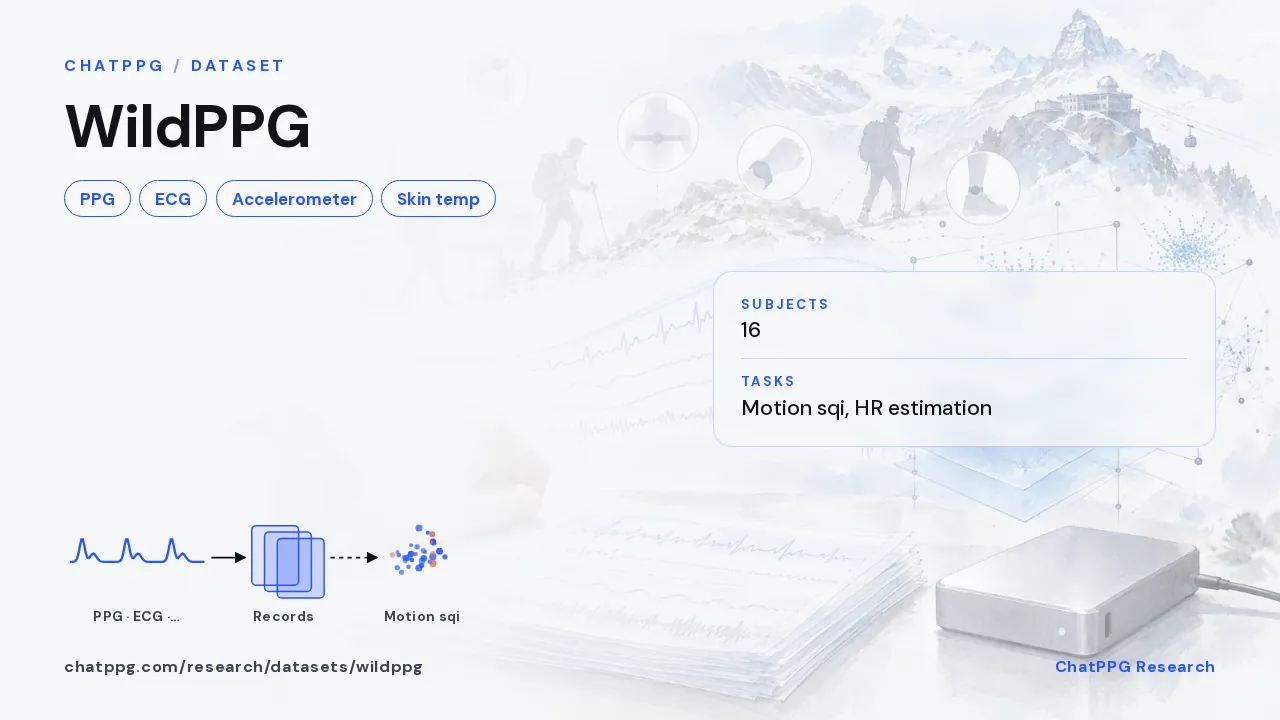
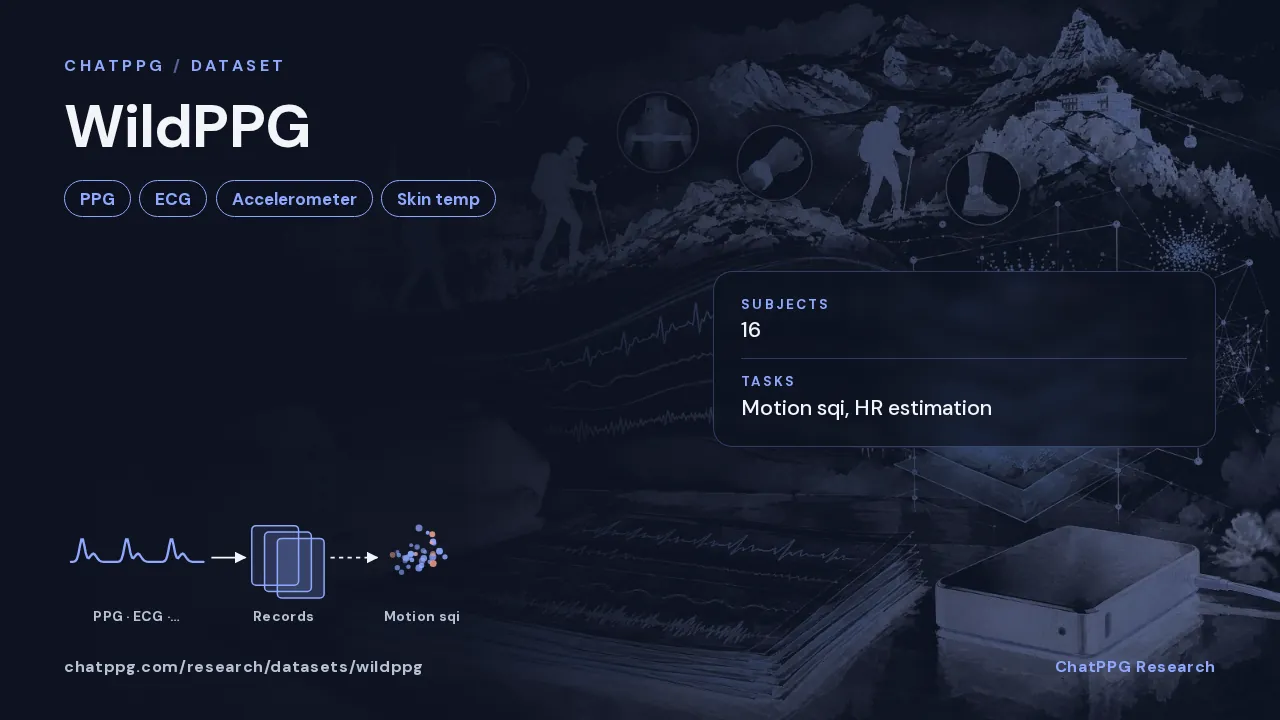
ETH Zürich (Siplab) real-world PPG dataset — NeurIPS 2024 Datasets & Benchmarks. Four custom devices worn simultaneously at head, sternum, wrist, ankle during a full-day outdoor trip from Zurich to Jungfraujoch (up to 3,571 m elevation).
- License
- Data: CC BY-NC-SA 4.0. Code: GPL-3.0
- Type
- Dataset
- DOI
- Not reported
- Licence
- Data: CC BY-NC-SA 4.0. Code: GPL-3.0
- Code & repos
- Access
- Open
- Subjects
- 16
- PPG sites
- WristChest torsoOther
- Setting
- In the wild
- Wrist
- Yes
- Raw waveforms
- Yes
- Tasks
- Motion SQIHeart rate estimation
- Papers
- Updated
- Nov 24, 2026


WildPPG: overview
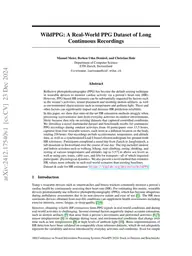
WildPPG (Meier, Demirel and Holz, ETH Zürich, NeurIPS 2024 Datasets and Benchmarks) records 16 participants for about 13.5 hours each during a day trip from Zurich to the Jungfraujoch, up to 3,571 m altitude. Four custom devices at the head, sternum, wrist and ankle each logged 3-channel PPG (red, green, infrared), accelerometer, temperature and barometric altitude (216 hours of recordings in total), and the sternum device recorded Lead I ECG for reference heart rate. Activities were unscripted: walking, hiking, stairs, eating, resting and travel by car, train and cable car. Data are released under CC BY-NC-SA 4.0.
What's inside
- Participants
- 16, about 13.5 hours each
- Body sites
- Head, sternum, wrist and ankle
- PPG
- Red, green and infrared at 128 Hz (MAX86141)
- Other signals
- 3-axis accelerometer at 128 Hz; temperature and barometric altitude at 0.5 Hz
- Reference
- Lead I ECG from the sternum device at 128 Hz
- Formats
- One MATLAB .mat file per participant; a structured version is on Hugging Face
How to access it
Host: ETH Zürich (polybox) and Hugging Face
- Open access: download the .mat files from the polybox link on the project page.
- Or use the cleaned, segmented version on Hugging Face (eth-siplab/WildPPG).
- Baseline code and loaders are in github.com/eth-siplab/WildPPG.
Licence: Data: CC BY-NC-SA 4.0. Code: GPL-3.0
What it allows: Non-commercial use with attribution; share adaptations under the same licence.
Load WildPPG in Python
pip install scipyfrom scipy.io import loadmat
p = loadmat("WildPPG_Part_an0.mat", simplify_cells=True) # one file per participant
wrist = p["wrist"]
g = wrist["ppg_g"] # each trace has fs, descr and v
print(g["fs"], len(g["v"])) # 128 Hz
ecg = p["sternum"]["ecg"]["v"] # Lead I referenceUntested: the file name is a placeholder. Field names follow the structure on the project page (body location, then sensor trace with fs, descr and v). The repo's load_wildppg_participant() cleans the loaded structure.
Caveats
- Non-commercial licence (CC BY-NC-SA 4.0).
- Only 16 participants: report per-participant results and leave-one-subject-out splits.
- No fixed protocol: activity labels are not given per window, so stratify by accelerometer intensity if you need activity levels.
- Reference HR comes from Lead I ECG peak detection, which can itself fail during heavy motion.
Similar datasets
| Dataset | Subjects | Signals | Licence |
|---|---|---|---|
| PPG-DaLiA | 15 | ppg, ecg, accel, skin-temp, resp | Scientific, non-commercial use with credit to the owners |
| IEEE Signal Processing Cup 2015 (TROIKA) | 12 | ppg, accel, ecg | CC BY 4.0 |
| Pulse Transit Time PPG | 22 | ppg, ecg, accel, gyro | ODbL 1.0 |
| MW-PPG-HR | 20 | ppg, ecg, accel | Not stated |
Sources: WildPPG project page · WildPPG GitHub README · Updated 2026-10-21
Key numbers
How it works
- Sampling
- PPG red+green+IR 128Hz, accel 128Hz, temp, baro; sternum ECG ref
- Reference labels
- hr, sqi, ecg
- Device roles
- Study wearable (IMU)
Devices· 1
Icons show the form factor: we have no openly licensed or manufacturer-cleared photo of these exact devices yet.
Leaderboard rows· 2
All leaderboards| Task | Dataset | Metric | Value | Rank |
|---|---|---|---|---|
| Heart rate estimation | WildPPG | MAE (bpm) ↓ | 8.37 | #1 / 2 |
| Heart rate estimation | WildPPG | MAE (bpm) ↓ | 9.76 | #2 / 2 |
Papers and models using this dataset· 6
Papers
Models
#41 of 186 most-used datasets by published papers and models · #19 of 88 PPG · #20 of 78 ECG · #20 of 84 IMU
Browse these 3 papers in the research explorer (filtered to WildPPG)
FAQ
How long are the WildPPG recordings?
About 13.5 hours per participant from 16 participants, recorded at four body sites, 216 hours of recordings in total.
What licence is WildPPG under?
The data are CC BY-NC-SA 4.0 (non-commercial, share-alike). The code is GPL-3.0.
Which PPG wavelengths does WildPPG include?
Red, green and infrared at 128 Hz at each of the four body sites.
Cite
No citation metadata yet.
Cite the ChatPPG record
Cite the dated snapshot 2026-10 for a fixed, reproducible version. Please also cite the original publications listed above.
APA
ChatPPG. (2026). WildPPG: dataset record (Version 2026-10) [Data set]. ChatPPG Research Hub. https://chatppg.com/research/datasets/wildppg
BibTeX
@misc{chatppg_dataset_wildppg,
  author       = {{ChatPPG}},
  title        = {{WildPPG: dataset record}},
  year         = {2026},
  month        = nov,
  version      = {2026-10},
  howpublished = {\url{https://chatppg.com/research/datasets/wildppg}},
  note         = {ChatPPG Research Hub, Snapshot 2026-10, https://chatppg.com/research/snapshots/2026-10}
}
CITATION.cff
cff-version: 1.2.0
message: "If you use this resource, please cite it as below."
type: dataset
title: "WildPPG: dataset record"
authors:
  - name: "ChatPPG"
url: "https://chatppg.com/research/datasets/wildppg"
repository-artifact: "https://chatppg.com/research/snapshots/2026-10"
version: "2026-10"
date-released: "2026-11-24"
History
Record updated