PaperarXiv:2606.07365
A robust PPG foundation model using multimodal physiological supervision
ICML 2026 workshop / preprint (Dolby Labs + Georgia Tech)
 (opens in a new tab)
Geenjaar, Eloy et al., "A robust PPG foundation model using multimodal physiological supervision", arXiv:2606.07365, CC BY-NC-ND 4.0
TL;DR
Pretrains a PPG-only foundation model (1D ResNet-26 encoder) on MIMIC-III Waveform Database Matched Subset (10,282 ICU patients, 125 Hz) using co-recorded ECG and respiration signals only to select which PPG windows count as contrastive positives/negatives during training — five summary metrics from ECG/RESP per 10s window build a "physiological metric space," and windows close in that space become positive pairs. At inference, only PPG is used. Explicitly targets robustness to noisy/motion-corrupted PPG, including an IMU-energy-stratified DaLiA noise analysis.
- Subjects: 10282
Abstract
Photoplethysmography (PPG), a non-invasive measure of changes in blood volume, is widely used in both wearable devices and clinical settings. Recent PPG foundation models either use open-source ICU datasets with pretraining paradigms that require curated data and thus complicate generalization to field-like data, or use closed-source field-like PPG data. In contrast, we propose a PPG foundation model that does not require high-quality or field-like pretraining data, and instead leverages accompanying electrocardiogram and respiratory signals in ICU datasets to select contrastive samples during pretraining. Our approach allows the model to retain and learn from noisy PPG segments, improving robustness at inference. Our model, pretrained on 3x fewer subjects than existing state-of-the-art approaches, achieves performance improvements on 14 out of 15 diverse downstream tasks, including field-like daily activity and heart rate prediction. Our results demonstrate that multimodal supervision can integrate complementary physiological information to improve the robustness of PPG foundation models and enhance their generalization to consumer-grade data.
Verbatim from arXiv (opens in a new tab) · arXiv metadata (abstracts are released under CC0)
Results on ChatPPG leaderboards
All leaderboardsNo results from this paper on ChatPPG leaderboards yet. Browse the leaderboards.
Tasks & signals
Signals
Devices
Keywords
Datasets used
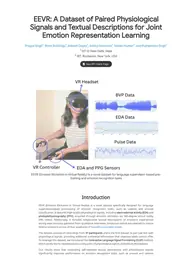 EEVRVR emotion elicitation with PPG + EDA and textual emotion descriptions (NeurIPS 2024 D&B)Evaluation37 subjects · PPG · EDA
 PPG-DaLiAPPG dataset for motion compensation / HREvaluation15 subjects · PPG · ECG · IMU
 VitalVideosface video + contact PPG + BP/SpO2 (Europe-1, Africa-1, Worldwide)Evaluation850 subjects · PPG
Models
How it works
Cite this paper
A robust PPG foundation model using multimodal physiological supervision. (2026). ICML 2026 workshop / preprint. https://arxiv.org/abs/2606.07365
@misc{geenjaarmultimod2026robust,
  title         = {{A robust PPG foundation model using multimodal physiological supervision}},
  year          = {2026},
  howpublished  = {ICML 2026 workshop / preprint},
  eprint        = {2606.07365},
  archivePrefix = {arXiv}
}Record updated