Foundation model

Geenjaar multimodal-supervision PPG FM

From “A robust PPG foundation model using multimodal physiological supervision”
Year
2026
Form factor
ICU pretrain wrist eval
Geenjaar, Eloy et al., "A robust PPG foundation model using multimodal physiological supervision", arXiv:2606.07365, CC BY-NC-ND 4.0
PreprintFirst posted: Jun 5, 2026Added to atlas: Sep 26, 2026Source

Activity counts measure attention, not model quality. Missing counts are unknown. Publication status follows the linked source; a listed venue alone does not confirm peer review.

This PPG foundation model is pretrained on ICU data and uses the accompanying ECG and respiratory signals to choose contrastive pairs, so it does not need curated or field-like PPG. Pretrained on three times fewer subjects than leading models, it improved results on 14 of 15 downstream tasks, including daily activity and heart rate prediction.

Published
arXiv preprint, 2026
Signals
PPG
Evaluation
15 downstream tasks
Year
2026
Pretraining

ICU PPG with ECG and respiration guiding contrastive sampling

Result

better on 14 of 15 tasks with 3x fewer pretraining subjects

At a glance
Type
Foundation model
Modalities
PPG
Parameters
Not reported
Architecture
1D ResNet-26
Venue
arXiv preprint
Year
2026
Code
Not released
Weights
Not released
Licence
Not reported
Caveats
Not reported
Added
Sep 26, 2026
Updated
Oct 12, 2026

Abstract

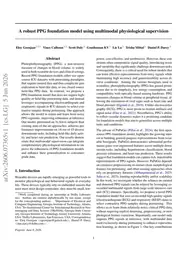
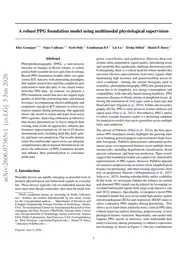
Photoplethysmography (PPG), a non-invasive measure of changes in blood volume, is widely used in both wearable devices and clinical settings. Recent PPG foundation models either use open-source ICU datasets with pretraining paradigms that require curated data and thus complicate generalization to field-like data, or use closed-source field-like PPG data. In contrast, we propose a PPG foundation model that does not require high-quality or field-like pretraining data, and instead leverages accompanying electrocardiogram and respiratory signals in ICU datasets to select contrastive samples during pretraining. Our approach allows the model to retain and learn from noisy PPG segments, improving robustness at inference. Our model, pretrained on 3x fewer subjects than existing state-of-the-art approaches, achieves performance improvements on 14 out of 15 diverse downstream tasks, including field-like daily activity and heart rate prediction. Our results demonstrate that multimodal supervision can integrate complementary physiological information to improve the robustness of PPG foundation models and enhance their generalization to consumer-grade data.
Verbatim fromarXiv· arXiv metadata (abstracts are released under CC0)

How it works

How Geenjaar multimodal-supervision PPG FM works: Input signals → Foundation model → Downstream tasksInput signals: PPG (Photoplethysmogram). Datasets: PPG-DaLiA, EEVR, VitalVideos. Foundation model: Geenjaar multimodal-supervision PPG FM (Convolutional network · Contrastive learning).Input signalsPPG: PhotoplethysmogramPPGPhotoplethysmogramDatasets: PPG-DaLiA, EEVR, VitalVideosDatasetsPPG-DaLiA, EEVR +1 moreFoundation modelGeenjaar multimodal-supervisio…Convolutional network · Contrastive…

Datasets linked in the hub; pretraining vs evaluation roles follow the paper.

Architecture
1D ResNet-26
Inputs
PPG
Approach
PPG · Dolby · Georgia Tech · ICML · contrastive · SKIP

Devices· 2

Full photo credits and licences are on each device page. An icon means we have no openly licensed or manufacturer-cleared photo of that exact device yet.

Datasets used· 3

Papers· 1

Authors· 7

Cite this model

Cite the publication recorded for this model. Check it against the publisher before submitting.

A robust PPG foundation model using multimodal physiological supervision. (2026). arXiv preprint. https://doi.org/10.48550/arXiv.2606.07365
@misc{geenjaarppgfm2026robust,
  title         = {{A robust PPG foundation model using multimodal physiological supervision}},
  year          = {2026},
  howpublished  = {arXiv preprint},
  doi           = {10.48550/arXiv.2606.07365},
  eprint        = {2606.07365},
  archivePrefix = {arXiv}
}

History

  1. Record updated

  2. Added to the ChatPPG research hub