Activity counts measure attention, not model quality. Missing counts are unknown. Publication status follows the linked source; a listed venue alone does not confirm peer review.
LingSante-Pulse is a single signal-conditioned encoder for many physiological signals resampled to 128 Hz, pretrained with random-feature prediction, alignment across signal types and masked reconstruction (arXiv technical report, 2026). With the encoder frozen it reports PPG-DaLiA heart-rate MAE of 5.68 bpm (AnyPPG 7.59, DNA-PPG 8.15 and MOMENT 8.46 under the same protocol), HMC multimodal sleep staging macro-F1 0.7784, Sleep-EDF EEG-only 0.7941 and single-lead ECG apnea AUROC 0.9183.
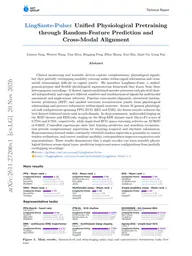
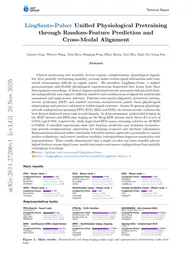
Clinical monitoring and wearable devices capture complementary physiological signals, but their partially overlapping modality coverage makes within-signal information and cross-modal relationships difficult to exploit jointly. We introduce LingSante-Pulse, a unified, general-purpose and flexible physiological representation framework that learns from these heterogeneous recordings. A shared, signal-conditioned encoder processes each physical channel independently and supports different numbers and combinations of signals for multimodal assessment and single-sensor inference. Pairwise cross-modal alignment, structured random-feature prediction (RFP) and masked waveform reconstruction jointly learn physiological relationships and preserve informative within-signal structure. Across 38 general physiological task configurations spanning PPG, ECG, EEG and EMG, the frozen encoder achieves the best dataset-balanced mean rank in each domain. In sleep assessment, multimodal staging on the HMC dataset and EEG-only staging on the Sleep-EDF dataset reach Macro-F1 scores of 0.7784 and 0.7941, respectively, while single-lead ECG apnea screening achieves an AUROC of 0.9183. Controlled experiments show that function prediction and waveform reconstruction provide complementary supervision for retaining temporal and rhythmic information. Representations learned under continually refreshed random supervision generalize to unseen teacher realizations, and correct auxiliary modality correspondence improves respiration-only representations. These results demonstrate that a single encoder can learn reusable physiological features across signal types, prediction targets and sensor configurations from partially overlapping recordings.
Verbatim fromarXiv· arXiv metadata (abstracts are released under CC0)
Key results
5.68 bpm
MAE
With the encoder frozen it reports PPG-DaLiA heart-rate MAE of 5.68 bpm (AnyPPG 7.59, DNA-PPG 8.15 and MOMENT 8.46 under the same protoco…
How it works
Datasets linked in the hub; pretraining vs evaluation roles follow the paper.
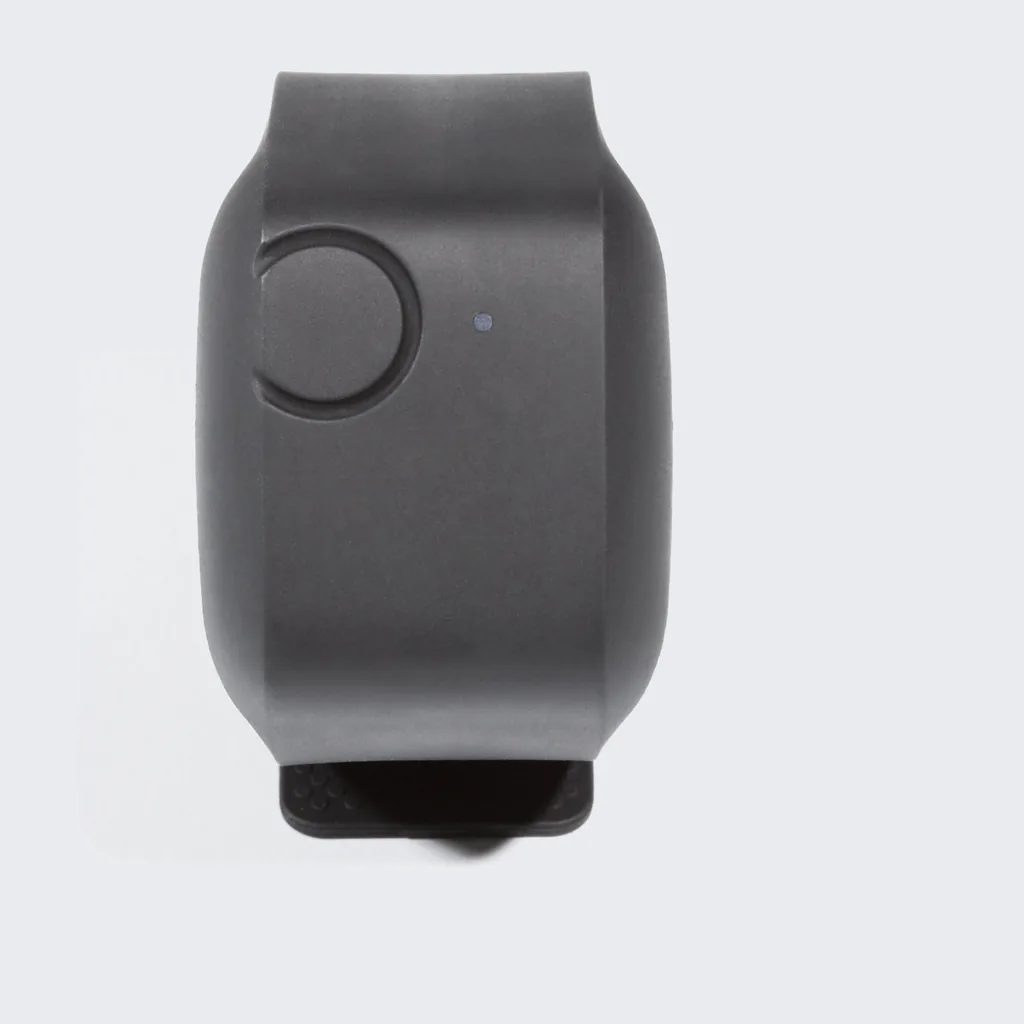
Full photo credits and licences are on each device page. An icon means we have no openly licensed or manufacturer-cleared photo of that exact device yet.
Yang, L., Wang, W., Zhou, T., Peng, B., Zhang, Z., Zhu, Z., Gu, J. and Sun, L. (2026) 'LingSante-Pulse: Unified Physiological Pretraining through Random-Feature Prediction and Cross-Modal Alignment', arXiv technical report. doi: 10.48550/arXiv.2611.27206.
Yang, Linxiao, et al. "LingSante-Pulse: Unified Physiological Pretraining through Random-Feature Prediction and Cross-Modal Alignment." arXiv technical report, 2026. https://doi.org/10.48550/arXiv.2611.27206.
L. Yang et al., "LingSante-Pulse: Unified Physiological Pretraining through Random-Feature Prediction and Cross-Modal Alignment," arXiv technical report, 2026, doi: 10.48550/arXiv.2611.27206.
@misc{yang2026lingsantepulse,
  title         = {{LingSante-Pulse: Unified Physiological Pretraining through Random-Feature Prediction and Cross-Modal Alignment}},
  author        = {Yang, Linxiao and Wang, Wenwei and Zhou, Tian and Peng, Bingqing and Zhang, Zihao and Zhu, Zuyi and Gu, Jinjie and Sun, Liang},
  year          = {2026},
  howpublished  = {arXiv technical report},
  doi           = {10.48550/arXiv.2611.27206},
  eprint        = {2611.27206},
  archivePrefix = {arXiv}
}
History
Added to the ChatPPG research hub
Newsletter
Get new PPG datasets, papers and models
Get alerts when LingSante-Pulse is benchmarked on new datasets, plus the weekly digest.
New datasets, papers and models
Practical guides from the hub
Unsubscribe anytime
The waveform is an illustration of a PPG pulse, not a recording.