Why Wearables Sometimes Skip Heart Rate Readings: Selective Reporting for PPG Under Motion
Selective reporting lets wearables skip unreliable heart rate readings during motion instead of showing bad data. The CITRUS framework shows how confidence scoring reduces motion error from 10.8 to 6.2 BPM at 50% coverage.
Reviewed by Sameer Sontakey, Co-founder and Chief AI & Algorithms Officer at Sensor Bio. ChatPPG is independent and device-neutral; it is not a Sensor Bio product.
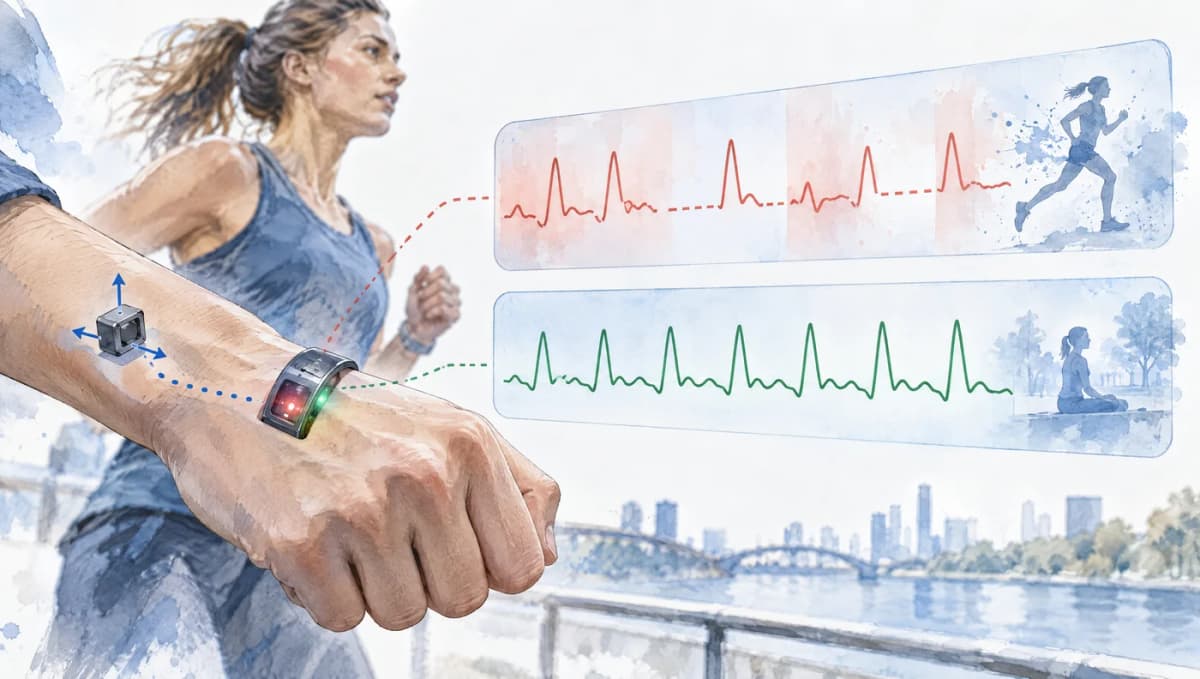
Have you ever noticed your fitness tracker showing gaps in heart rate data during a workout? That's selective reporting at work. Instead of displaying every heart rate estimate regardless of quality, modern wearables can choose to skip readings when the signal is too corrupted by motion to produce reliable results. The goal is simple: show accurate data or show nothing.
A recent preprint from Tsinghua University presents CITRUS, a framework that implements selective reporting for wearable PPG heart rate monitoring under motion (Wang, 2026, arXiv:2607.18818). The system achieves substantial error reduction by reporting only the most confident estimates. During motion, the framework reduces mean absolute error from approximately 10.8 BPM at 100% coverage to 6.2 BPM when reporting only the most confident 50% of windows. Understanding how CITRUS works reveals the tradeoff every wearable device faces: coverage versus accuracy.
The Coverage Versus Accuracy Tradeoff
Most discussions of wearable heart rate accuracy focus on a single number: the mean absolute error across all measurements. A device that reports 95% of heartbeats with 5 BPM error looks better than one reporting 90% of beats with 4 BPM error, even though the second device might be more useful if it's skipping the worst-quality readings. The selective reporting approach shifts focus from "how accurate is the device" to "how accurate are the readings the device chooses to show."
This matters most during motion. At rest, PPG heart rate accuracy is typically 2-3 BPM MAE for both wrist and ring sensors. During exercise, errors increase substantially due to motion artifacts. For details on how motion corrupts PPG signals, see our motion artifact removal guide.
The CITRUS framework splits the heart rate pipeline into two distinct stages: estimation and reporting. The estimation stage produces a heart rate value and a confidence score for every window. The reporting stage decides whether to show that estimate to the user based on confidence thresholds. Separating these stages lets researchers optimize each independently.
How CITRUS Estimates Heart Rate During Motion
The CITRUS estimation pipeline combines three components: candidate generation, candidate scoring, and causal Viterbi decoding.
Candidate Generation and Scoring
Rather than producing a single heart rate estimate per window, the system generates multiple candidate heart rates and assigns each a probability score. The scoring model uses a lightweight neural network trained to predict which candidate is most likely correct based on PPG waveform features and accelerometer data. This probabilistic approach handles the fundamental ambiguity that arises when motion artifacts create multiple plausible peaks in the frequency spectrum.
Causal Viterbi Tracking
After scoring, the system uses a Viterbi-like algorithm to select the most consistent sequence of heart rate estimates across time. The key constraint is causality: the algorithm only looks backward in time (using past estimates to inform the current choice) rather than forward, which allows real-time implementation. This temporal smoothing helps reject spurious candidates that would be implausible given the recent heart rate trajectory.
The causal Viterbi decoder is where CITRUS achieves its core motion robustness. On the ring platform used in the study (Ring1 with reflective PPG), motion-only heart rate MAE dropped from 14.39 BPM (using a simpler LSTM-based motion audit model) to 10.91 BPM with the full candidate generation and Viterbi decoding approach (Wang, 2026).
For context on the motion audit baseline, a standard LSTM network trained to estimate heart rate during motion produced 14.39±0.47 BPM MAE. Adding signal smoothing and better accelerometer integration reduced that to 13.00±0.41 BPM. The full CITRUS estimation stack (candidates plus Viterbi) reached 10.91±0.73 BPM during motion and 3.73±0.13 BPM overall when including rest periods.
The Reporting Layer: Accept, Hold, or Reject
The second stage of CITRUS implements a reporting policy that categorizes each heart rate estimate into one of three classes: accept (report immediately), hold (delay reporting while gathering more evidence), or reject (skip entirely). This policy operates on the confidence scores produced by the estimation stage.
How the Policy Works
The reporting model is trained to predict whether the current estimate has an error exceeding 10 BPM. When the model is confident the estimate is accurate, it accepts and reports the value. When confidence is low, the policy rejects the estimate and shows a gap instead. The hold category handles borderline cases where immediate acceptance is risky but complete rejection might discard usable data if future windows provide confirming evidence.
The framework uses only PPG-derived features for the reliability score, meaning it doesn't require accelerometer data for the reporting decision. This design choice reflects the reality that accelerometer availability and quality vary across devices. The PPG-only reliability model achieves an AUC (area under the ROC curve) of 0.898 for detecting errors exceeding 10 BPM (Wang, 2026).
Selective Reporting in Practice
The most striking result from CITRUS is how selective reporting changes the accuracy picture during motion. At 100% coverage (reporting every window), motion MAE is approximately 10.8 BPM. But at 50% coverage (reporting only the most confident half of motion windows), MAE drops to 6.2 BPM. That's a 42% error reduction in exchange for skipping half the readings during motion.
This tradeoff is exactly what many commercial wearables implement. When you see gaps in your workout heart rate graph, the device has chosen accuracy over completeness. For users tracking exercise intensity zones or recovery metrics, getting accurate readings 50-70% of the time may be more useful than getting noisy readings 100% of the time. For more on how accurate fitness trackers are during exercise, see our exercise heart rate accuracy comparison.
The Ring Platform: Why This Study Used Rings
The CITRUS validation used a custom ring platform called τ-Ring with two device variants. Ring1 employed a reflective GH3026 sensor, while Ring2 used a transmissive AFE4403 configuration. Both captured infrared and red wavelengths at 100 Hz. The study collected 49.76 hours of data from 54 participants across various activities.
Why rings? Finger-based PPG typically provides higher signal quality than wrist sensors due to better perfusion and less motion at the finger during ambulation. The ring form factor also minimizes sensor displacement during hand movements. For detailed comparison of ring versus wrist PPG, see our sensor comparison guide.
The Ring1 reflective configuration achieved the best overall performance in the study: 5.33±0.17 BPM MAE for basic heart rate estimation, dropping to 3.73±0.13 BPM with the full CITRUS estimation pipeline. During motion segments specifically, Ring1 reached 10.91±0.73 BPM before applying selective reporting.
Validation on PPG-DaLiA: External Dataset Testing
To test generalization, the CITRUS team evaluated their system on PPG-DaLiA, a widely used public benchmark dataset from Reiss et al. (2019). PPG-DaLiA contains wrist-worn PPG and accelerometer data from 15 participants performing activities including sitting, walking, cycling, and stair climbing.
On PPG-DaLiA, the causal Viterbi decoder achieved 12.62 BPM MAE during motion segments. When applying a finite-state reporting policy at 50% overall coverage (31% of motion windows reported), the motion MAE dropped to 4.14 BPM (Wang, 2026). This cross-dataset result demonstrates that selective reporting isn't overfitting to the τ-Ring platform, it works across different sensor types and body locations.
The PPG-DaLiA validation is important because it shows the framework transferring from ring to wrist form factors. Wrist PPG is noisier than finger PPG, yet selective reporting still provides substantial error reduction. This suggests the reporting approach could apply to any wearable PPG device.
Implementation Considerations: Can This Run on a Wearable?
One practical question is whether CITRUS can run on the microcontrollers embedded in wearable devices. The study reports that the heart rate estimation model requires fewer than 100,000 parameters (either 85,000 or 28,000 depending on whether raw PPG CNN features are included) and approximately 18-19 million floating-point operations (MFLOPs) per window.
For reference, modern wearable MCUs can typically execute tens to hundreds of MFLOPs per second depending on architecture and power budget. An 18 MFLOP model processing one-second windows would require roughly 18 MFLOPS sustained throughput, which is feasible on current mid-range to high-end wearable processors. The memory footprint of 85k-100k parameters (340-400 KB at 32-bit precision) also fits comfortably within typical MCU flash and SRAM budgets.
This means selective reporting with confidence scoring is not just a research concept but a deployable feature for commercial wearables. The computation and memory requirements are comparable to the real-time PPG processing algorithms already running on devices today.
What Selective Reporting Doesn't Solve
Selective reporting improves the reliability of displayed heart rate estimates, but it doesn't address several fundamental limitations:
Motion artifacts during intense exercise: When motion artifacts completely dominate the PPG signal, no algorithm can reliably extract heart rate. Selective reporting will correctly reject these windows, but the result is zero coverage during the most intense parts of a workout. For activities with sustained high-intensity motion (sprinting, high-cadence cycling), coverage may drop below 20-30%.
Physiologically coupled motion: During rhythmic exercise, heart rate and motion cadence sometimes lock (for example, footstrike-synchronized heartbeats during running). The Viterbi decoder in CITRUS can over-smooth rapid heart rate changes of 3-5 BPM when adjacent estimates differ, which may mask real physiological variation (Wang, 2026). Selective reporting doesn't fix this smoothing artifact.
Arrhythmia detection: The CITRUS validation used healthy adult participants with normal sinus rhythm. The framework has not been tested on arrhythmic populations. Irregular heartbeats combined with motion may confuse the candidate generation and scoring models, potentially leading to incorrect accepts or rejects. For context on wearable arrhythmia detection accuracy, see our atrial fibrillation monitoring guide.
HRV metrics: Selective reporting that skips 30-50% of heartbeats will corrupt heart rate variability calculations, which require continuous inter-beat interval sequences. For HRV analysis, the estimation pipeline would need modification to either maintain continuity or flag HRV metrics as unavailable during high-reject periods. See our PPG HRV guide for more on this limitation.
Practical Takeaways for Wearable Users
If your fitness tracker sometimes shows heart rate gaps during workouts, that's likely selective reporting protecting you from bad data. Here's what to keep in mind:
Gaps during high motion are normal: When you're running hard, doing burpees, or performing high-intensity intervals, wearable PPG accuracy degrades substantially. A device showing 50-70% coverage with 5-6 BPM error is more trustworthy than one claiming 100% coverage with hidden 15+ BPM errors.
Ring sensors typically outperform wrist sensors: The CITRUS results on finger rings (6.2 BPM motion MAE at 50% coverage) are better than typical wrist-worn devices achieve during comparable motion. If you do high-motion activities and want better heart rate data, ring sensors offer an advantage. For a full comparison, see our ring vs. wrist accuracy analysis.
Selective reporting helps for zone training: If you're using heart rate zones for training guidance, getting accurate readings 60% of the time is more useful than getting noisy readings continuously. A gap in the data won't mislead you into the wrong training zone.
Continuous HRV tracking needs different approaches: For overnight HRV tracking or resting HRV measurements, selective reporting is less of a concern because motion is minimal. For HRV during activity, current wearables may not provide reliable metrics. See our HRV motion artifacts guide for details.
Important Limitations and Caveats
The CITRUS framework is reported in a preprint and doctoral thesis (arXiv:2607.18818, July 2026), not yet peer-reviewed. The validation used a healthy adult cohort performing controlled activities. Real-world generalization to diverse populations, pathological conditions, and uncontrolled daily activity remains to be demonstrated.
Selective reporting trades coverage for accuracy. This tradeoff is appropriate for wellness and fitness contexts where users can tolerate data gaps. It is not appropriate for medical monitoring applications where continuous coverage is required (for example, ICU patient monitoring, cardiac telemetry). Clinical-grade continuous heart rate monitoring still requires ECG or high-quality PPG with different signal quality standards.
The reliability scoring model (AUC 0.898 for detecting errors exceeding 10 BPM) is good but not perfect. At typical operating thresholds, some bad estimates will be accepted and some good estimates will be rejected. Users should not assume that every reported value is guaranteed accurate or that every gap represents truly unusable data.
Finally, consumer wearable devices implement proprietary algorithms and may use selective reporting policies different from CITRUS. The specific coverage versus accuracy tradeoff varies by device and manufacturer. For context on how accurate consumer fitness trackers are, see our tracker accuracy comparison.
Frequently Asked Questions
What is selective reporting in wearable heart rate monitoring?
Selective reporting means the device chooses which heart rate estimates to display based on confidence scores, skipping readings that are likely inaccurate due to motion artifacts or poor signal quality. Instead of showing every estimate regardless of reliability, the device reports only high-confidence values and leaves gaps where data quality is insufficient. This trades coverage for accuracy.
How much does selective reporting improve heart rate accuracy during motion?
In the CITRUS framework validation, selective reporting reduced motion heart rate error from approximately 10.8 BPM at full coverage to 6.2 BPM when reporting the most confident 50% of motion windows. This represents a 42% error reduction. The exact improvement varies by activity type, sensor placement, and algorithm design.
Why do fitness trackers show gaps in heart rate data during workouts?
Gaps typically indicate that the wearable's motion artifact rejection or selective reporting system has determined the PPG signal quality is too poor to produce a reliable heart rate estimate. This is most common during high-intensity exercise with vigorous arm movements. The device is prioritizing accuracy over completeness by skipping unreliable readings.
Does selective reporting work better on ring sensors or wrist sensors?
The CITRUS validation showed that selective reporting works on both form factors. The ring platform achieved lower absolute errors (6.2 BPM motion MAE at 50% coverage on Ring1), while wrist PPG on the PPG-DaLiA dataset reached 4.14 BPM at 31% motion coverage. Ring sensors generally provide better raw signal quality due to higher perfusion at the finger, which gives selective reporting algorithms more accurate confidence scores to work with.
Can selective reporting detect arrhythmias like atrial fibrillation?
The CITRUS framework was validated only on healthy participants with normal sinus rhythm. Selective reporting for arrhythmia detection has not been demonstrated. Irregular heartbeats combined with motion may confuse the confidence scoring, potentially causing the system to reject valid arrhythmic beats or accept motion artifacts that mimic arrhythmias. Wearable arrhythmia detection remains an active research area with separate validation requirements.
Is selective reporting used in commercial wearables?
Most modern fitness trackers and smartwatches implement some form of signal quality assessment and selective reporting, though manufacturers rarely publish details of their algorithms. When you see heart rate gaps during exercise or receive warnings about poor sensor contact, you're likely seeing selective reporting or quality gating in action. The specific coverage versus accuracy tradeoff varies by device.
References
-
Wang, Y. (2026). CITRUS: Candidate Inference and Temporal-tracking for Reliable, Unobtrusive Sensing of Wearable Heart Rate under Motion. arXiv preprint arXiv:2607.18818. https://doi.org/10.48550/arXiv.2607.18818
-
Reiss, A., Indlekofer, I., Schmidt, P., & Van Laerhoven, K. (2019). Deep PPG: Large-scale heart rate estimation with convolutional neural networks. Sensors, 19(14), 3079. https://doi.org/10.3390/s19143079
-
Zhang, Z., Pi, Z., & Liu, B. (2015). TROIKA: A general framework for heart rate monitoring using wrist-type photoplethysmographic signals during intensive physical exercise. IEEE Transactions on Biomedical Engineering, 62(2), 522-531. https://doi.org/10.1109/TBME.2014.2359372
Frequently Asked Questions
- What is selective reporting in wearable heart rate monitoring?
- Selective reporting means the device chooses which heart rate estimates to display based on confidence scores, skipping readings that are likely inaccurate due to motion artifacts or poor signal quality. This trades coverage for accuracy.
- How much does selective reporting improve heart rate accuracy during motion?
- In the CITRUS framework validation, selective reporting reduced motion heart rate error from approximately 10.8 BPM at full coverage to 6.2 BPM when reporting the most confident 50% of motion windows, representing a 42% error reduction.
- Why do fitness trackers show gaps in heart rate data during workouts?
- Gaps indicate that the wearable's selective reporting system has determined the PPG signal quality is too poor to produce a reliable heart rate estimate. This is most common during high-intensity exercise with vigorous arm movements. The device prioritizes accuracy over completeness.
- Does selective reporting work better on ring sensors or wrist sensors?
- Selective reporting works on both form factors. Ring platforms achieved 6.2 BPM motion MAE at 50% coverage, while wrist PPG reached 4.14 BPM at 31% motion coverage. Ring sensors generally provide better raw signal quality due to higher perfusion at the finger.
- Can selective reporting detect arrhythmias like atrial fibrillation?
- The CITRUS framework was validated only on healthy participants with normal sinus rhythm. Selective reporting for arrhythmia detection has not been demonstrated. Irregular heartbeats combined with motion may confuse confidence scoring.
- Is selective reporting used in commercial wearables?
- Most modern fitness trackers and smartwatches implement some form of signal quality assessment and selective reporting, though manufacturers rarely publish algorithm details. Heart rate gaps during exercise or sensor contact warnings indicate selective reporting in action.
Related articles
STFT Heart Rate Tracking: Accurate PPG During Motion
How to use STFT for PPG heart rate tracking that stays accurate during motion. Window sizes, overlap, spectral peak tracking, and motion artifact handling explained.
PPG Heart Rate Sensor Explained: Optical Modules, Multi-LED Design, and Motion Compensation
How PPG heart rate sensors work inside wearables. Learn about multi-LED arrays, ambient light rejection, accelerometer fusion, and sensor module design.
Pulse Oximeter Readings Chart: SpO2 and Heart Rate Ranges Explained
A complete pulse oximeter readings chart covering normal, borderline, and dangerous SpO2 and heart rate ranges, plus factors that affect accuracy.
PPG for HRV: How Wearables Measure Heart Rate Variability
Heart rate variability from PPG wearables: accuracy, best practices, and what the research shows about HRV measured with optical sensors vs. ECG gold standard.
Green vs Red vs Infrared Light in PPG Sensors: Wavelength Selection Guide
A technical deep dive into PPG wavelength selection comparing green (520-530nm), red (660nm), and infrared (940nm) light for heart rate monitoring, SpO2 measurement, and wearable sensor design. Covers absorption spectra, skin tone considerations, motion artifact behavior, and multi-wavelength approaches.