Activity counts measure attention, not model quality. Missing counts are unknown. Publication status follows the linked source; a listed venue alone does not confirm peer review.
FairTune is a bias-aware fine-tuning recipe for PPG-GPT, not a new pretrained encoder. The authors start from a PPG-GPT checkpoint pretrained on UCSF ICU data (over 200 million segments; four sizes from 19M to 1B) and fully fine-tune it for heart-rate regression. They resample PPG-DaLiA (wrist, 64 Hz), BUT-PPG (Xiaomi Mi9 camera, 30 Hz), and a MIMIC ICU set at 125 Hz to 40 Hz and use 1-second windows. The MIMIC extract is cited via Charlton et al. 2022 and is not tied to one hub dataset page. Table 2 reports unbalanced fine-tuning MAE 17.62 bpm on DaLiA, down from a pretrained MAE 89.54 bpm (80%). The same table reports MAE 19.23 bpm on BUT-PPG, down from 78.22 bpm (75%). It reports MAE 24.73 bpm on MIMIC, down from 93.81 bpm (74%). Same-dataset Table A1 unbalanced MAE is 4.28 bpm on DaLiA, 9.94 bpm on BUT-PPG, and 9.76 bpm on MIMIC. The gender gap is the absolute male–female MAE difference. Table 3 does not shrink it on every transfer: DaLiA to MIMIC moves from 0.80 bpm unbalanced to 1.06 bpm with inverse-frequency weighting, 1.20 bpm with GroupDRO, and 1.16 bpm with adversarial debiasing, while DaLiA to BUT-PPG GroupDRO lowers the gap from 2.36 to 0.68 bpm. The PDF uses a Proceedings of Machine Learning Research class header and names no volume. No code URL is given.
- Signals
- PPG
- Authors
Panchumarthi, Kataria, Wu, Hu, Fedorov, Kwak (Emory; Wu also University of Oklahoma)
arXiv:2509.16491v1 (20 Sep 2025); DOI 10.48550/arXiv.2509.16491; PDF metadata licence CC BY 4.0; no code URL; PMLR class header, no volume
Full fine-tune of PPG-GPT. Reported results use 19M; the paper also scales from 19M to 1B. Checkpoint pretrained on UCSF ICU data, over 200M segments
- Table 2 unbalanced MAE
DaLiA 89.54 to 17.62 bpm (80%), BUT-PPG 78.22 to 19.23 bpm (75%), MIMIC 93.81 to 24.73 bpm (74%). Table A1 same-dataset unbalanced MAE: 4.28, 9.94, 9.76 bpm
Table 3, 19M medians, DaLiA to BUT-PPG: unbalanced MAE 19.23 gap 2.36; IF 13.44 / 1.30; GroupDRO 15.47 / 0.68; ADV 14.49 / 0.70 bpm
Table 3 does not shrink every gap. BUT-PPG to DaLiA: unbalanced 6.99 vs IF 6.86 bpm. DaLiA to MIMIC: unbalanced 0.80 vs IF 1.06, GroupDRO 1.20, ADV 1.16 bpm. At 1B, DaLiA to MIMIC is MAE 26.66 gap 1.27 (19M: 24.74 and 0.80); MIMIC to BUT-PPG is MAE 16.23 gap 2.65 (19M: 18.68 and 4.93)
Table 1 counts samples, not subjects: DaLiA 35,099 female (54.3%) and 29,598 male (45.7%); BUT-PPG 1,986 (51.1%) and 1,902 (48.9%); MIMIC 6,804 (62.3%) and 4,123 (37.7%). Table 4 MMD male vs female: unbalanced 0.004478, IF 0.003896 (authors: 13%)
- Type
- FM adaptation
- Modalities
- PPG
- Form factor
- PPG gpt bias aware finetune
- Parameters
- 19M–1B
- Architecture
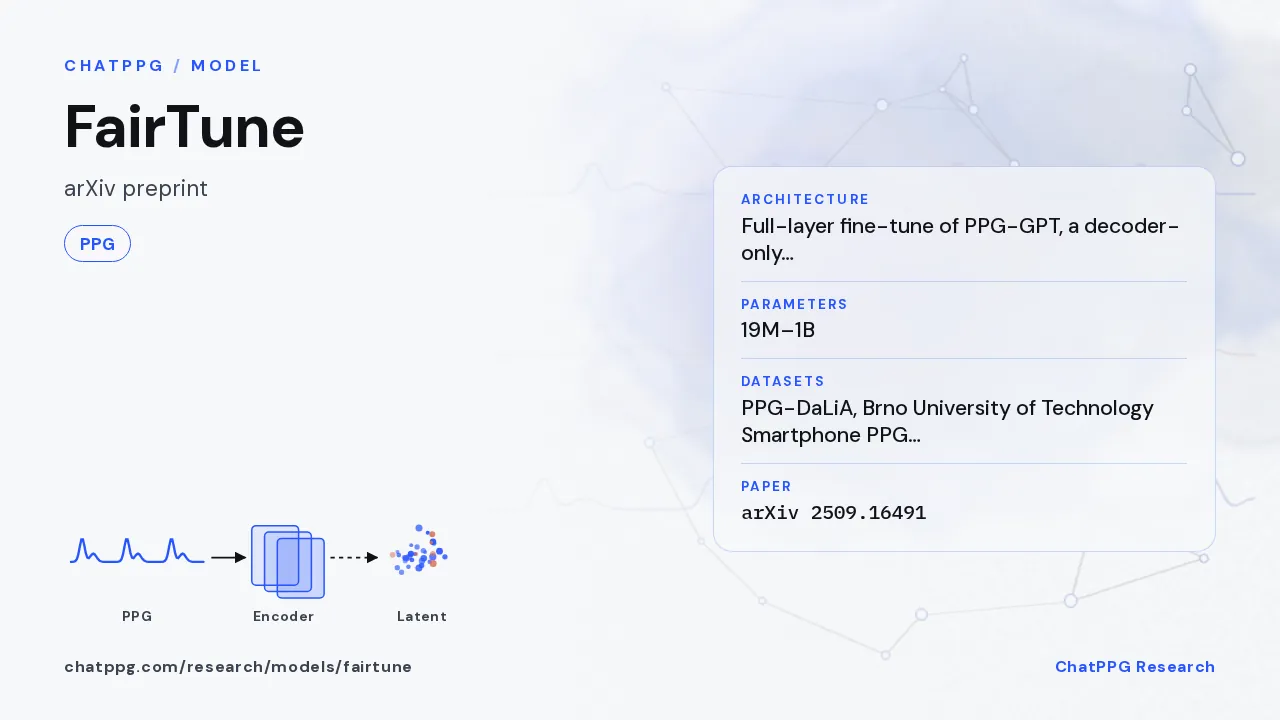
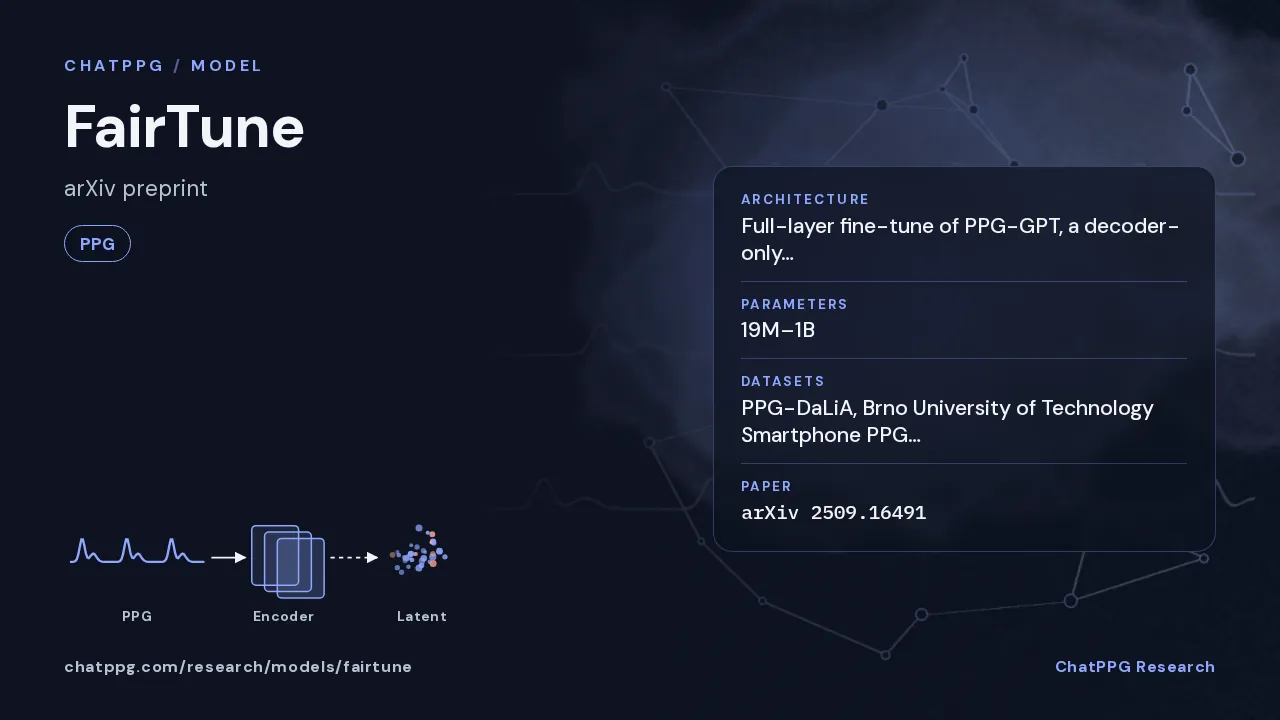
- Full-layer fine-tune of PPG-GPT, a decoder-only transformer with 40-sample patches. Heart-rate regression with inverse-frequency weighting, GroupDRO, or adversarial debiasing. Signals resampled to 40 Hz and cut into 1-second windows
- Venue
- arXiv preprint
- Year
- 2025
- Code
- Not released
- Weights
- Not released
- Caveats
- FairTune fine-tunes PPG-GPT. It is not a new pretrained foundation model, and this preprint gives no code or weight URL. The fairness axis in the experiments is binary gender. Age, skin tone, and race are not evaluated. Table 3 medians do not show a smaller gender gap on every transfer, and some mitigation rows raise MAE. The MIMIC ICU PPG set is cited through Charlton et al. 2022. It is not linked to one hub dataset page.
- Added
- Oct 26, 2026
- Updated
- Oct 26, 2026
Abstract
Foundation models pretrained on physiological data such as photoplethysmography (PPG) signals are increasingly used to improve heart rate (HR) prediction across diverse settings. Fine-tuning these models for local deployment is often seen as a practical and scalable strategy. However, its impact on demographic fairness—particularly under domain shifts—remains underexplored. We fine-tune PPG-GPT — a transformer-based foundation model pretrained on intensive care unit (ICU) data — across three heterogeneous datasets (ICU, wearable, smartphone) and systematically evaluate the effects on HR prediction accuracy and gender fairness. While fine-tuning substantially reduces mean absolute error (up to 80%), it can simultaneously widen fairness gaps, especially in larger models and under significant distributional characteristics shifts. To address this, we introduce FairTune, a bias-aware fine-tuning framework in which we benchmark three mitigation strategies: class weighting based on inverse group frequency (IF), Group Distributionally Robust Optimization (GroupDRO), and adversarial debiasing (ADV). We find that IF and GroupDRO significantly reduce fairness gaps without compromising accuracy, with effectiveness varying by deployment domain. Representation analyses further reveal that mitigation techniques reshape internal embeddings to reduce demographic clustering. Our findings highlight that fairness does not emerge as a natural byproduct of fine-tuning and that explicit mitigation is essential for equitable deployment of physiological foundation models.
Verbatim fromarXiv· arXiv metadata (abstracts are released under CC0)
Key results
How it works
Datasets linked in the hub; pretraining vs evaluation roles follow the paper.
- Pretraining data
- PPG-GPT checkpoint pretrained on UCSF ICU PPG, over 200 million segments. FairTune does not run a new pretraining
- Architecture
- Full-layer fine-tune of PPG-GPT, a decoder-only transformer with 40-sample patches. Heart-rate regression with inverse-frequency weighting, GroupDRO, or adversarial debiasing. Signals resampled to 40 Hz and cut into 1-second windows
- Inputs
- PPG
- Approach
- PPG · foundation model · fairness · heart rate · groupdro · emory
Datasets· 2

Papers· 1
Cite
APA
Panchumarthi, L. Y., Kataria, S., Wu, Y., Hu, X., Fedorov, A., & Kwak, H. G. (2025). FairTune: A Bias-Aware Fine-Tuning Framework Towards Fair Heart Rate Prediction from PPG. arXiv preprint. https://doi.org/10.48550/arXiv.2509.16491
BibTeX
@misc{panchumarthi2025fairtune,
  title         = {{FairTune: A Bias-Aware Fine-Tuning Framework Towards Fair Heart Rate Prediction from PPG}},
  author        = {Panchumarthi, Lovely Yeswanth and Kataria, Saurabh and Wu, Yi and Hu, Xiao and Fedorov, Alex and Kwak, Hyunjung Gloria},
  year          = {2025},
  howpublished  = {arXiv preprint},
  doi           = {10.48550/arXiv.2509.16491},
  eprint        = {2509.16491},
  archivePrefix = {arXiv}
}
Built from the hub record. Check it against the publisher before submitting.
History
Added to the ChatPPG research hub
Connections
Open in the graph explorerPapers
- FairTune: A Bias-Aware Fine-Tuning Framework Towards Fair Heart Rate Prediction from PPGPaper on this modelarXiv preprint · 2025
 Unlocking the Specialization Capability of PPG Foundation Models for Wearable Signals through Structured Pruning and Adaptive Fine-Tuning (SPAFT)Also uses PPG-DaLiAarXiv 2610.33788v1 · 2026
 Bridging ECG and PPG: Latent-Space Prediction for Robust Physiological AnalysisAlso uses PPG-DaLiAKDD '26 · 2026